Home > Press > Edible Nanostructures
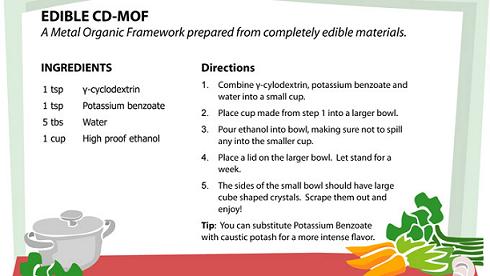 |
| This simple recipe can be followed to make all-natural metal-organic frameworks. |
Abstract:
Compounds made from renewable materials could be used for gas storage, food technologies
By Megan Fellman
Edible Nanostructures
Evanston, IL | Posted on September 3rd, 2010Sugar, salt, alcohol and a little serendipity led a Northwestern University research team to discover a new class of nanostructures that could be used for gas storage and food and medical technologies. And the compounds are edible.
The porous crystals are the first known all-natural metal-organic frameworks (MOFs) that are simple to make. Most other MOFs are made from petroleum-based ingredients, but the Northwestern MOFs you can pop into your mouth and eat, and the researchers have.
"They taste kind of bitter, like a Saltine cracker, starchy and bland," said Ronald A. Smaldone, a postdoctoral fellow at Northwestern. "But the beauty is that all the starting materials are nontoxic, biorenewable and widely available, offering a green approach to storing hydrogen to power vehicles."
Smaldone is co-first author of a paper about the edible MOFs published by Angewandte Chemie. The study is slated to appear on the cover of one of the journal's November issues.
"With our accidental discovery, chemistry in the kitchen has taken on a whole new meaning," said Sir Fraser Stoddart, Board of Trustees Professor of Chemistry in the Weinberg College of Arts and Sciences at Northwestern. The implications of what Sir Fraser refers to as "Bob's your uncle chemistry" go all the way from cleaner air to healthier living, and it all comes from a product that can be washed down the sink.
Stoddart led the research group that included a trio of postdoctoral fellows in chemistry at Northwestern and colleagues from the University of California, Los Angeles (UCLA) and the University of St. Andrews in the U.K.
Metal-organic frameworks are well-ordered, lattice-like crystals. The nodes of the lattices are metals (such as copper, zinc, nickel or cobalt), and organic molecules connect the nodes. Within their very roomy pores, MOFs can effectively store gases such as hydrogen or carbon dioxide, making the nanostructures of special interest to engineers as well as scientists.
"Using natural products as building blocks provides a new direction for an old technology," said Jeremiah J. Gassensmith, a postdoctoral fellow in Stoddart's lab and an author of the paper.
"The metal-organic framework technology has been around since 1999 and relies on chemicals that come from crude oil," explained Ross S. Forgan, also a postdoctoral fellow in Stoddart's lab and co-first author of the paper. "Our main constituent is a starch molecule that is a leftover from corn production."
For their edible MOFs, the researchers use not ordinary table sugar but gamma-cyclodextrin, an eight-membered sugar ring produced from biorenewable cornstarch. The salts can be potassium chloride, a common salt substitute, or potassium benzoate, a commercial food preservative, and the alcohol is the grain spirit Everclear.
With these ingredients in hand, the researchers actually had set out to make new molecular architectures based on gamma-cyclodextrin. Their work produced crystals. Upon examining the crystals' structures using X-rays, the researchers were surprised to discover they had created metal-organic frameworks -- not an easy feat using natural products.
"Symmetry is very important in metal-organic frameworks," Stoddart said. "The problem is that natural building blocks are generally not symmetrical, which seems to prevent them from crystallizing as highly ordered, porous frameworks."
It turns out gamma-cyclodextrin solves the problem: it comprises eight asymmetrical glucose residues arranged in a ring, which is itself symmetrical. The gamma-cyclodextrin and potassium salt are dissolved in water and then crystallized by vapor diffusion with alcohol.
The resulting arrangement -- crystals consisting of cubes made from six gamma-cyclodextrin molecules linked in three-dimensions by potassium ions -- was previously unknown. The research team believes this strategy of marrying symmetry with asymmetry will carry over to other materials.
The cubes form a porous framework with easily accessible pores, perfect for capturing gases and small molecules. The pore volume encompasses 54 percent of the solid body.
"We achieved this level of porosity quickly and using simple ingredients," Smaldone said. "Creating metal-organic frameworks using petroleum-based materials, on the other hand, can be expensive and very time consuming."
Stoddart added, "It is both uplifting and humbling to come to terms with the fact that a piece of serendipity could have far-reaching consequences for energy storage and environmental remediation on the one hand and food quality control and health care on the other."
The National Science Foundation and the Engineering and Physical Sciences Research Council (U.K.) supported the research.
The title of the paper is "Metal-Organic Frameworks from Edible Natural Products." In addition to Stoddart, Smaldone, Forgan and Gassensmith, other authors of the paper are Hiroyasu Furukawa and Omar M. Yaghi, from UCLA, and Alexandra M. Z. Slawin, from the University of St. Andrews.
####
For more information, please click here
Contacts:
Megan Fellman
Copyright © Northwestern University
If you have a comment, please Contact us.Issuers of news releases, not 7th Wave, Inc. or Nanotechnology Now, are solely responsible for the accuracy of the content.
Bookmark:


| Related News Press |
News and information
 Simulating magnetization in a Heisenberg quantum spin chain April 5th, 2024
NRL charters Navy’s quantum inertial navigation path to reduce drift April 5th, 2024
Discovery points path to flash-like memory for storing qubits: Rice find could hasten development of nonvolatile quantum memory April 5th, 2024
Govt.-Legislation/Regulation/Funding/Policy
NRL charters Navy’s quantum inertial navigation path to reduce drift April 5th, 2024
Discovery points path to flash-like memory for storing qubits: Rice find could hasten development of nonvolatile quantum memory April 5th, 2024
Chemical reactions can scramble quantum information as well as black holes April 5th, 2024
Possible Futures
Discovery points path to flash-like memory for storing qubits: Rice find could hasten development of nonvolatile quantum memory April 5th, 2024
With VECSELs towards the quantum internet Fraunhofer: IAF achieves record output power with VECSEL for quantum frequency converters April 5th, 2024
Academic/Education
Rice University launches Rice Synthetic Biology Institute to improve lives January 12th, 2024
Multi-institution, $4.6 million NSF grant to fund nanotechnology training September 9th, 2022
Nanomedicine
New micromaterial releases nanoparticles that selectively destroy cancer cells April 5th, 2024
Good as gold - improving infectious disease testing with gold nanoparticles April 5th, 2024
Researchers develop artificial building blocks of life March 8th, 2024
Discoveries
Chemical reactions can scramble quantum information as well as black holes April 5th, 2024
New micromaterial releases nanoparticles that selectively destroy cancer cells April 5th, 2024
Utilizing palladium for addressing contact issues of buried oxide thin film transistors April 5th, 2024
Announcements
NRL charters Navy’s quantum inertial navigation path to reduce drift April 5th, 2024
Discovery points path to flash-like memory for storing qubits: Rice find could hasten development of nonvolatile quantum memory April 5th, 2024
Food/Agriculture/Supplements
Silver nanoparticles: guaranteeing antimicrobial safe-tea November 17th, 2023
Night-time radiative warming using the atmosphere November 17th, 2023
DGIST and New Life Group launched a research project on "Functional beauty and health products using the latest nanotechnology" May 12th, 2023
Environment
Billions of nanoplastics released when microwaving baby food containers: Exposure to plastic particles kills up to 75% of cultured kidney cells July 21st, 2023
Energy
Development of zinc oxide nanopagoda array photoelectrode: photoelectrochemical water-splitting hydrogen production January 12th, 2024
Shedding light on unique conduction mechanisms in a new type of perovskite oxide November 17th, 2023
Inverted perovskite solar cell breaks 25% efficiency record: Researchers improve cell efficiency using a combination of molecules to address different November 17th, 2023
The efficient perovskite cells with a structured anti-reflective layer – another step towards commercialization on a wider scale October 6th, 2023
Automotive/Transportation
Researchers’ approach may protect quantum computers from attacks March 8th, 2024
Tests find no free-standing nanotubes released from tire tread wear September 8th, 2023
 |
||
 |
||
| The latest news from around the world, FREE | ||
 |
||
|
|
||
| Premium Products | ||
 |
||
|
Only the news you want to read!
Learn More |
||
 |
||
|
Full-service, expert consulting
Learn More |
||
|
|
||