Home > Press > Super-sizing a cancer drug minimizes side effects
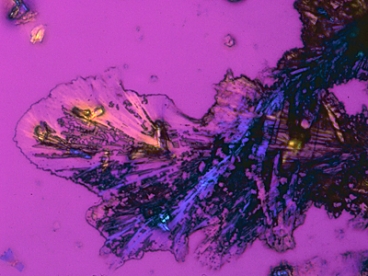 |
| Crystals of cisplatin, a platinum compound that is used as a chemotherapy drug, are shown here. Image: National Cancer Institute |
Abstract:
Researchers design a new version of cisplatin that spares the kidneys, letting doctors use higher doses.
By Anne Trafton, MIT News Office
Super-sizing a cancer drug minimizes side effects
Cambridge, MA | Posted on July 31st, 2010One of the first chemotherapy drugs given to patients diagnosed with cancer — especially lung, ovarian or breast cancer — is cisplatin, a platinum-containing compound that gums up tumor cells' DNA. Cisplatin does a good job of killing those tumor cells, but it can also seriously damage the kidneys, which receive high doses of cisplatin because they filter the blood.
Now a team of scientists at the Harvard-MIT Division of Health Sciences and Technology (HST) has come up with a new way to package cisplatin into nanoparticles that are too big to enter the kidneys. The new compound could spare patients the usual side effects and allow doctors to administer higher doses of the drug, says Shiladitya Sengupta, leader of the research team.
"We could give so much more cisplatin than is now possible," says Sengupta, an assistant professor of HST. "You could wipe out the tumor by carpet-bombing it."
Tumors in mice treated with the new cisplatin nanoparticle shrank to half the size of those treated with traditional cisplatin, with minimal side effects. The findings were reported (*) in the Proceedings of the National Academy of Sciences in June.
Beads on a string
Doctors began using cisplatin to treat cancer in the 1970s. Early on, doctors recognized that it harmed the kidneys, and cancer researchers began looking for alternatives. In the past few decades, the FDA has approved two less-toxic derivatives of cisplatin: carboplatin and oxaliplatin. However, those drugs don't kill tumor cells as successfully as cisplatin.
Cisplatin's effectiveness lies in how easily it releases its platinum molecule, freeing it to cross-link DNA strands, disrupting cell division and forcing the cell to undergo suicide. Carboplatin and oxaliplatin are less effective (but less toxic) than cisplatin because they hold on to their platinum atoms more tightly.
Sengupta and his colleagues took a new approach to making cisplatin safer: stringing cisplatin molecules together into a nanoparticle that is too large to get into the kidneys. (It has been shown that the kidneys cannot absorb particles larger than five nanometers — about 1/10,000th the diameter of a human hair).
His team designed a polymer that binds to cisplatin, arranging the molecules like beads on a string. The string then winds itself into a nanoparticle about 100 nanometers long — much too large to fit into the kidneys. However, the particles can still reach tumor cells because tumors are surrounded by "leaky" blood vessels, which have 500-nanometer pores.
Their first nanoparticle proved less effective than cisplatin, so they tweaked the polymer to make it hold a little less tightly to platinum, and ended up with a molecule with a tumor-killing power similar to cisplatin's. However, because its side effects are minimal, the nanoparticle can be delivered in higher doses.
Daniela Dinulescu, an author of the paper and pathology instructor at Brigham and Women's Hospital in Boston, showed that the nanoparticles outperformed cisplatin in mice engineered to develop ovarian cancer. The researchers also showed it to be effective against lung and breast tumor cells grown in the lab. Once the tumor cells die, the immune system clears platinum from the body.
The research was funded by the Department of Defense Breast Cancer Research Program and the National Institutes of Health.
It is difficult to develop and gain approval for new platinum-based compounds, says Nicholas Farrell, professor of inorganic chemistry at Virginia Commonwealth University, but he believes Sengupta's new nanoparticles are promising. "If successful, the approach promises to maintain the status of cisplatin as one of the most useful drugs available to the clinician," says Farrell.
The MIT researchers are now working on new variants of the nanoparticles that would be easier to manufacture. They are also making plans to test the nanoparticles in clinical trials, which Sengupta hopes will get underway within the next two years. The polymer used for the nanoparticle backbone is similar to malic acid, a natural product of cellular metabolism, so Sengupta is optimistic that it will prove safe in humans.
(*) www.pnas.org/content/107/28/12435.abstract
####
For more information, please click here
Contacts:
Tel 617.253.2700
Copyright © MIT
If you have a comment, please Contact us.Issuers of news releases, not 7th Wave, Inc. or Nanotechnology Now, are solely responsible for the accuracy of the content.
Bookmark:


| Related News Press |
News and information
 Simulating magnetization in a Heisenberg quantum spin chain April 5th, 2024
NRL charters Navy’s quantum inertial navigation path to reduce drift April 5th, 2024
Discovery points path to flash-like memory for storing qubits: Rice find could hasten development of nonvolatile quantum memory April 5th, 2024
Govt.-Legislation/Regulation/Funding/Policy
NRL charters Navy’s quantum inertial navigation path to reduce drift April 5th, 2024
Discovery points path to flash-like memory for storing qubits: Rice find could hasten development of nonvolatile quantum memory April 5th, 2024
Chemical reactions can scramble quantum information as well as black holes April 5th, 2024
Possible Futures
Discovery points path to flash-like memory for storing qubits: Rice find could hasten development of nonvolatile quantum memory April 5th, 2024
With VECSELs towards the quantum internet Fraunhofer: IAF achieves record output power with VECSEL for quantum frequency converters April 5th, 2024
Academic/Education
Rice University launches Rice Synthetic Biology Institute to improve lives January 12th, 2024
Multi-institution, $4.6 million NSF grant to fund nanotechnology training September 9th, 2022
Nanomedicine
New micromaterial releases nanoparticles that selectively destroy cancer cells April 5th, 2024
Good as gold - improving infectious disease testing with gold nanoparticles April 5th, 2024
Researchers develop artificial building blocks of life March 8th, 2024
Announcements
NRL charters Navy’s quantum inertial navigation path to reduce drift April 5th, 2024
Discovery points path to flash-like memory for storing qubits: Rice find could hasten development of nonvolatile quantum memory April 5th, 2024
Nanobiotechnology
New micromaterial releases nanoparticles that selectively destroy cancer cells April 5th, 2024
Good as gold - improving infectious disease testing with gold nanoparticles April 5th, 2024
Researchers develop artificial building blocks of life March 8th, 2024
 |
||
 |
||
| The latest news from around the world, FREE | ||
 |
||
|
|
||
| Premium Products | ||
 |
||
|
Only the news you want to read!
Learn More |
||
 |
||
|
Full-service, expert consulting
Learn More |
||
|
|
||