Home > Press > 'White graphene' to the rescue
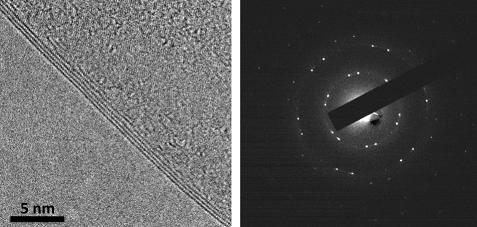 |
| Caption: A transmission electron microscope image, left, shows one-atom-thick layers of hexagonal boron nitride edge-on. At right is a selected area electron diffraction of an h-BN layer. (Credit Li Song/Rice University) |
Abstract:
Hexagonal boron nitride sheets may help graphene supplant silicon
'White graphene' to the rescue
Houston, TX | Posted on July 30th, 2010What researchers might call "white graphene" may be the perfect sidekick for the real thing as a new era unfolds in nanoscale electronics.
But single-atom-thick layers of hexagonal boron nitride (h-BN), the material under intense study at Rice University's world-class Department of Mechanical Engineering and Materials Science, are likely to find some macro applications as well.
Researchers in the lab of Pulickel Ajayan, Rice's Benjamin M. and Mary Greenwood Anderson Professor in Mechanical Engineering and Materials Science and of chemistry, have figured out how to make sheets of h-BN, which could turn out to be the complementary apple to graphene's orange.
The results were reported last week in the online journal Nano Letters.
Graphene, touted as a possible successor to silicon in microelectronics applications, is the new darling of research labs that hope to take advantage of its superb electronic properties.
Hexagonal boron nitride, on the other hand, is an insulator. Earlier this year, Rice postdoctoral researchers in Ajayan's group found a way to implant islands of h-BN into sheets of graphene, a unique way to exert a level of control over the sheet's electronic character.
Now the team, led by primary author Li Song, has figured out how to deposit sheets of pure h-BN, which is naturally white in bulk form, anywhere from one to five atoms thick on a copper substrate. The material can then be transferred to other substrates.
They used a chemical vapor deposition process to grow the h-BN sheets on a 5-by-5 centimeter copper backing at temperatures around 1,000 degrees Celsius. The sheets could then be stripped from the copper and placed on a variety of substrates.
Ultimately, Song sees h-BN sheets finding wide use as a highly effective insulator in graphene-based electronics, another stride on the quick-step march toward the replacement of silicon with materials that could push beyond the boundaries of Moore's Law, which states the number of transistors that can be placed on an integrated circuit doubles about every two years.
He said it should be also possible to draw microscopic patterns of graphene and h-BN, which could be useful in creating nanoscale field-effect transistors, quantum capacitors or biosensors.
Strength tests using the tip of an atomic force microscope to push h-BN into holes in a silicon substrate showed it to be highly elastic and nearly as strong as graphene, the single-atom form of pure carbon.
Song said the size of h-BN sheets is limited only by the size of the copper foil and furnace used to grow it. The process should be adaptable to the same kind of roll-to-roll technique recently used to form 30-inch sheets of graphene. "If you have a huge furnace, you can go large," he said.
Co-authors of the paper with Song and Ajayan are Boris Yakobson, a professor in mechanical engineering and materials science and of chemistry; Jun Lou, an assistant professor in mechanical engineering and materials science; postdoctoral research associates Lijie Ci and Pavel Sorokin; and graduate student Hao Lu, all of Rice; Chuanhong Jin of the National Institute of Advanced Industrial Science and Technology in Tsukuba, Japan; visiting student Jie Ni of Tsinghua University, China; and Alexander Kvashnin and Dmitry Kvashnin of Siberian Federal University of Krasnoyarsk, Russia.
The research was funded by Rice University, the Office of Naval Research MURI program on graphene, the Basic Energy Science division of the Department of Energy, the National Science Foundation, the Welch Foundation, the International Balzan Foundation and the Chinese State Scholarship Fund.
Read the abstract at pubs.acs.org/doi/abs/10.1021/nl1022139
####
For more information, please click here
Contacts:
David Ruth
Director of National Media Relations
Rice University
Houston, Texas
(W) 713-348-6327
(C) 612-702-9473
Copyright © Rice University
If you have a comment, please Contact us.Issuers of news releases, not 7th Wave, Inc. or Nanotechnology Now, are solely responsible for the accuracy of the content.
Bookmark:


| Related News Press |
News and information
 Simulating magnetization in a Heisenberg quantum spin chain April 5th, 2024
NRL charters Navy’s quantum inertial navigation path to reduce drift April 5th, 2024
Discovery points path to flash-like memory for storing qubits: Rice find could hasten development of nonvolatile quantum memory April 5th, 2024
Govt.-Legislation/Regulation/Funding/Policy
NRL charters Navy’s quantum inertial navigation path to reduce drift April 5th, 2024
Discovery points path to flash-like memory for storing qubits: Rice find could hasten development of nonvolatile quantum memory April 5th, 2024
Chemical reactions can scramble quantum information as well as black holes April 5th, 2024
Possible Futures
Discovery points path to flash-like memory for storing qubits: Rice find could hasten development of nonvolatile quantum memory April 5th, 2024
With VECSELs towards the quantum internet Fraunhofer: IAF achieves record output power with VECSEL for quantum frequency converters April 5th, 2024
Academic/Education
Rice University launches Rice Synthetic Biology Institute to improve lives January 12th, 2024
Multi-institution, $4.6 million NSF grant to fund nanotechnology training September 9th, 2022
Chip Technology
Discovery points path to flash-like memory for storing qubits: Rice find could hasten development of nonvolatile quantum memory April 5th, 2024
Utilizing palladium for addressing contact issues of buried oxide thin film transistors April 5th, 2024
HKUST researchers develop new integration technique for efficient coupling of III-V and silicon February 16th, 2024
Nanotubes/Buckyballs/Fullerenes/Nanorods/Nanostrings
Tests find no free-standing nanotubes released from tire tread wear September 8th, 2023
Detection of bacteria and viruses with fluorescent nanotubes July 21st, 2023
Nanoelectronics
Interdisciplinary: Rice team tackles the future of semiconductors Multiferroics could be the key to ultralow-energy computing October 6th, 2023
Key element for a scalable quantum computer: Physicists from Forschungszentrum Jülich and RWTH Aachen University demonstrate electron transport on a quantum chip September 23rd, 2022
Reduced power consumption in semiconductor devices September 23rd, 2022
Atomic level deposition to extend Moore’s law and beyond July 15th, 2022
Announcements
NRL charters Navy’s quantum inertial navigation path to reduce drift April 5th, 2024
Discovery points path to flash-like memory for storing qubits: Rice find could hasten development of nonvolatile quantum memory April 5th, 2024
Interviews/Book Reviews/Essays/Reports/Podcasts/Journals/White papers/Posters
Simulating magnetization in a Heisenberg quantum spin chain April 5th, 2024
Discovery points path to flash-like memory for storing qubits: Rice find could hasten development of nonvolatile quantum memory April 5th, 2024
Research partnerships
Discovery points path to flash-like memory for storing qubits: Rice find could hasten development of nonvolatile quantum memory April 5th, 2024
Researchers’ approach may protect quantum computers from attacks March 8th, 2024
'Sudden death' of quantum fluctuations defies current theories of superconductivity: Study challenges the conventional wisdom of superconducting quantum transitions January 12th, 2024
 |
||
 |
||
| The latest news from around the world, FREE | ||
 |
||
|
|
||
| Premium Products | ||
 |
||
|
Only the news you want to read!
Learn More |
||
 |
||
|
Full-service, expert consulting
Learn More |
||
|
|
||