Home > Press > Two Catalysts Are Better Than One
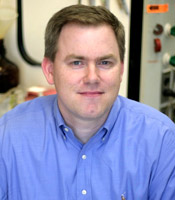 |
| Karl Scheidt |
Abstract:
New catalytic process could be used to create pharmaceuticals with less chemical waste
By Megan Fellman
Two Catalysts Are Better Than One
Evanston, IL | Posted on July 28th, 2010Much like two children in the back seat of a car, it can be challenging to get two catalysts to cooperate for the greater good. Now Northwestern University chemists have gotten two catalysts to work together on the same task -- something easily done by nature but a difficult thing to do in the laboratory.
The findings, published by the journal Nature Chemistry, will allow medicinal chemists to invent new reactions and produce valuable bioactive compounds faster with less impact on the environment.
Catalysis is inherently green chemistry. Catalytic reactions typically employ a single molecule (a catalyst) to enhance a reaction or make a reaction possible that wouldn't otherwise be possible. Since a catalyst only needs to be used in very small amounts, the potential to control chemical processes while reducing waste makes catalysis very attractive. The Northwestern team wanted to see if they could turn a good thing -- a single catalyst -- into something even better by employing two catalysts.
"In our new approach, we discovered a pair of catalysts that work cooperatively to produce valuable compounds for biomedical research, which is important given the demand for new pharmaceuticals of all kinds," said senior author Karl A. Scheidt, the Irving M. Klotz Professor of Chemistry in the Weinberg College of Arts and Sciences. "Cooperative catalysis -- using two catalysts instead of just one -- will help us develop important compounds faster and with less waste. It also opens up an exciting new area of catalysis to explore."
Scheidt and his team started with simple stock chemicals and ended up with a number of compounds that are potentially bioactive and similar to each other. In the reaction, catalyst one (a magnesium salt that acts as an electron-deficient "Lewis acid") activates one molecule, and catalyst two (a mimic of thiamine, a carbene and an electron-rich "Lewis base") activates a second molecule simultaneously. The two activated substrates come together. The result is rapid, efficient and controlled production of large amounts of a molecule called gamma-lactam, a key building block for many pharmaceuticals.
On paper, the two catalysts should bind together and not be that effective as catalysts, but, it turns out, they don't interact that tightly. Instead, when there is a substrate for each catalyst, they work in tandem. Before this discovery, no one had identified an electron-deficient metal Lewis acid that works with a carbene. (A carbene is a highly reactive, transient molecule in which a carbon atom has only two bonds versus the normal four.)
"Nature employs a lot of catalysis -- to do such crucial biological transformations as acylations, oxidations and reductions, but it's hard to do what nature does in a flask," said Scheidt, director of Northwestern's Center for Molecular Innovation and Drug Discovery. "Getting two catalysts that are seemingly incompatible to work together is a significant advance. Now we have a great first step to realizing the full potential of this powerful cooperative catalysis strategy. Ultimately, this approach should allow chemists to combine simple components under catalytic conditions to generate new bioactive compounds of high value."
The National Institute of General Medical Sciences and the Alfred P. Sloan Foundation supported the research.
In addition to Scheidt, other authors of the paper are Dustin E. A. Raup, Benoit Cardinal-David and Dane Holte, all from Northwestern.
####
For more information, please click here
Contacts:
Megan Fellman
Copyright © Northwestern University
If you have a comment, please Contact us.Issuers of news releases, not 7th Wave, Inc. or Nanotechnology Now, are solely responsible for the accuracy of the content.
Bookmark:


| Related News Press |
News and information
 Simulating magnetization in a Heisenberg quantum spin chain April 5th, 2024
NRL charters Navy’s quantum inertial navigation path to reduce drift April 5th, 2024
Discovery points path to flash-like memory for storing qubits: Rice find could hasten development of nonvolatile quantum memory April 5th, 2024
Chemistry
What heat can tell us about battery chemistry: using the Peltier effect to study lithium-ion cells March 8th, 2024
Nanoscale CL thermometry with lanthanide-doped heavy-metal oxide in TEM March 8th, 2024
Possible Futures
Discovery points path to flash-like memory for storing qubits: Rice find could hasten development of nonvolatile quantum memory April 5th, 2024
With VECSELs towards the quantum internet Fraunhofer: IAF achieves record output power with VECSEL for quantum frequency converters April 5th, 2024
Academic/Education
Rice University launches Rice Synthetic Biology Institute to improve lives January 12th, 2024
Multi-institution, $4.6 million NSF grant to fund nanotechnology training September 9th, 2022
Nanomedicine
New micromaterial releases nanoparticles that selectively destroy cancer cells April 5th, 2024
Good as gold - improving infectious disease testing with gold nanoparticles April 5th, 2024
Researchers develop artificial building blocks of life March 8th, 2024
Announcements
NRL charters Navy’s quantum inertial navigation path to reduce drift April 5th, 2024
Discovery points path to flash-like memory for storing qubits: Rice find could hasten development of nonvolatile quantum memory April 5th, 2024
 |
||
 |
||
| The latest news from around the world, FREE | ||
 |
||
|
|
||
| Premium Products | ||
 |
||
|
Only the news you want to read!
Learn More |
||
 |
||
|
Full-service, expert consulting
Learn More |
||
|
|
||