Home > Press > Researchers use nanoparticles to shrink tumors in mice
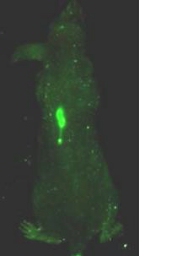 |
| Mouse tumor: Fluorescence shows accumulation of nanoparticles in tumor. A dorsal view of a mouse showing accumulation of nanoparticles in a tumor four hours after intravenous administration. Bright fluorescence is observed predominantly in the tumor. |
Abstract:
Findings hold important implications for cancer therapy
By Jennifer Marcus
Researchers use nanoparticles to shrink tumors in mice
Los Angeles, CA | Posted on July 28th, 2010The application of nanotechnology in the field of drug delivery has attracted much attention in recent years. In cancer research, nanotechnology holds great promise for the development of targeted, localized delivery of anticancer drugs, in which only cancer cells are affected.
Such targeted-therapy methods would represent a major advance over current chemotherapy, in which anticancer drugs are distributed throughout the body, attacking healthy cells along with cancer cells and causing a number of adverse side effects.
By carrying out comprehensive studies on mice with human tumors, UCLA scientists have obtained results that move the research one step closer to this goal. In a paper published July 8 in the journal Small, researchers at UCLA's California NanoSystems Institute and Jonsson Comprehensive Cancer Center demonstrate that mesoporous silica nanoparticles (MSNs), tiny particles with thousands of pores, can store and deliver chemotherapeutic drugs in vivo and effectively suppress tumors in mice.
The researchers also showed that MSNs accumulate almost exclusively in tumors after administration and that the nanoparticles are excreted from the body after they have delivered their chemotherapeutic drugs.
The study was conducted jointly in the laboratories of Fuyu Tamanoi, a UCLA professor of microbiology, immunology and molecular genetics and director of the signal transduction and therapeutics program at UCLA's Jonsson Comprehensive Cancer Center, and Jeffrey Zink, a UCLA professor of chemistry and biochemistry. Tamanoi and Zink are researchers at the California NanoSystems Institute (CNSI) and are two of the co-directors of the CNSI's Nano Machine Center for Targeted Delivery and On-Demand Release. The lead investigator on the research is Jie Lu, a postdoctoral fellow in Tamanoi's lab. Monty Liong and Zongxi Li, researchers from Zink's lab, also contributed to this work.
In the study, researchers found that MSNs circulate in the bloodstream for extended periods of time and accumulate predominantly in tumors. The tumor accumulation could be further improved by attaching a targeting moiety to MSNs, the researchers said.
The treatment of mice with camptothecin-loaded MSNs led to shrinkage and regression of xenograft tumors. By the end of the treatment, the mice were essentially tumor free, and acute and long-term toxicity of MSNs to the mice was negligible. Mice with breast cancer were used in this study, but the researchers have recently obtained similar results using mice with human pancreatic cancer.
"Our present study shows, for the first time, that MSNs are effective for anticancer drug delivery and that the capacity for tumor suppression is significant," Tamanoi said.
"Two properties of these nanoparticles are important," Lu said. "First, their ability to accumulate in tumors is excellent. They appear to evade the surveillance mechanism that normally removes materials foreign to the body. Second, most of the nanoparticles that were injected into the mice were excreted out through urine and feces within four days. The latter results are quite interesting and might explain the low toxicity observed in the biocompatabilty experiments we conducted."
Researchers at the Nano Machine Center for Targeted Delivery and On-Demand Release are modifying MSNs — which are easily modifiable — so that the nanoparticles can be equipped with nanomachines. For example, nanovalves are being attached at the opening of the pores to control the release of anticancer drugs. In addition, the interior of the pores is being modified so that the light-induced release of anticancer drugs can be achieved.
"We can modify both the particles themselves and also the attachments on the particles in a wide variety of ways, which makes this material particularly attractive for engineering drug-delivery vehicles," Zink said.
The team is now planning future research that involves testing MSNs in a variety of animal-model systems and carrying out extensive studies on the safety of MSNs.
"Comprehensive investigation with practical dosages which are adequate and suitable for in vivo delivery of anticancer drugs is needed before MSNs can reach clinics as a drug-delivery system," Tamanoi said.
The research received support from National Institutes of Health and the National Science Foundation. In addition, NanoPacific Holdings Inc. provided critical support for the animal experiments.
####
About California NanoSystems Institute at UCLA
The California NanoSystems Institute at UCLA is an integrated research center operating jointly at UCLA and UC Santa Barbara whose mission is to foster interdisciplinary collaborations for discoveries in nanosystems and nanotechnology; train the next generation of scientists, educators and technology leaders; and facilitate partnerships with industry, fueling economic development and the social well-being of California, the United States and the world. The CNSI was established in 2000 with $100 million from the state of California and an additional $250 million in federal research grants and industry funding. At the institute, scientists in the areas of biology, chemistry, biochemistry, physics, mathematics, computational science and engineering are measuring, modifying and manipulating the building blocks of our world — atoms and molecules. These scientists benefit from an integrated laboratory culture enabling them to conduct dynamic research at the nanoscale, leading to significant breakthroughs in the areas of health, energy, the environment and information technology.
For more information, please click here
Contacts:
Media Contacts
Jennifer Marcus
310-267-4839
Copyright © California NanoSystems Institute at UCLA
If you have a comment, please Contact us.Issuers of news releases, not 7th Wave, Inc. or Nanotechnology Now, are solely responsible for the accuracy of the content.
Bookmark:


| Related News Press |
News and information
 Simulating magnetization in a Heisenberg quantum spin chain April 5th, 2024
NRL charters Navy’s quantum inertial navigation path to reduce drift April 5th, 2024
Discovery points path to flash-like memory for storing qubits: Rice find could hasten development of nonvolatile quantum memory April 5th, 2024
Govt.-Legislation/Regulation/Funding/Policy
NRL charters Navy’s quantum inertial navigation path to reduce drift April 5th, 2024
Discovery points path to flash-like memory for storing qubits: Rice find could hasten development of nonvolatile quantum memory April 5th, 2024
Chemical reactions can scramble quantum information as well as black holes April 5th, 2024
Possible Futures
Discovery points path to flash-like memory for storing qubits: Rice find could hasten development of nonvolatile quantum memory April 5th, 2024
With VECSELs towards the quantum internet Fraunhofer: IAF achieves record output power with VECSEL for quantum frequency converters April 5th, 2024
Academic/Education
Rice University launches Rice Synthetic Biology Institute to improve lives January 12th, 2024
Multi-institution, $4.6 million NSF grant to fund nanotechnology training September 9th, 2022
Nanomedicine
New micromaterial releases nanoparticles that selectively destroy cancer cells April 5th, 2024
Good as gold - improving infectious disease testing with gold nanoparticles April 5th, 2024
Researchers develop artificial building blocks of life March 8th, 2024
Announcements
NRL charters Navy’s quantum inertial navigation path to reduce drift April 5th, 2024
Discovery points path to flash-like memory for storing qubits: Rice find could hasten development of nonvolatile quantum memory April 5th, 2024
Nanobiotechnology
New micromaterial releases nanoparticles that selectively destroy cancer cells April 5th, 2024
Good as gold - improving infectious disease testing with gold nanoparticles April 5th, 2024
Researchers develop artificial building blocks of life March 8th, 2024
Research partnerships
Discovery points path to flash-like memory for storing qubits: Rice find could hasten development of nonvolatile quantum memory April 5th, 2024
Researchers’ approach may protect quantum computers from attacks March 8th, 2024
'Sudden death' of quantum fluctuations defies current theories of superconductivity: Study challenges the conventional wisdom of superconducting quantum transitions January 12th, 2024
 |
||
 |
||
| The latest news from around the world, FREE | ||
 |
||
|
|
||
| Premium Products | ||
 |
||
|
Only the news you want to read!
Learn More |
||
 |
||
|
Full-service, expert consulting
Learn More |
||
|
|
||