Home > Press > Higest Energy X-Ray Used to Probe Materials
 |
Abstract:
Scientists for the first time have dived into the effect that an intense X-ray free electron laser (XFEL) has on materials.
Higest Energy X-Ray Used to Probe Materials
Livermore, CA | Posted on July 23rd, 2010Using the Linac Coherent Light Source (LCLS) facility at the SLAC National Accelerator Laboratory, Lawrence Livermore scientists probed nitrogen gas at X-ray energies of up to 8 keV (kiloelectronvolts), the highest X-ray energy ever used at an XFEL, to see how it behaved when the laser hit it.
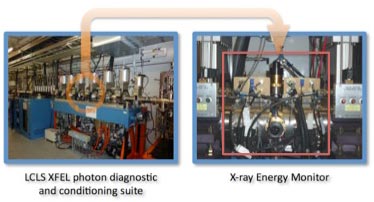
The photoluminescence-based pulse-energy detector allowed the team to study the interaction - including electron dynamics and space charge effects - between nitrogen gas and the XFEL beam. Understanding the precise dynamics at work on these scales will forever change the understanding of chemistry, physics and materials science.
The XFEL's light is so bright at 8 kilo electron volts and so fast (it has a pulse length from 10 femtoseconds to 100 femtoseconds) that LLNL scientists were able to validate the physics of simulations done using nitrogen gas. (One femtosecond is one quadrillionth of a second).
"The detailed physics is very important for most LCLS experiments since it determines the interpretation of the results," said Lab scientist Stefan Hau-Riege. "The unique thing about this experiment is that it was performed upstream from the LCLS mirrors, and so we had access to the full range of LCLS X-ray energies (which went up to 8 keV at the time)."
The heart of the LCLS is a free-electron laser that produces beams of coherent, high-energy X-rays. Coherence - the phenomenon of all photons in a beam acting together in perfect lockstep - makes laser light far brighter than ordinary light. Since X-ray photons at the LCLS are coherent, the resulting beam of light will be as much as a billion times brighter than any other X-ray light source available today.
The LCLS also contains a femto-camera that can sequence together images of the ultra small, taken with the ultrafast pulses of the LCLS. Scientists are for the first time creating molecular movies, revealing the frenetic action of the atomic world.
The LCLS, and its cousins planned in Germany and Japan, improves on third-generation light sources. The third-generation sources are circular, stadium-size synchrotrons, and they produce streams of incoherent X-ray photons. Since their pulses are long compared to the motion of electrons around an atom, synchrotron light sources cannot begin to explore the dynamic motion of molecules.
The pulses of light from the fourth-generation LCLS are so short, lasting for just quadrillionths of a second, that its beam provides an X-ray strobe light to capture such atomic and molecular behavior.
Other Livermore researchers include Richard Bionta, Dmitri Ryutov, Richard London, Elden Ables, Keith Kishiyama, Stewart Shen, Mark McKernan and Donn McMahon. Collaborators included the SLAC National Accelerator Laboratory and the Center for Free-Electron Laser Science, DESY, in Hamburg.
The research will appear in the July 27 online edition of Physical Review Letters.
####
About Lawrence Livermore National Laboratory
Founded in 1952, Lawrence Livermore National Laboratory (www.llnl.gov) is a national security laboratory that develops science and engineering technology and provides innovative solutions to our nation's most important challenges. Lawrence Livermore National Laboratory is managed by Lawrence Livermore National Security, LLC for the U.S. Department of Energy's National Nuclear Security Administration.
For more information, please click here
Contacts:
Anne M. Stark
Phone: (925) 422-9799
Copyright © Lawrence Livermore National Laboratory
If you have a comment, please Contact us.Issuers of news releases, not 7th Wave, Inc. or Nanotechnology Now, are solely responsible for the accuracy of the content.
Bookmark:


| Related News Press |
Physics
 Simulating magnetization in a Heisenberg quantum spin chain April 5th, 2024
Nanoscale CL thermometry with lanthanide-doped heavy-metal oxide in TEM March 8th, 2024
News and information
Simulating magnetization in a Heisenberg quantum spin chain April 5th, 2024
NRL charters Navy’s quantum inertial navigation path to reduce drift April 5th, 2024
Discovery points path to flash-like memory for storing qubits: Rice find could hasten development of nonvolatile quantum memory April 5th, 2024
Chemistry
What heat can tell us about battery chemistry: using the Peltier effect to study lithium-ion cells March 8th, 2024
Nanoscale CL thermometry with lanthanide-doped heavy-metal oxide in TEM March 8th, 2024
Materials/Metamaterials/Magnetoresistance
Nanoscale CL thermometry with lanthanide-doped heavy-metal oxide in TEM March 8th, 2024
Focused ion beam technology: A single tool for a wide range of applications January 12th, 2024
Announcements
NRL charters Navy’s quantum inertial navigation path to reduce drift April 5th, 2024
Discovery points path to flash-like memory for storing qubits: Rice find could hasten development of nonvolatile quantum memory April 5th, 2024
Tools
Ferroelectrically modulate the Fermi level of graphene oxide to enhance SERS response November 3rd, 2023
The USTC realizes In situ electron paramagnetic resonance spectroscopy using single nanodiamond sensors November 3rd, 2023
Research partnerships
Discovery points path to flash-like memory for storing qubits: Rice find could hasten development of nonvolatile quantum memory April 5th, 2024
Researchers’ approach may protect quantum computers from attacks March 8th, 2024
'Sudden death' of quantum fluctuations defies current theories of superconductivity: Study challenges the conventional wisdom of superconducting quantum transitions January 12th, 2024
 |
||
 |
||
| The latest news from around the world, FREE | ||
 |
||
|
|
||
| Premium Products | ||
 |
||
|
Only the news you want to read!
Learn More |
||
 |
||
|
Full-service, expert consulting
Learn More |
||
|
|
||