Home > Press > Spintronics breakthrough documented by UNL MRSEC team
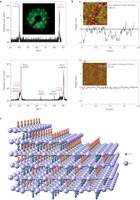 |
| a, è–2è X-ray diffraction pattern of chromia bulk single crystal (upper panel) and thin film (lower panel) showing the chromia (0006) and (00012) peaks, respectively. Copyright Nature |
Abstract:
A team at the University of Nebraska-Lincoln's Materials Research Science Engineering Center made a leap forward in modern spintronics, potentially revolutionizing information technology through reduced power consumption, faster processing speed and improved function compared to today's electronics.
By Christian Binek, with Kelly Bartling, University Communications
Spintronics breakthrough documented by UNL MRSEC team
Lincoln, NB | Posted on July 20th, 2010Led by physicists in the UNL MRSEC, professors Christian Binek and Peter Dowben, together with theorist Kirill Belashchenko and collaborators published "Robust isothermal electric control of exchange bias at room temperature." The article appeared in the June 20 online edition of the journal Nature Materials, and will be published later in the print edition.
"The research team achieved a qualitative leap forward in modern spintronics," said Binek, associate professor of physics and astronomy. "Spintronics is a rapidly evolving research field that exploits the spin degree of freedom of electrons to create an advanced generation of electronic devices. The spin of an electron is a purely quantum mechanical property but can to some extent be pictured in analogy to the classical angular momentum of a spinning top."
Binek said it is this spin degree of freedom that is responsible for the magnetic moment of an electron allowing it to interact with a magnetic field similar to the interaction of a compass needle aligning in Earth's magnetic field. The spin provides an "experimental handle" in addition to the electron charge to control electrons, and thus making spintronic devices feasible.
He said spintronic devices could revolutionize information technology through reduced power consumption, enhanced processing speed, integration density and functionality when compared to present day complementary metal-oxide-semiconductor electronics.
In their experiments the researchers grew a ferromagnetic film on top of chromia, an exotic magnetoelectric material that reacts with excess magnetization when exposed to an electric field. Using specific theoretical insights the researchers realized pure voltage-control of the magnetic state of the ferromagnetic film. Achieving such control at room temperature resembles a significant breakthrough in this research and promises a new route toward voltage-controlled spintronics and electrically controlled magnetism, Binek said.
Under the guidance of Binek, Dowben and Belashchenko, important hands-on contributions came from UNL graduate students Xi He, Yi Wang and UNL postdoctoral researcher Ning Wu, supported by Anthony Caruso from the University of Missouri-Kansas City and Elio Vescovo from Brookhaven National Laboratory.
The paper is published online at www.nature.com/nmat/journal/vaop/ncurrent/abs/nmat2785.html. The National Science Foundation supports this research.
####
For more information, please click here
Contacts:
Christian Binek, Assoc. Professor, Physics and Astronomy
(402) 472-5231
Copyright © University of Nebraska-Lincoln
If you have a comment, please Contact us.Issuers of news releases, not 7th Wave, Inc. or Nanotechnology Now, are solely responsible for the accuracy of the content.
Bookmark:


| Related News Press |
News and information
 Simulating magnetization in a Heisenberg quantum spin chain April 5th, 2024
NRL charters Navy’s quantum inertial navigation path to reduce drift April 5th, 2024
Discovery points path to flash-like memory for storing qubits: Rice find could hasten development of nonvolatile quantum memory April 5th, 2024
Possible Futures
Discovery points path to flash-like memory for storing qubits: Rice find could hasten development of nonvolatile quantum memory April 5th, 2024
With VECSELs towards the quantum internet Fraunhofer: IAF achieves record output power with VECSEL for quantum frequency converters April 5th, 2024
Academic/Education
Rice University launches Rice Synthetic Biology Institute to improve lives January 12th, 2024
Multi-institution, $4.6 million NSF grant to fund nanotechnology training September 9th, 2022
Spintronics
Quantum materials: Electron spin measured for the first time June 9th, 2023
Linearly assembled Ag-Cu nanoclusters: Spin transfer and distance-dependent spin coupling November 4th, 2022
Discoveries
Chemical reactions can scramble quantum information as well as black holes April 5th, 2024
New micromaterial releases nanoparticles that selectively destroy cancer cells April 5th, 2024
Utilizing palladium for addressing contact issues of buried oxide thin film transistors April 5th, 2024
Announcements
NRL charters Navy’s quantum inertial navigation path to reduce drift April 5th, 2024
Discovery points path to flash-like memory for storing qubits: Rice find could hasten development of nonvolatile quantum memory April 5th, 2024
Research partnerships
Discovery points path to flash-like memory for storing qubits: Rice find could hasten development of nonvolatile quantum memory April 5th, 2024
Researchers’ approach may protect quantum computers from attacks March 8th, 2024
'Sudden death' of quantum fluctuations defies current theories of superconductivity: Study challenges the conventional wisdom of superconducting quantum transitions January 12th, 2024
 |
||
 |
||
| The latest news from around the world, FREE | ||
 |
||
|
|
||
| Premium Products | ||
 |
||
|
Only the news you want to read!
Learn More |
||
 |
||
|
Full-service, expert consulting
Learn More |
||
|
|
||