Home > Press > UT researchers develop anthrax sensor
 |
Abstract:
Nanotechnologists at University of Twente's MESA+ research institute have developed a sensor that can detect anthrax spores. The invention is more sensitive and efficient than existing detection methods. The research is being published in the leading scientific journal Angewandte Chemie.
UT researchers develop anthrax sensor
The Netherlands | Posted on July 19th, 2010Anthrax - notorious as the powder ingredient in letter-bombs - is an infectious and potentially fatal disease caused by the bacterium Bacillus anthracis. This bacterium produces spores - dried bacteria with a hard shell - that can survive long-term in the open air. University of Twente researchers have now designed a sensor that can detect a biomarker of the spores and thus determine their presence in a concentration one thousand times lower than the known toxic level.
Techniques for detecting anthrax spores (such as fluorescence and mass spectroscopy) already exist, but the UT sensor is much more sensitive and effective than any of them. It can also be reused in subsequent trials.
How the sensor works
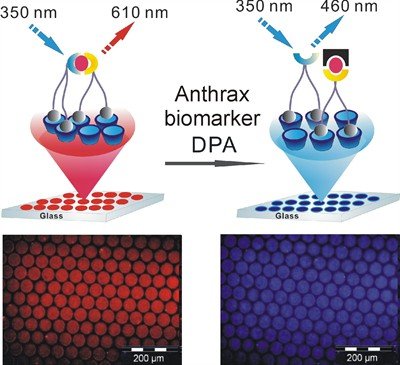
Like other detection techniques, the UT sensor measures the presence of dipicolinic acid (DPA), a substance that accounts for between five and fifteen per cent of the dry weight of the spores. The sensor consists of a glass plate to which DPA-sensitive receptors have been attached. When the receptors are brought into contact with anthrax spores, the DPA binds with them. The concentration of the spores can be calculated with fluorescence spectroscopy, by shining ultraviolet light on to the sensor. DPA-bonded receptors will absorb this light and emit blue light, whereas receptors that have no DPA bonding will emit red light. By measuring the ratio of red to blue light in a sample, it is possible to determine the concentration of anthrax spores. The advantage of the sensor is that it does not need calibrating and is more finely tuned than other current methods. The next step for the researchers is to convert the system into a 'lab-on-a-chip' which will make it possible to measure samples using a fully automatic on-off process.
Note to the press
The research is being conducted by the departments of Molecular Nanofabrication and Supramolecular Chemistry & Technology at University of Twente's MESA+ research institute. It has been made possible by NanoNed and the Netherlands Organization for Scientific Research (NWO).
For further details or a digital copy of the article Ratiometric Fluorescent Detection of an Anthrax Biomarker at Molecular Printboards, please contact our Science Information Officer Wiebe van der Veen +31(0)53 489 4424).
####
For more information, please click here
Contacts:
Science Information Officer
Wiebe van der Veen
+31(0)53 489 4424
Copyright © University of Twente
If you have a comment, please Contact us.Issuers of news releases, not 7th Wave, Inc. or Nanotechnology Now, are solely responsible for the accuracy of the content.
Bookmark:


| Related News Press |
News and information
 Simulating magnetization in a Heisenberg quantum spin chain April 5th, 2024
NRL charters Navy’s quantum inertial navigation path to reduce drift April 5th, 2024
Discovery points path to flash-like memory for storing qubits: Rice find could hasten development of nonvolatile quantum memory April 5th, 2024
Possible Futures
Discovery points path to flash-like memory for storing qubits: Rice find could hasten development of nonvolatile quantum memory April 5th, 2024
With VECSELs towards the quantum internet Fraunhofer: IAF achieves record output power with VECSEL for quantum frequency converters April 5th, 2024
Academic/Education
Rice University launches Rice Synthetic Biology Institute to improve lives January 12th, 2024
Multi-institution, $4.6 million NSF grant to fund nanotechnology training September 9th, 2022
Sensors
Announcements
NRL charters Navy’s quantum inertial navigation path to reduce drift April 5th, 2024
Discovery points path to flash-like memory for storing qubits: Rice find could hasten development of nonvolatile quantum memory April 5th, 2024
Homeland Security
The picture of health: Virginia Tech researchers enhance bioimaging and sensing with quantum photonics June 30th, 2023
Sensors developed at URI can identify threats at the molecular level: More sensitive than a dog's nose and the sensors don't get tired May 21st, 2021
Highly sensitive dopamine detector uses 2D materials August 7th, 2020
Military
NRL charters Navy’s quantum inertial navigation path to reduce drift April 5th, 2024
What heat can tell us about battery chemistry: using the Peltier effect to study lithium-ion cells March 8th, 2024
New chip opens door to AI computing at light speed February 16th, 2024
Nanobiotechnology
New micromaterial releases nanoparticles that selectively destroy cancer cells April 5th, 2024
Good as gold - improving infectious disease testing with gold nanoparticles April 5th, 2024
Researchers develop artificial building blocks of life March 8th, 2024
 |
||
 |
||
| The latest news from around the world, FREE | ||
 |
||
|
|
||
| Premium Products | ||
 |
||
|
Only the news you want to read!
Learn More |
||
 |
||
|
Full-service, expert consulting
Learn More |
||
|
|
||