Home > Press > World records by UCLA chemists, Korean colleagues enhance ability to capture CO2
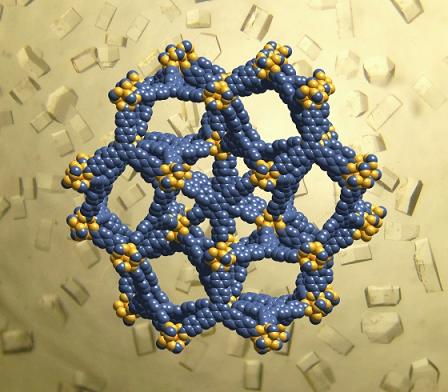 |
| Crystal structure of MOF-200, in UCLA's blue and gold. Atom colors: UCLA blue = carbon, UCLA gold = oxygen, orange = zinc. Optical image of MOF-200 crystals. (Credit: UCLA Department of Chemistry and Biochemistry; UCLA–Department of Energy Institute of Genomics and Proteomics) |
Abstract:
Chemists from UCLA and South Korea report the "ultimate porosity of a nano-material," achieving world records for both porosity and carbon dioxide storage capacity in an important class of materials known as MOFs, or metal-organic frameworks.
By Stuart Wolpert
World records by UCLA chemists, Korean colleagues enhance ability to capture CO2
Los Angeles, CA | Posted on July 19th, 2010MOFs, sometimes described as crystal sponges, have pores — openings on the nanoscale which can store gases that are usually difficult to store and transport. Porosity is crucial for compacting large amounts of gases into small volumes and is an essential property for capturing carbon dioxide.
The research could lead to cleaner energy and the ability to capture heat-trapping carbon dioxide emissions before they reach the atmosphere and contribute to global warming, rising sea levels and the increased acidity of oceans.
The research will be published July 23 in the print edition of the journal Science and is currently available in the journal's advance online edition.
"We are reporting the ultimate porosity of a nano-material; we believe this to be the upper limit or very near the upper limit for porosity in materials," said the paper's senior author, Omar Yaghi, a UCLA professor of chemistry and biochemistry and a member of both the California NanoSystems Institute (CNSI) at UCLA and the UCLA-Department of Energy Institute of Genomics and Proteomics.
"Porosity is a way to do a lot with little," said Yaghi, who holds UCLA's Irving and Jean Stone Chair in Physical Sciences and directs the CNSI's Center for Reticular Chemistry. "Instead of having only the outside surface of a particle, we drill small holes to dramatically increase the surface."
With lead author Hiroyasu (Hiro) Furukawa, co-author Jaheon Kim and colleagues, Yaghi reports on two materials that not only break the porosity record, but do so by an extremely large margin. The materials are MOF-200, made at UCLA by Furukawa, a postdoctoral scholar in Yaghi's laboratory, and MOF-210, made at Seoul's Soongsil University in South Korea by Kim, a chemistry professor and former graduate student in Yaghi's laboratory, and colleagues.
"We have made not just incremental strides with MOFs," said Yaghi, whose research overlaps chemistry, materials science and engineering. "What is special about MOF-200 and MOF-210 is that they are approaching the limit of what you can get in a material. We may be able to design better structures, but they will not be easy to make."
Invented by Yaghi the early 1990s, MOFs are like scaffolds made of linked rods, with nanoscale pores that are the right size to trap carbon dioxide. The components of MOFs can be changed nearly at will, and Yaghi's laboratory has made several hundred MOFs, with a variety of properties and structures.
Since 1999, MOFs have held the record for having the highest porosity of any material. MOFs can be made from low-cost ingredients, such as zinc oxide, a common ingredient in sunscreen, and terephthalate, which is found in plastic soda bottles.
Yaghi discovered the key to making highly porous structures, which he and colleagues reported in the journal Nature in 2004 (MOF-177 broke the previous porosity record, which had been held since 1999 by Yaghi's MOF-5) and in Science in 2005. Since then, chemists have been in a race to make higher and higher surface areas for materials, with the highest porosity.
Now Yaghi, Furukawa and Kim have made MOFs that are twice the porosity of MOF-177, three times the porosity of MOF-5 and 10 times the porosity of the most porous material prior to 1999. This means they can now store twice as much gas as they could in 2004, an enormous increase.
"If I take a gram of MOF-200 and unravel it, it will cover many football fields, and that is the space you have for gases to assemble," Yaghi said. "It's like magic. Forty tons of MOFs is equal to the entire surface area of California.
"This is only the beginning of MOFs," he said, "because now we can see the platform of materials on which we can build. In science, achieving the limit by experiment is magnificent, and now we can test the properties of these materials for various applications. Requirements for making a viable material for carbon dioxide capture are high capacity and high selectivity. We reported before on how to get high selectivity for carbon dioxide; now we are showing how to get high capacity. The industrial applications are being deployed or, in certain cases, are in the process of being developed. Many companies are working on the development of MOFs."
For example, BASF, a global chemical company based in Germany, makes large quantities of MOFs, which are sold by Sigma-Aldrich, a life science and high-technology company.
Yaghi, Furukawa and Kim also report in Science a record for carbon dioxide storage capacity. MOF-200 and MOF-210 take up the highest amount of hydrogen, methane and carbon dioxide, by weight, ever achieved.
On Feb. 12 of this year, Yaghi, UCLA graduate student Hexiang Deng, Furukawa and UCLA colleagues reported in Science their creation of a synthetic "gene" that could capture carbon dioxide emissions.
Carbon dioxide is polluting Earth's atmosphere and damaging coral reefs and marine life —impacts that are irreversible in our lifetime, Yaghi said.
With the new research, it is now possible to develop the synthetic gene with MOF-200 and MOF-210, giving it a much larger surface area.
"MOFs are a class of materials unparalleled by any other," Yaghi said. "MOFs are among the largest class of materials ever made, in number, variety and diversity of composition."
Furukawa, who has worked in Yaghi's laboratory for seven years, earned his Ph.D. from the University of Tokyo.
"Hiro discovered a way of evacuating completely the solvent that otherwise would fill the holes, which allowed access to the porosity," Yaghi said. "That was the magic."
Learning from 'As the World Turns' and 'Three's Company'
When Furukawa came to the United States on a Japanese fellowship, he spoke almost no English.
Yaghi, one of the world's great scientists, recalls without embarrassment how he watched "As the World Turns" and "Days of Our Lives" to learn English when he came to New York from Jordan at age 15.
"When I picked Hiro up," Yaghi said, "I thought, 'He has no clue about the world he is entering' — America or my lab. I said to him, 'I will not talk with you until you buy a small TV and you watch soap operas every day; I want you to learn English.' The way I learned English was to read the newspaper with a dictionary and underline words I didn't understand. Almost every other line had an underlined word that I looked up, but you learn very quickly. I watched soap operas, too. I used to run back to my room from school to watch what happened. The stories don't move very fast; it's almost like doing research."
Furukawa took Yaghi's advice and watched reruns of "Three's Company."
"I couldn't understand it at first," he said, "but later, it was easy to follow."
How does Yaghi decide which students to accept into his laboratory?
"You have to look into their eyes and see whether there is passion and energy," Yaghi said. "Technical ability has to be coupled with the ability to harness your potential and elevate your mind."
Furukawa frequently works until 4 a.m., often on his computer at home.
"When I want to finish something, I like to keep working," he said.
"The best thing I learned from Professor Yaghi," Furukawa said, "is not chemistry but his way of thinking. When I joined his group, I was very surprised because I have never seen a professor who thinks like him in Japan. He publishes only exceptional results. That is why he is the leader of the field. He motivates us to find breakthroughs, new concepts and world records. The experience of working in his laboratory has definitely improved my mind and my thinking process."
The new Science research was funded by BASF, the U.S. Department of Energy's Office of Basic Energy Sciences, and South Korea's Hydrogen Energy R&D Center (one of the Korean Ministry of Education, Science and Technology's 21st Century Frontier R&D Programs).
How does Yaghi feel about the achievements reported in Science?
"Ready for the next challenge," he said. "MOFs are a gold mine."
####
About UCLA
UCLA is California's largest university, with an enrollment of nearly 38,000 undergraduate and graduate students. The UCLA College of Letters and Science and the university's 11 professional schools feature renowned faculty and offer more than 323 degree programs and majors. UCLA is a national and international leader in the breadth and quality of its academic, research, health care, cultural, continuing education and athletic programs. Five alumni and five faculty have been awarded the Nobel Prize.
For more information, please click here
Contacts:
Media Contacts
Stuart Wolpert,
310-206-0511
Copyright © UCLA
If you have a comment, please Contact us.Issuers of news releases, not 7th Wave, Inc. or Nanotechnology Now, are solely responsible for the accuracy of the content.
Bookmark:


| Related News Press |
News and information
 Simulating magnetization in a Heisenberg quantum spin chain April 5th, 2024
NRL charters Navy’s quantum inertial navigation path to reduce drift April 5th, 2024
Discovery points path to flash-like memory for storing qubits: Rice find could hasten development of nonvolatile quantum memory April 5th, 2024
Possible Futures
Discovery points path to flash-like memory for storing qubits: Rice find could hasten development of nonvolatile quantum memory April 5th, 2024
With VECSELs towards the quantum internet Fraunhofer: IAF achieves record output power with VECSEL for quantum frequency converters April 5th, 2024
Academic/Education
Rice University launches Rice Synthetic Biology Institute to improve lives January 12th, 2024
Multi-institution, $4.6 million NSF grant to fund nanotechnology training September 9th, 2022
Announcements
NRL charters Navy’s quantum inertial navigation path to reduce drift April 5th, 2024
Discovery points path to flash-like memory for storing qubits: Rice find could hasten development of nonvolatile quantum memory April 5th, 2024
Environment
Billions of nanoplastics released when microwaving baby food containers: Exposure to plastic particles kills up to 75% of cultured kidney cells July 21st, 2023
Energy
Development of zinc oxide nanopagoda array photoelectrode: photoelectrochemical water-splitting hydrogen production January 12th, 2024
Shedding light on unique conduction mechanisms in a new type of perovskite oxide November 17th, 2023
Inverted perovskite solar cell breaks 25% efficiency record: Researchers improve cell efficiency using a combination of molecules to address different November 17th, 2023
The efficient perovskite cells with a structured anti-reflective layer – another step towards commercialization on a wider scale October 6th, 2023
Research partnerships
Discovery points path to flash-like memory for storing qubits: Rice find could hasten development of nonvolatile quantum memory April 5th, 2024
Researchers’ approach may protect quantum computers from attacks March 8th, 2024
'Sudden death' of quantum fluctuations defies current theories of superconductivity: Study challenges the conventional wisdom of superconducting quantum transitions January 12th, 2024
 |
||
 |
||
| The latest news from around the world, FREE | ||
 |
||
|
|
||
| Premium Products | ||
 |
||
|
Only the news you want to read!
Learn More |
||
 |
||
|
Full-service, expert consulting
Learn More |
||
|
|
||