Home > Press > Secret Revealed
 |
Abstract:
The crystal structure of ribose—finally!
Secret Revealed
Weinheim, Germany | Posted on July 8th, 2010D-Ribose is just a small molecule - but an extremely important one for us life forms. It is astounding that the crystal structure of ribose is not included among the over 500,000 structures that have been solved. After all, ribose is a fundamental building block of ribosomes, the "protein factories" of cells. A Nobel Prize was awarded in 2009 for studies of the structure and function of ribosomes. In the journal Angewandte Chemie, the winners of this prize have just presented a first-hand report of their research. Also in Angewandte Chemie, a team of German and Swiss-based researchers has now presented another long-sought result: they have finally been able to solve the crystal structure of ribose.
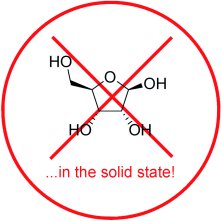
Ribose belongs in the chemical class of sugars. Its backbone is a chain of five carbon atoms; four of them carry an OH group, the fifth an oxygen atom attached by a double bond. In most modern textbooks and handbooks, ribose is represented as a â-furanose: four of the carbon atoms and the oxygen atom form a five-membered ring. However, it has been known for over 40 years that in solution, ribose exists as a mixure of four different structures: á- and â-furanoses as well as á- and the dominant â-pyranose. Pyranoses are a form of sugar in which the five carbon atoms and an oxygen atom form a six-membered ring. The prefix á or â indicates whether a specific OH group lies above or below the plane of the ring.
But what form does crystalline ribose adopt? Whereas the structures of other important sugars have been known for a long time, ribose has been reluctant to reveal its secret; the compound is extremely difficult to crystallize. Despite such adverse conditions and countless failed attempts, the team led by Lynne B. McCusker, Beat H Meier, Roland Boese, and Jack D. Dunitz at the ETH Zurich (Switzerland) and the University of Duisburg-Essen have finally succeeded in cracking the structure. By using complex computer calculations, they were first able to obtain meaningful results from X-ray diffraction analyses of powder samples. They were then also able to produce single crystals by zone-melting recrystallization. In this technique, only a small zone of the material is heated and this melt zone is moved. The cooling melt then solidifies with a uniform crystal structure to form the desired single crystal. This can then be examined in by X-ray crystal-structure analysis. Solid-state NMR spectroscopic studies yielded further, complementary information about ribose.
Overall, the researchers came to the realization that D-ribose molecules crystallize as pyranoses, which are six-membered rings. These are present in two crystalline forms that contain â- and á-pyranose in various proportions.
Author: Jack D. Dunitz, Swiss Federal Institute of Technology (ETH) Zurich (Switzerland), www.loc.ethz.ch/people/emerit/dunitz
Title: The Crystal Structure of D-Ribose—At Last!
Angewandte Chemie International Edition 2000, 39, No. 26, 4503-4505, Permalink to the article: dx.doi.org/10.1002/anie.201001266
####
For more information, please click here
Copyright © Angewandte Chemie
If you have a comment, please Contact us.Issuers of news releases, not 7th Wave, Inc. or Nanotechnology Now, are solely responsible for the accuracy of the content.
Bookmark:


| Related News Press |
News and information
 Simulating magnetization in a Heisenberg quantum spin chain April 5th, 2024
NRL charters Navy’s quantum inertial navigation path to reduce drift April 5th, 2024
Discovery points path to flash-like memory for storing qubits: Rice find could hasten development of nonvolatile quantum memory April 5th, 2024
Chemistry
What heat can tell us about battery chemistry: using the Peltier effect to study lithium-ion cells March 8th, 2024
Nanoscale CL thermometry with lanthanide-doped heavy-metal oxide in TEM March 8th, 2024
Academic/Education
Rice University launches Rice Synthetic Biology Institute to improve lives January 12th, 2024
Multi-institution, $4.6 million NSF grant to fund nanotechnology training September 9th, 2022
Discoveries
Chemical reactions can scramble quantum information as well as black holes April 5th, 2024
New micromaterial releases nanoparticles that selectively destroy cancer cells April 5th, 2024
Utilizing palladium for addressing contact issues of buried oxide thin film transistors April 5th, 2024
Announcements
NRL charters Navy’s quantum inertial navigation path to reduce drift April 5th, 2024
Discovery points path to flash-like memory for storing qubits: Rice find could hasten development of nonvolatile quantum memory April 5th, 2024
 |
||
 |
||
| The latest news from around the world, FREE | ||
 |
||
|
|
||
| Premium Products | ||
 |
||
|
Only the news you want to read!
Learn More |
||
 |
||
|
Full-service, expert consulting
Learn More |
||
|
|
||