Home > Press > New Tools for New Light Source at Brookhaven Lab
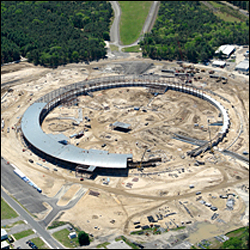 |
| National Synchrotron Light Source II under construction |
Abstract:
The U.S. Department of Energy's (DOE) Brookhaven National Laboratory is constructing the world's most brilliant light source, the National Synchrotron Light Source II (NSLS-II). In a recent decision, DOE has approved a new project to begin conceptual design of NSLS-II experimental tools, named NEXT.
By Mona S. Rowe
New Tools for New Light Source at Brookhaven Lab
Upton, NY | Posted on June 24th, 2010The research potential of NSLS-II will only be realized when it is equipped with scientific instruments known as beamlines. Specialized magnets called insertion devices will create the light used by the most advanced of these beamlines. The NSLS-II construction project is already building six beamlines with insertion devices. NEXT would support the creation of another five or six insertion device beamlines. NSLS-II will be capable of supporting some 58 beamlines in total. Additional beamlines for NSLS-II would be funded by various other sources over time.
An insertion device beamline can range in cost from $10-15 million, depending on its design and components. Those requirements are determined by the particular experimental studies being done.
"Much of the research at NSLS-II will focus on developing the next generation of sustainable energy technologies," said Steve Dierker, NSLS-II Project Director and Associate Laboratory Director for Light Sources at Brookhaven Lab. According to Dierker, these new technologies will be based on novel materials that have yet to be designed and fabricated. The NEXT project would provide beamlines with the advanced capabilities needed for studying the properties and functions of complex materials.
"Most of today's technologies are built using bulk materials whose properties are not sufficient to enable next generation technologies," added Dierker. "Although we understand quite a lot about the properties of bulk materials, we have not yet succeeded at improving their properties by the amount needed for the new applications. The challenge is to work dramatically below the bulk state, in the range of single atoms to tens of atoms. The NEXT project can give NSLS-II the advanced tools to do that."
####
About Brookhaven National Laboratory
One of ten national laboratories overseen and funded primarily by the Office of Science of the U.S. Department of Energy (DOE), Brookhaven National Laboratory conducts research in the physical, biomedical, and environmental sciences, as well as in energy technologies and national security. Brookhaven Lab also builds and operates major scientific facilities available to university, industry and government researchers. Brookhaven is operated and managed for DOE's Office of Science by Brookhaven Science Associates, a limited-liability company founded by the Research Foundation of State University of New York on behalf of Stony Brook University, the largest academic user of Laboratory facilities, and Battelle, a nonprofit, applied science and technology organization.
About NSLS-II
As the world's most brilliant light source, NSLS-II will foster groundbreaking scientific advances. Brookhaven's currently operating light source, NSLS, draws each year about 2,200 researchers from 400 universities, government labs, and companies to study a wide range of materials, from catalysts, to computer chips, to biological molecules.
To take their research to the next level - to probe even smaller, subtler details of their samples - scientists need more intense, better-focused light. NSLS-II will deliver world-leading intensity and brightness, producing x-rays 10,000 times brighter than the current NSLS. In fact, its x-ray brightness and resolution will exceed all other light sources, existing and under construction. This will enable the nanoscience revolution, giving scientists the ability to image materials down to a nanometer, one billionth of a meter - a capability not available at any other light source in the world.
The unique characteristics of NSLS-II will help scientists explore the grand challenges they face in developing new materials with advanced properties. It will pave the way to discoveries in physics, chemistry, and biology - advances that will ultimately enhance national security and help drive the development of abundant, safe, and clean energy technologies.
NSLS-II construction began in 2009, creating jobs and stimulating the economy. The facility is expected to start operating in 2015.
NSLS-II is funded by the Department of Energy Office of Science, which is also supporting the NEXT project. For more information about the NSLS-II project, visit the website at www.bnl.gov/nsls2.
For more information, please click here
Contacts:
Kendra Snyder, 631 344-8191, or Peter Genzer, 631
344-3174,
Copyright © Brookhaven National Laboratory
If you have a comment, please Contact us.Issuers of news releases, not 7th Wave, Inc. or Nanotechnology Now, are solely responsible for the accuracy of the content.
Bookmark:


| Related News Press |
News and information
 Simulating magnetization in a Heisenberg quantum spin chain April 5th, 2024
NRL charters Navy’s quantum inertial navigation path to reduce drift April 5th, 2024
Discovery points path to flash-like memory for storing qubits: Rice find could hasten development of nonvolatile quantum memory April 5th, 2024
Govt.-Legislation/Regulation/Funding/Policy
NRL charters Navy’s quantum inertial navigation path to reduce drift April 5th, 2024
Discovery points path to flash-like memory for storing qubits: Rice find could hasten development of nonvolatile quantum memory April 5th, 2024
Chemical reactions can scramble quantum information as well as black holes April 5th, 2024
Materials/Metamaterials/Magnetoresistance
Nanoscale CL thermometry with lanthanide-doped heavy-metal oxide in TEM March 8th, 2024
Focused ion beam technology: A single tool for a wide range of applications January 12th, 2024
Announcements
NRL charters Navy’s quantum inertial navigation path to reduce drift April 5th, 2024
Discovery points path to flash-like memory for storing qubits: Rice find could hasten development of nonvolatile quantum memory April 5th, 2024
Tools
Ferroelectrically modulate the Fermi level of graphene oxide to enhance SERS response November 3rd, 2023
The USTC realizes In situ electron paramagnetic resonance spectroscopy using single nanodiamond sensors November 3rd, 2023
 |
||
 |
||
| The latest news from around the world, FREE | ||
 |
||
|
|
||
| Premium Products | ||
 |
||
|
Only the news you want to read!
Learn More |
||
 |
||
|
Full-service, expert consulting
Learn More |
||
|
|
||