Home > Press > Optical ethanol vapor sensor shows potential of SOI-based integrated gas sensors
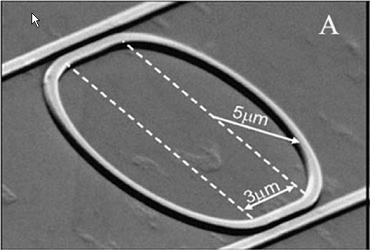 |
| A scanning electron microscope (SEM) image of a SOI microring resonator of 5µm radius |
Abstract:
An ethanol vapor sensor is fabricated using a ZnO nanoparticle film as a coating on a silicon-on-insulator (SOI) microring resonator of 5µm in radius. The sensor can detect ethanol vapor concentrations as low as 100ppm. This achievement successfully demonstrates the potential of SOI technology for the development of sensitive, compact, low-power and inexpensive optical gas sensing devices.
Optical ethanol vapor sensor shows potential of SOI-based integrated gas sensors
Belgium | Posted on June 22nd, 2010INTEC, imec's associated laboratory at Ghent University, and imec have coated SOI microring resonators with films of 3.5nm ZnO nanocrystals for optical sensing of gaseous ethanol. Ethanol vapor concentrations down to 100ppm have been detected. The proposed technology meets today's demand for compact, cheap, low-power and reasonably sensitive gas detection systems. By doping metal oxides with specific functional molecules, this technique can be extended for selective detection of other gases.
With this result, INTEC and imec have demonstrated the potential of SOI technology for integrated low-power and low-cost optical gas sensing. With future advancements in micropatterning techniques, other selective films can efficiently be coated on several microring resonators to achieve integrated and multiplexed multi-gas sensing on an optical chip. In several industrial, medical and environmental applications, this technology can be advantageous over other techniques (electrochemical, catalytic...). For instance, integrated optical gas sensors are very compact and can operate at room temperature, they are suitable for remote sensing and multiplexing, they are not affected by electromagnetic interference and don't involve direct electrical contacts enabling risk free operation in explosive gas environments. Moreover, these sensors can provide a robust and reliable solution taking the advantage of stable metal oxide coatings. The compatibility of the SOI devices with CMOS fabrication tools and the promise of inexpensive mass fabrication make this technology additionally attractive.
The microring resonators have been fabricated with standard CMOS fabrication facilities. In practice, 193nm deep-ultraviolet photolithography in combination with dry etching is used to fabricate high-Q microring resonators of 5µm in radius. The local coating on the ring resonators is prepared from colloidal suspensions of ZnO nanoparticles of 3.5nm diameter. After coating, the SOI microring resonators have Q values of about 15,000. The porous nature of the coating provides a large surface area for gas adsorption. When ethanol vapor is adsorbed, a change in the ZnO refractive index occurs and a shift in the resonance wavelength of the microring resonator due to evanescent field interaction can be measured. E.g., exposure to 1500ppm of ethanol leads to a shift of 500pm. With this sensing configuration, ethanol vapor concentrations down to 100ppm are detected and a detection limit below 25ppm is estimated.
####
About imec
Imec is Europe’s largest independent research center in nanoelectronics and nano-technology. Its staff of more than 1,750 people includes over 550 industrial residents and guest researchers. Imec’s research is applied in better healthcare, smart electronics, sustainable energy, and safer transport.
For more information, please click here
Contacts:
Kapeldreef 75
B-3001 Leuven
Belgium
Phone: +32 16 28 12 11
Fax: +32 16 22 94 00
Copyright © imec
If you have a comment, please Contact us.Issuers of news releases, not 7th Wave, Inc. or Nanotechnology Now, are solely responsible for the accuracy of the content.
Bookmark:


| Related News Press |
News and information
 Simulating magnetization in a Heisenberg quantum spin chain April 5th, 2024
NRL charters Navy’s quantum inertial navigation path to reduce drift April 5th, 2024
Discovery points path to flash-like memory for storing qubits: Rice find could hasten development of nonvolatile quantum memory April 5th, 2024
Chip Technology
Discovery points path to flash-like memory for storing qubits: Rice find could hasten development of nonvolatile quantum memory April 5th, 2024
Utilizing palladium for addressing contact issues of buried oxide thin film transistors April 5th, 2024
HKUST researchers develop new integration technique for efficient coupling of III-V and silicon February 16th, 2024
Sensors
Announcements
NRL charters Navy’s quantum inertial navigation path to reduce drift April 5th, 2024
Discovery points path to flash-like memory for storing qubits: Rice find could hasten development of nonvolatile quantum memory April 5th, 2024
 |
||
 |
||
| The latest news from around the world, FREE | ||
 |
||
|
|
||
| Premium Products | ||
 |
||
|
Only the news you want to read!
Learn More |
||
 |
||
|
Full-service, expert consulting
Learn More |
||
|
|
||