Home > Press > Layered Footballs
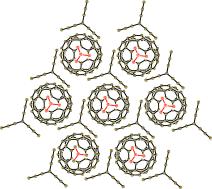 |
| The first fullerene organic metal: (MDABCO+)TPC(C60.-), which has two-dimensional layers with a honeycomb arrangement of C60.- (see picture), is a fascinating example of a material composed of only light elements (C, H, N); it adopts a metallic state down to 1.9 K. |
Abstract:
First two-dimensional organic metal made of fullerenes
Layered Footballs
Weinheim, Germany | Posted on June 9th, 2010Since their discovery in the mid 1980s, fullerenes have caused a sensation. The tiny hollow spheres made of 60 carbon atoms, constructed out of pentagons and hexagons like miniature soccer balls, have unusual physical properties. In the meantime, a variety of fullerene-containing materials have been developed. Now a new variant has been made: A Russian and Japanese team has produced the first material made of two-dimensional fullerene layers that acts like a metal. As the researchers report in the journal Angewandte Chemie, this new class of compounds could open a route toward novel superconducting materials.
All previous fullerene-containing crystals with metallic properties have been one- or three-dimensional structures and contained metal elements. Dmitri V. Konarev, Gunzi Saito, and their co-workers from Chernogolovka, Kyoto, and Nagoya had the ambition to make a metallic conducting fullerene "salt" containing two-dimensional fullerene layers. In addition, they wanted it to be free of metal ions, containing only the elements carbon, hydrogen, and nitrogen.
For this to work, three different components were needed: 1) fullerene anions, negatively charged "miniature soccer balls"; 2) positively charged organic counterions (cations); and 3) large neutral organic molecules. Component 2, the cations, are needed to maintain the right distribution of electrical charge within the material. The neutral compound 3 assures the correct spatial arrangement of the individual building blocks within the crystal structure.
The problem: fullerene anions in a crystal have a tendency to form pairs. In order for the material to behave as a metal, the fullerene anions need to be densely packed within their layer. Only when the geometry and size of the neutral partner are exactly right does this work. The team chose to use triptycene as the neutral component; this is an aromatic ring system whose shape is reminiscent of a three-bladed propeller. The organic cation they used has a cage-like structure.
The result is a crystal in which fullerene layers alternate with layers made of the two other partners. The fullerene layer has a honeycomb structure in which every tiny, negatively charged "soccer ball" has six adjacent neighbors. The fullerene layers are highly conducting like a metal—even down to temperatures near absolute zero (1.9 K), which is very unusual.
It should be possible to produce other materials in this class by varying the individual partners. The researches expect that this will produce materials with exotic electronic properties, such as novel superconductors or spin liquids, which are materials that show an unusual magnetic state at absolute zero.
Author: Dimitri Konarev, Russian Academy of Science, Moscow (Russia),
Title: A Two-Dimensional Organic Metal Based on Fullerene
Angewandte Chemie International Edition, Permalink to the article: dx.doi.org/10.1002/anie.201001463
####
For more information, please click here
Contacts:
Editorial office: or Alina Boey (Asia):
Copyright © Angewandte Chemie
If you have a comment, please Contact us.Issuers of news releases, not 7th Wave, Inc. or Nanotechnology Now, are solely responsible for the accuracy of the content.
Bookmark:


| Related News Press |
News and information
 Simulating magnetization in a Heisenberg quantum spin chain April 5th, 2024
NRL charters Navy’s quantum inertial navigation path to reduce drift April 5th, 2024
Discovery points path to flash-like memory for storing qubits: Rice find could hasten development of nonvolatile quantum memory April 5th, 2024
Possible Futures
Discovery points path to flash-like memory for storing qubits: Rice find could hasten development of nonvolatile quantum memory April 5th, 2024
With VECSELs towards the quantum internet Fraunhofer: IAF achieves record output power with VECSEL for quantum frequency converters April 5th, 2024
Nanotubes/Buckyballs/Fullerenes/Nanorods/Nanostrings
Tests find no free-standing nanotubes released from tire tread wear September 8th, 2023
Detection of bacteria and viruses with fluorescent nanotubes July 21st, 2023
Discoveries
Chemical reactions can scramble quantum information as well as black holes April 5th, 2024
New micromaterial releases nanoparticles that selectively destroy cancer cells April 5th, 2024
Utilizing palladium for addressing contact issues of buried oxide thin film transistors April 5th, 2024
Materials/Metamaterials/Magnetoresistance
Nanoscale CL thermometry with lanthanide-doped heavy-metal oxide in TEM March 8th, 2024
Focused ion beam technology: A single tool for a wide range of applications January 12th, 2024
Announcements
NRL charters Navy’s quantum inertial navigation path to reduce drift April 5th, 2024
Discovery points path to flash-like memory for storing qubits: Rice find could hasten development of nonvolatile quantum memory April 5th, 2024
 |
||
 |
||
| The latest news from around the world, FREE | ||
 |
||
|
|
||
| Premium Products | ||
 |
||
|
Only the news you want to read!
Learn More |
||
 |
||
|
Full-service, expert consulting
Learn More |
||
|
|
||