Home > Press > Argonne Labs battery symposium looks to electric cars with a 500-mile range
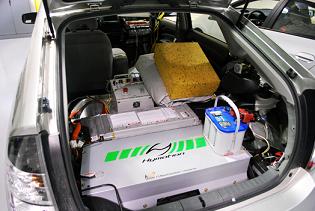 |
| Plug-in hybrid vehicles stand to be major beneficiaries of futuistic battery research at Argonne National Laboratory. Experts at Argonne predict new batteries will mean a car reach 500 miles per plug-in within the next 20 years. |
Abstract:
What we may need more than new energy is a better way to store what we have.
That was the focus of Argonne National Laboratory's recent symposium on next-generation batteries.
By Alex Baumgardner
Argonne Labs battery symposium looks to electric cars with a 500-mile range
Chicago, IL | Posted on June 8th, 2010The recent symposium, Computational Perspectives, drew scientists and engineers from the public and private sector across the world.
While sustainable energy alternatives continue to dominate conversations in environmental and industry circles, Argonne's battery research offers the promise of electric cars with 500-miles of power, though battery development for them may take another decade.
"We're in research, and we're always looking for the next big thing," said Daniel Abraham, a leading researcher in the field of lithium-ion batteries and materials scientist at Argonne.
During this week's next generation battery symposium at Argonne, scientists and engineers focused on finding ways to increase the energy stored in a battery with innovative new battery materials - including just plain air.
Advanced batteries would bring longer running times to cell phone and laptops. But one of the biggest beneficiaries of this research could be the electric car. Argonne has tested its lithium-ion battery in a Toyota Prius, running it on an on-site track the equivalent of the distance to California without ever having to stop.
Currently, Argonne's engineers remain focused on lithium-ion batteries, which have already doubled the capacity of the more common acid based batteries. But through funding granted by the American Recovery and Reinvestment Act, the lab now has $8.8 million to develop high-performance battery systems, such as lithium-air systems. These new systems could potentially increase battery life and power exponentially.
What makes these battery systems work is the substance used in the battery. Common acid batteries use a water-based conductor but the acid causes the water to decompose quickly, limiting power and lifespan. Lithium-ion and futuristic lithium-air batteries allow for longer battery life and increased voltage because of the components themselves can last longer and allow for higher conductivity.
"The benefit is tremendous" with lithium-air said Dr. Khalil Amine, one of Argonne's top material scientists. "We're talking about 10 times more energy. We're not talking about doubling, which is already a big breakthrough. This is the future."
It's grants such as the one from American Recovery that allow Argonne to remain at the forefront of this type of research, said Argonne's senior accounts manager Jeff Chamberlain. He said it's what keeps industries relying on government labs for technological advancement and technology transfer.
"It's different for industry," Chamberlain said. "For these publicly traded companies that live quarter to quarter, they can't afford to make this type of investment to solve this type of problem."
Lithium-air batteries in the early stages of development would compress air and increase a stable reaction surface to generate electrons that deliver stored energy from batteries.
"It's intrinsic, it's not something we design," Amine said. "Lithium air has almost [the energy] of gasoline. So you can expect 500 miles in a charge with the electric car. Now it's 100 miles with the Leaf from Nissan, this December."
Still, these advancements are in the development stages, and won't likely be seen for at least a decade. But the advancement in technology is only a matter of time. Amine estimated by 2020, approximately 25 percent of the cars on the road will be electric.
But three major challenges remain, preventing these new battery systems from reaching consumers quickly, Abraham said. The first is advancing the power potential of the battery but safety and cost also need to be addressed.
"One of the complaints of these lithium-ion systems now is that they're kind of expensive," Abraham said. "Not many people buy the Prius because it's expensive. We are doing research to reduce the cost of these batteries."
####
For more information, please click here
Copyright © Northwestern University
If you have a comment, please Contact us.Issuers of news releases, not 7th Wave, Inc. or Nanotechnology Now, are solely responsible for the accuracy of the content.
Bookmark:


| Related News Press |
News and information
 Simulating magnetization in a Heisenberg quantum spin chain April 5th, 2024
NRL charters Navy’s quantum inertial navigation path to reduce drift April 5th, 2024
Discovery points path to flash-like memory for storing qubits: Rice find could hasten development of nonvolatile quantum memory April 5th, 2024
Possible Futures
Discovery points path to flash-like memory for storing qubits: Rice find could hasten development of nonvolatile quantum memory April 5th, 2024
With VECSELs towards the quantum internet Fraunhofer: IAF achieves record output power with VECSEL for quantum frequency converters April 5th, 2024
Announcements
NRL charters Navy’s quantum inertial navigation path to reduce drift April 5th, 2024
Discovery points path to flash-like memory for storing qubits: Rice find could hasten development of nonvolatile quantum memory April 5th, 2024
Energy
Development of zinc oxide nanopagoda array photoelectrode: photoelectrochemical water-splitting hydrogen production January 12th, 2024
Shedding light on unique conduction mechanisms in a new type of perovskite oxide November 17th, 2023
Inverted perovskite solar cell breaks 25% efficiency record: Researchers improve cell efficiency using a combination of molecules to address different November 17th, 2023
The efficient perovskite cells with a structured anti-reflective layer – another step towards commercialization on a wider scale October 6th, 2023
Automotive/Transportation
Researchers’ approach may protect quantum computers from attacks March 8th, 2024
Tests find no free-standing nanotubes released from tire tread wear September 8th, 2023
Battery Technology/Capacitors/Generators/Piezoelectrics/Thermoelectrics/Energy storage
What heat can tell us about battery chemistry: using the Peltier effect to study lithium-ion cells March 8th, 2024
A battery’s hopping ions remember where they’ve been: Seen in atomic detail, the seemingly smooth flow of ions through a battery’s electrolyte is surprisingly complicated February 16th, 2024
Events/Classes
Researchers demonstrate co-propagation of quantum and classical signals: Study shows that quantum encryption can be implemented in existing fiber networks January 20th, 2023
Grants/Sponsored Research/Awards/Scholarships/Gifts/Contests/Honors/Records
Discovery points path to flash-like memory for storing qubits: Rice find could hasten development of nonvolatile quantum memory April 5th, 2024
Chemical reactions can scramble quantum information as well as black holes April 5th, 2024
 |
||
 |
||
| The latest news from around the world, FREE | ||
 |
||
|
|
||
| Premium Products | ||
 |
||
|
Only the news you want to read!
Learn More |
||
 |
||
|
Full-service, expert consulting
Learn More |
||
|
|
||