Home > Press > Doping graphene
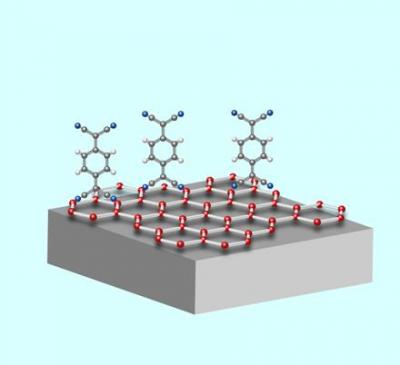 |
| Dopant chemicals adhere to a graphene sheet, modifying its properties for the development of ultra small and fast electronic devices. Credit: American Physical Society |
Abstract:
New graphene-based electronics could take a page out of the silicon electronics book
Doping graphene
Posted on June 2nd, 2010An organic molecule that has been found to be effective in making silicon-based electronics may be viable for building electronics on sheets of carbon only a single molecule thick. Researchers at the Max Plank Institute for Metals Research in Stuttgart report the advance in a paper appearing online in the journal Physical Review B on June 1.
Ultrathin carbon layers known as graphene show promise as the basis for a host of extremely small and efficient electronic devices. But in order to create a useful component, the electronic properties of materials like silicon or graphene must be tailored through a doping process. Typically, silicon-based devices are doped by replacing some of the atoms in a silicon crystal with various dopant atoms or molecules . In graphene, on the other hand, dopants are generally deposited on top of the carbon sheet rather than taking the place of some of the carbon atoms. Materials such as gold, bismuth and nitrogen dioxide have been used to dope graphene with varying degrees of success. Now, Max Planck Institute researchers have found that the compound F4-TCNQ (tetrafluoro-tetracyanoquinodimethane), which has been proven effective for producing LEDs in silicon, seems to fit the bill for graphene as well. F4-TCNQ forms stable layers on graphene that are fairly robust under exposure to elevated levels of heat and light, and can control graphene electrical properties in ways that suggest it may be a good dopant choice.
In a Viewpoint article in the current issue of APS Physics (physics.aps.org), Alexei Fedorov of the Lawrence Berkeley National Laboratory describes the challenges of creating electronic devices built of graphene and recent attempts to identify doping materials to do the job.
####
About American Physical Society
APS Physics publishes expert written commentaries and highlights of papers appearing in the journals of the American Physical Society.
For more information, please click here
Contacts:
James Riordon
301-209-3238
Copyright © Eurekalert
If you have a comment, please Contact us.Issuers of news releases, not 7th Wave, Inc. or Nanotechnology Now, are solely responsible for the accuracy of the content.
Bookmark:


| Related News Press |
News and information
 Simulating magnetization in a Heisenberg quantum spin chain April 5th, 2024
NRL charters Navy’s quantum inertial navigation path to reduce drift April 5th, 2024
Discovery points path to flash-like memory for storing qubits: Rice find could hasten development of nonvolatile quantum memory April 5th, 2024
Possible Futures
Discovery points path to flash-like memory for storing qubits: Rice find could hasten development of nonvolatile quantum memory April 5th, 2024
With VECSELs towards the quantum internet Fraunhofer: IAF achieves record output power with VECSEL for quantum frequency converters April 5th, 2024
Chip Technology
Discovery points path to flash-like memory for storing qubits: Rice find could hasten development of nonvolatile quantum memory April 5th, 2024
Utilizing palladium for addressing contact issues of buried oxide thin film transistors April 5th, 2024
HKUST researchers develop new integration technique for efficient coupling of III-V and silicon February 16th, 2024
Nanotubes/Buckyballs/Fullerenes/Nanorods/Nanostrings
Tests find no free-standing nanotubes released from tire tread wear September 8th, 2023
Detection of bacteria and viruses with fluorescent nanotubes July 21st, 2023
Nanoelectronics
Interdisciplinary: Rice team tackles the future of semiconductors Multiferroics could be the key to ultralow-energy computing October 6th, 2023
Key element for a scalable quantum computer: Physicists from Forschungszentrum Jülich and RWTH Aachen University demonstrate electron transport on a quantum chip September 23rd, 2022
Reduced power consumption in semiconductor devices September 23rd, 2022
Atomic level deposition to extend Moore’s law and beyond July 15th, 2022
Announcements
NRL charters Navy’s quantum inertial navigation path to reduce drift April 5th, 2024
Discovery points path to flash-like memory for storing qubits: Rice find could hasten development of nonvolatile quantum memory April 5th, 2024
 |
||
 |
||
| The latest news from around the world, FREE | ||
 |
||
|
|
||
| Premium Products | ||
 |
||
|
Only the news you want to read!
Learn More |
||
 |
||
|
Full-service, expert consulting
Learn More |
||
|
|
||