Home > Press > Crystallisation drives controlled assembly of nanoparticles
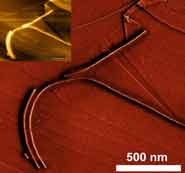 |
| Cylindrical nanostructures on a carbon surface |
Abstract:
A paper published in Nature Chemistry
Crystallisation drives controlled assembly of nanoparticles
Bristol, UK | Posted on May 31st, 2010Cylindrical structures such as fibres or filaments with nanoscale dimensions are rapidly attracting interest for use in a variety of potentially important applications - the controlled delivery of drugs to the body, for instance.
However, the ability to prepare samples where the dimensions are precisely controlled is very rare outside the biological domain. This represents a major drawback as there is a need to create cylindrical structures that vary in length.
A collaboration between researchers in two departments at the University of Bristol, England, and another group at the University of Toronto, Canada, has now led to the discovery of a new self-assembly method for controlling the dimensions of cylinders created from polymer precursors which contain two chemically different segments joined together, so the length of the cylinders can be precisely controlled.
The results are published online today in the prestigious journal Nature Chemistry.
Professor Ian Manners, a senior author on the paper, said: "The method relies on crystallisation as the driving force for the controlled assembly process. The work lays the conceptual groundwork for a broad variety of exciting developments - from the potential discovery of new phenomena to the creation of new nanoscopic devices, multifunctional catalysts, and controlled drug delivery vehicles."
The collaborative work was performed by postdoctoral research associates Dr. Joe Gilroy and Dr. Torben Gaedt, together with Dr. George Whittell and Dr Laurent Chabanne in the Ian Manners Group, and atomic force microscopy expert Dr John Mitchells, all in the School of Chemistry at Bristol, along with Professor Robert Richardson in the Department of Physics at Bristol, and collaborator Professor Mitchell Winnik in the Department of Chemistry at the University of Toronto.
####
For more information, please click here
Contacts:
Aliya Mughal
Copyright © University of Bristol
If you have a comment, please Contact us.Issuers of news releases, not 7th Wave, Inc. or Nanotechnology Now, are solely responsible for the accuracy of the content.
Bookmark:


| Related News Press |
News and information
 Simulating magnetization in a Heisenberg quantum spin chain April 5th, 2024
NRL charters Navy’s quantum inertial navigation path to reduce drift April 5th, 2024
Discovery points path to flash-like memory for storing qubits: Rice find could hasten development of nonvolatile quantum memory April 5th, 2024
Possible Futures
Discovery points path to flash-like memory for storing qubits: Rice find could hasten development of nonvolatile quantum memory April 5th, 2024
With VECSELs towards the quantum internet Fraunhofer: IAF achieves record output power with VECSEL for quantum frequency converters April 5th, 2024
Academic/Education
Rice University launches Rice Synthetic Biology Institute to improve lives January 12th, 2024
Multi-institution, $4.6 million NSF grant to fund nanotechnology training September 9th, 2022
Self Assembly
Liquid crystal templated chiral nanomaterials October 14th, 2022
Nanoclusters self-organize into centimeter-scale hierarchical assemblies April 22nd, 2022
Atom by atom: building precise smaller nanoparticles with templates March 4th, 2022
Nanostructures get complex with electron equivalents: Nanoparticles of two different sizes break away from symmetrical designs January 14th, 2022
Nanomedicine
New micromaterial releases nanoparticles that selectively destroy cancer cells April 5th, 2024
Good as gold - improving infectious disease testing with gold nanoparticles April 5th, 2024
Researchers develop artificial building blocks of life March 8th, 2024
Announcements
NRL charters Navy’s quantum inertial navigation path to reduce drift April 5th, 2024
Discovery points path to flash-like memory for storing qubits: Rice find could hasten development of nonvolatile quantum memory April 5th, 2024
 |
||
 |
||
| The latest news from around the world, FREE | ||
 |
||
|
|
||
| Premium Products | ||
 |
||
|
Only the news you want to read!
Learn More |
||
 |
||
|
Full-service, expert consulting
Learn More |
||
|
|
||