Home > Press > World record for shortest controllable time
 |
Abstract:
Lasers can now generate light pulses down to 100 attoseconds (1 attosecond = 10-18s = one billionth of the billionth of a second) thereby enabling real-time measurements on ultrashort time scales that are inaccessible by any other methods. Scientist at the Max Born Institute for Nonlinear Optics and Short Time Spectroscopy (MBI) in Berlin, Germany have now demonstrated timing control with a residual uncertainty of 12 attoseconds.
World record for shortest controllable time
Germany | Posted on May 20th, 2010This constitutes a new world record for the shortest controllable time scale. They reported about in Nature Photonics.
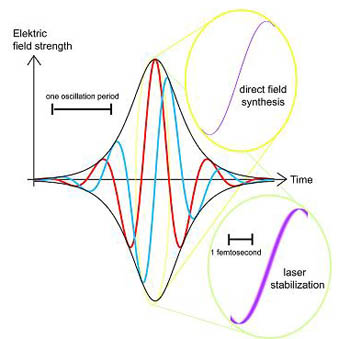
Light is an electromagnetic wave of very high frequency. In the visible domain, a single oscillation of the electric field only takes about 1200-2500 attoseconds. Consequently, an ultrashort laser pulse is comprised of a few of these oscillations. However, pulses from conventional short-pulse laser sources exhibit strong fluctuations of the positions of the field maximum relative to the pulse center. For maximum field strength, the center of the pulse has to coincide with a maximum of the electric field, as shown in Fig. 1 as a red curve. Consequently, methods have been developed to stabilize the position of the field maximum, i.e., the phase of the pulse.
Together with Vienna based laser manufacturer Femtolasers, MBI researchers in the group of Günter Steinmeyer have now developed a new method to control the phase of the pulse outside of the laser. In contrast to previous approaches, no manipulation inside the laser is necessary, which completely eliminates fluctuations of laser power and pulse duration and guarantees a strongly improved long-term stability. Correction of the pulse phase relies on a so-called acousto-optic frequency shifter, which is directly driven by the measured signal. Dr. Steinmeyer is convinced: "This direct correction of the phase dramatically simplifies many experiments in attosecond physics and frequency metrology."
Previously, stabilization of the position of the field maxima was only possible with a precision of about 100 attoseconds (10-16 s, corresponding to 1/20 of the wavelength), which is comparable to the shortest duration of attosecond pulses demonstrated so far. The new method allowed to push this limitation down to 12 attoseconds (1.2 x 10⁻¹⁷ s, 1/200 of the wavelength), which surpasses the atomic unit of time (24 attoseconds) by a factor of two. As the atomic unit of time marks the fastest possible time scale of processes in the outer shells of an atom, the new stabilization method will enable significant progress in the research on the fastest processes in nature.
This success strongly relied on a close collaboration with laser manufacturer Femtolasers who provided a specifically optimized laser for the joint experiment and is currently developing products based on this new method.
####
About Forschungsverbund Berlin e.V
The Forschungsverbund Berlin e.V (FVB) comprises eight research institutes in Berlin. The institutes are active in the fields of natural sciences, life sciences and environmental sciences. They pursue common interests within the framework of a single legal entity while preserving their scientific autonomy. As research institutes of national scientific importance, they are jointly funded by the German federal and state governments in accordance with Article 91b of the German Constitution. The institutes share an administrative infrastructure (Common Administration) and belong to the Leibniz Association (Leibniz-Gemeinschaft).
For more information, please click here
Contacts:
Dr. habil. Günter Steinmeyer
Tel +4930 63921440
Copyright © Forschungsverbund Berlin e.V
If you have a comment, please Contact us.Issuers of news releases, not 7th Wave, Inc. or Nanotechnology Now, are solely responsible for the accuracy of the content.
Bookmark:


| Related News Press |
News and information
 Simulating magnetization in a Heisenberg quantum spin chain April 5th, 2024
NRL charters Navy’s quantum inertial navigation path to reduce drift April 5th, 2024
Discovery points path to flash-like memory for storing qubits: Rice find could hasten development of nonvolatile quantum memory April 5th, 2024
Academic/Education
Rice University launches Rice Synthetic Biology Institute to improve lives January 12th, 2024
Multi-institution, $4.6 million NSF grant to fund nanotechnology training September 9th, 2022
Announcements
NRL charters Navy’s quantum inertial navigation path to reduce drift April 5th, 2024
Discovery points path to flash-like memory for storing qubits: Rice find could hasten development of nonvolatile quantum memory April 5th, 2024
Tools
Ferroelectrically modulate the Fermi level of graphene oxide to enhance SERS response November 3rd, 2023
The USTC realizes In situ electron paramagnetic resonance spectroscopy using single nanodiamond sensors November 3rd, 2023
Photonics/Optics/Lasers
With VECSELs towards the quantum internet Fraunhofer: IAF achieves record output power with VECSEL for quantum frequency converters April 5th, 2024
Nanoscale CL thermometry with lanthanide-doped heavy-metal oxide in TEM March 8th, 2024
Optically trapped quantum droplets of light can bind together to form macroscopic complexes March 8th, 2024
HKUST researchers develop new integration technique for efficient coupling of III-V and silicon February 16th, 2024
 |
||
 |
||
| The latest news from around the world, FREE | ||
 |
||
|
|
||
| Premium Products | ||
 |
||
|
Only the news you want to read!
Learn More |
||
 |
||
|
Full-service, expert consulting
Learn More |
||
|
|
||