Home > Press > Cotton Could Serve as Cleanup Medium for Oil Spill
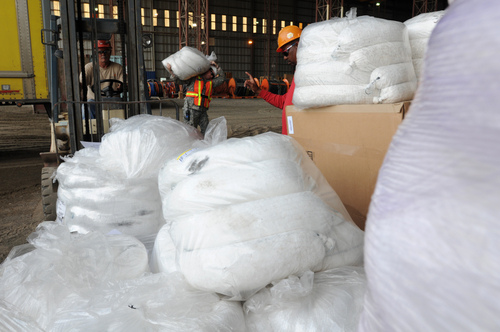 |
| Cotton could be a better absorbent than the oil-containment booms (pictured above) that are currently being used to absorb the oil spilling into the Gulf. Photo courtesy of Deepwater Horizon Response. |
Abstract:
Nonwoven cotton expert Seshadri Ramkumar believes raw cotton is a better material for oil absorbency
Cotton Could Serve as Cleanup Medium for Oil Spill
Lubbock, TX | Posted on May 18th, 2010The same Texas Tech-created nonwoven cotton technology that keeps soldiers safe from chemical and biological warfare agents may also serve as the perfect sponge for sopping up oil that has polluted the Gulf of Mexico.
As oil continues to gush from the exploded Deepwater Horizon oil rig, a Texas Tech expert in nonwoven cotton technology says the "fabric of our lives" may do a better job to absorb the oil spill than the booms made of synthetic material.
"Already, several million feet of the oil-containment booms have been used to capture the oil spilling into the Gulf," said Seshadri Ramkumar, associate professor of Nonwoven materials at The Institute of Environmental and Human Health (TIEHH). "They are made of synthetic materials, don't biodegrade and absorb only a third of what raw cotton can do. The properties of raw cotton allow it to soak up 40 times its weight. With chemical modifications, it can soak up to as much as 70 times its weight. And it won't just stay in a landfill forever."
Ramkumar's research focuses on developing value-added materials using nonwoven materials and nanotechnology. He supervises the Nonwoven and Advanced Materials Laboratory at TIEHH.
He is the creator of several nonwoven cotton technologies including FibertectTM, which is used in the U.S. military's decontamination kits. He and a small group of his graduate students are researching ways to use lower-quality cottons that don't make apparel grade for uses such as this.
"The nonwoven industry in the United States is well equipped with technologies that can develop oil-absorbent pads from natural fibers like cotton," Ramkumar said.
####
For more information, please click here
Contacts:
Office of Communications and Marketing
212 Administration Building,
PO Box 42022, Mailstop 2022
Lubbock, Texas 79409-2022
806.742.2136 phone
806.742.1615 fax
Copyright © Texas Tech University
If you have a comment, please Contact us.Issuers of news releases, not 7th Wave, Inc. or Nanotechnology Now, are solely responsible for the accuracy of the content.
Bookmark:


| Related News Press |
News and information
 Simulating magnetization in a Heisenberg quantum spin chain April 5th, 2024
NRL charters Navy’s quantum inertial navigation path to reduce drift April 5th, 2024
Discovery points path to flash-like memory for storing qubits: Rice find could hasten development of nonvolatile quantum memory April 5th, 2024
Announcements
NRL charters Navy’s quantum inertial navigation path to reduce drift April 5th, 2024
Discovery points path to flash-like memory for storing qubits: Rice find could hasten development of nonvolatile quantum memory April 5th, 2024
Environment
Billions of nanoplastics released when microwaving baby food containers: Exposure to plastic particles kills up to 75% of cultured kidney cells July 21st, 2023
 |
||
 |
||
| The latest news from around the world, FREE | ||
 |
||
|
|
||
| Premium Products | ||
 |
||
|
Only the news you want to read!
Learn More |
||
 |
||
|
Full-service, expert consulting
Learn More |
||
|
|
||