Home > Press > Argonne scientists reveal secret of nanoparticle crystallization in real time
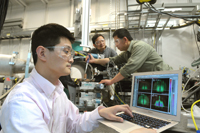 |
| Assistant physicist Zhang Jiang (from left) examines a X-ray diffraction as physicist Jin Wang and nanoscientist Xiao-Min Lin prepare a sample at one of the Advanced Photon Source’s beamlines. The Argonne scientists have examined nanoparticle crystallization in unprecedented detail using the high powered X-rays of the APS. |
Abstract:
A collaboration between the Advanced Photon Source and Center for Nanoscale Materials at U.S. Department of Energy's (DOE) Argonne National Laboratory has "seen" the crystallization of nanoparticles in unprecedented detail.
Argonne scientists reveal secret of nanoparticle crystallization in real time
Argonne, IL | Posted on May 15th, 2010"Nanoscience is a hot issue right now, and people are trying to create self-assembled nanoparticle arrays for data and memory storage," Argonne assistant physicist Zhang Jiang said. "In these devices, the degree of ordering is an important factor."
In order to call up a specific bit of data, it is ideal to store information on a two-dimensional crystal lattice with well-defined graphical coordinates. For example, every bit of information of a song saved on a hard drive must be stored at specific locations, so it can be retrieved later. However, in most cases, defects are inherent in nanoparticle crystal lattices.
"Defects in a lattice are like potholes on a road," Argonne physicist Jin Wang said. "When you're driving on the highway, you would like to know whether it is going to be a smooth ride or if you will have to zigzag in order to avoid a flat tire. Also, you want to know how the potholes form in the first place, so we can eliminate them."
Controlling the degree of ordering in nanoparticle arrays has been elusive. The number of nanoparticles a chemist can make in a small volume is astonishingly large.
"We can routinely produce 10>14 particles in a few droplets of solution. That is more than the number of stars in the Milky Way Galaxy," Argonne nanoscientist Xiao-Min Lin. "To find conditions under which nanoparticles can self-assemble into a crystal lattice with a low number of defects is quite challenging."
Because nanoparticles are so small, it is not easy to see how ordered the lattice is during the self-assembly process. Electron microscopy can see individual nanoparticles, but the field of view is too small for scientists to get a "big picture" of what the ordering is like in macroscopic length scale. It also doesn't work for wet solutions.
"With local ordering, one cannot assume the same order exists throughout the whole structure; it's like seeing a section of road and assuming it is straight and well constructed all the way to the end," Wang said.
The same group of researchers at Argonne, together with their collaborators at the University of Chicago, discovered that under the right conditions, nanoparticles can float at a liquid-air interface of a drying liquid droplet and become self-organized.
This allows the two-dimensional crystallization process to occur over a much longer time scale. "You typically don't expect metallic particles to float. It is like throwing stones into a pond and expecting them to float on the surface," Lin said. "But in the nanoworld, things behave differently."
Using high-resolution X-ray scattering at the Advanced Photon Source (APS), Jiang and the others examined the crystallization process in unprecedented detail as it forms in real time. They discovered that the nanoparticle arrays formed at the liquid-air interface can enter a regime of a highly crystalline phase defined in the classical two-dimensional crystal theory. Only when the solvent starts to dewet from the surface, do defects and disorder begin to appear.
"We can probe the entire macroscopic sample and monitor what's happening in real time," Jiang said. "This allows us to understand what parameters are important to control the self-assembly process."
With this level of understanding, the scientists hope that one day devices such as the iPod Nano can be made from nanoparticles.
A paper on this research was published in Nano Letters.
####
About Argonne National Laboratory
Argonne National Laboratory seeks solutions to pressing national problems in science and technology. The nation's first national laboratory, Argonne conducts leading-edge basic and applied scientific research in virtually every scientific discipline. Argonne researchers work closely with researchers from hundreds of companies, universities, and federal, state and municipal agencies to help them solve their specific problems, advance America 's scientific leadership and prepare the nation for a better future. With employees from more than 60 nations, Argonne is managed by UChicago Argonne, LLC for the U.S. Department of Energy's Office of Science.
The Advanced Photon Source at Argonne National Laboratory is one of four synchrotron radiation light sources supported by the U.S. Department of Energy’s Office of Science, Office of Basic Energy Sciences (BES). The APS is the source of the Western Hemisphere’s brightest x-ray beams for research in virtually every scientific discipline. More than 3,500 researchers representing universities, industry, and academic institutions from every U.S. state visit the APS each year to carry out both applied and basic research in support of the BES mission.
The Center for Nanoscale Materials at Argonne National Laboratory is one of the five DOE Nanoscale Science Research Centers (NSRCs), premier national user facilities for interdisciplinary research at the nanoscale, supported by the DOE Office of Science. Together the NSRCs comprise a suite of complementary facilities that provide researchers with state-of-the-art capabilities to fabricate, process, characterize and model nanoscale materials, and constitute the largest infrastructure investment of the National Nanotechnology Initiative. The NSRCs are located at DOE’s Argonne, Brookhaven, Lawrence Berkeley, Oak Ridge and Sandia and Los Alamos national laboratories.
For more information, please click here
Contacts:
Brock Cooper
630/252-5565
Copyright © Argonne National Laboratory
If you have a comment, please Contact us.Issuers of news releases, not 7th Wave, Inc. or Nanotechnology Now, are solely responsible for the accuracy of the content.
Bookmark:


| Related News Press |
News and information
 Simulating magnetization in a Heisenberg quantum spin chain April 5th, 2024
NRL charters Navy’s quantum inertial navigation path to reduce drift April 5th, 2024
Discovery points path to flash-like memory for storing qubits: Rice find could hasten development of nonvolatile quantum memory April 5th, 2024
Academic/Education
Rice University launches Rice Synthetic Biology Institute to improve lives January 12th, 2024
Multi-institution, $4.6 million NSF grant to fund nanotechnology training September 9th, 2022
Memory Technology
Utilizing palladium for addressing contact issues of buried oxide thin film transistors April 5th, 2024
Interdisciplinary: Rice team tackles the future of semiconductors Multiferroics could be the key to ultralow-energy computing October 6th, 2023
Researchers discover materials exhibiting huge magnetoresistance June 9th, 2023
Self Assembly
Liquid crystal templated chiral nanomaterials October 14th, 2022
Nanoclusters self-organize into centimeter-scale hierarchical assemblies April 22nd, 2022
Atom by atom: building precise smaller nanoparticles with templates March 4th, 2022
Nanostructures get complex with electron equivalents: Nanoparticles of two different sizes break away from symmetrical designs January 14th, 2022
Discoveries
Chemical reactions can scramble quantum information as well as black holes April 5th, 2024
New micromaterial releases nanoparticles that selectively destroy cancer cells April 5th, 2024
Utilizing palladium for addressing contact issues of buried oxide thin film transistors April 5th, 2024
Materials/Metamaterials/Magnetoresistance
Nanoscale CL thermometry with lanthanide-doped heavy-metal oxide in TEM March 8th, 2024
Focused ion beam technology: A single tool for a wide range of applications January 12th, 2024
Announcements
NRL charters Navy’s quantum inertial navigation path to reduce drift April 5th, 2024
Discovery points path to flash-like memory for storing qubits: Rice find could hasten development of nonvolatile quantum memory April 5th, 2024
Research partnerships
Discovery points path to flash-like memory for storing qubits: Rice find could hasten development of nonvolatile quantum memory April 5th, 2024
Researchers’ approach may protect quantum computers from attacks March 8th, 2024
'Sudden death' of quantum fluctuations defies current theories of superconductivity: Study challenges the conventional wisdom of superconducting quantum transitions January 12th, 2024
 |
||
 |
||
| The latest news from around the world, FREE | ||
 |
||
|
|
||
| Premium Products | ||
 |
||
|
Only the news you want to read!
Learn More |
||
 |
||
|
Full-service, expert consulting
Learn More |
||
|
|
||