Home > Press > Molecular Robots On the Rise
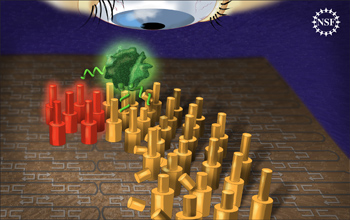 |
| Researchers have created and observed a molecular robot capable of many steps, and of making decisions where to step and how long to stay. As the robot walks on the substrate, it changes each piece by cleaving off a part. If it touches a spot that has been cleaved already, it does not linger as long. The end of the track glows red and captures the robot, letting the researchers know when it has completed its walk. The robot glows green, allowing for the researchers to see it better. Credit: Zina Deretsky, National Science Foundation |
Abstract:
Researchers announce new breakthrough in developing molecules that behave like robots
Molecular Robots On the Rise
Posted on May 13th, 2010Researchers from Columbia University, Arizona State University, the University of Michigan and the California Institute of Technology (Caltech) have created and programmed robots the size of single molecule that can move independently across a nano-scale track. This development, outlined in the May 13 edition of the journal Nature, marks an important advancement in the nascent fields of molecular computing and robotics, and could someday lead to molecular robots that can fix individual cells or assemble nanotechnology products.
The project was led by Milan N. Stojanovic, a faculty member in the division of experimental therapeutics at Columbia University, who partnered with Erik Winfree, associate professor of computer science at Caltech, Hao Yan, professor of chemistry and biochemistry at Arizona State University and an expert in DNA nanotechnology, and with Nils G. Walter, professor of chemistry and director of the Single Molecule Analysis in Real-Time (SMART) Center at the University of Michigan in Ann Arbor. Their work was supported in part by the National Science Foundation.
The word ‘robot' makes most people think of solid machines that use computer circuitry to perform defined jobs, such as vacuuming a carpet or welding together automobiles. In recent years, scientists have worked to create robots that could also reliably perform useful tasks, but at a molecular level. This is, needless to say, not a simple endeavor, and it involves reprogramming DNA molecules to perform in specific ways. "Can you instruct a biomolecule to move and function in a certain way--researchers at the interface of computer science, chemistry, biology and engineering are attempting to do just that," says Mitra Basu, a program director at NSF responsible for the agency's support to this research.
Recent molecular robotics work has produced so-called DNA walkers, or strings of reprogrammed DNA with 'legs' that enabled them to briefly walk. Now this research team has shown these molecular robotic spiders can in fact move autonomously through a specially-created, two-dimensional landscape. The spiders acted in rudimentary robotic ways, showing they are capable of starting motion, walking for awhile, turning, and stopping.
In addition to be incredibly small--about 4 nanometers in diameter--the walkers are also move slowly, covering 100 nanometers in times ranging 30 minutes to a full hour by taking approximately 100 steps. This is a significant improvement over previous DNA walkers that were capable of only about three steps.
While the field of molecular robotics is still emerging, it is possible that these tiny creations may someday have important medical applications. "This work one day may lead to effective control of chronic diseases such as diabetes or cancer," Basu says.
According to Stojanovich, these practical applications are still many years off, but he and his colleagues hope to continue their work in to the foundations of this young field. Stojanovich believes that their future work will also require extensive collaborations, with each of them bringing a specific expertise to the table, as was the case in the research published today. "If you take anyone of us with our disciplinary expertise out of this," Stojanovic said in an interview "this paper would have collapsed and never be what it is now."
View a video interview with Milan Stojanovich of Columbia University at
www.nsf.gov/news/news_videos.jsp?org=NSF&cntn_id=116957&media_id=66849
####
For more information, please click here
Contacts:
Media Contacts
Dana W. Cruikshank
NSF
(703) 292-7738
Kathy Svitil
Caltech
(626) 395-8022
Alex Lyda
Columbia Unviersity
(212) 305-0820
Nancy Ross-Flanigan
University of Michigan
(734) 647-1853
Joe Caspermeyer
Arizona State University
(480) 965-8383
Copyright © National Science Foundation
If you have a comment, please Contact us.Issuers of news releases, not 7th Wave, Inc. or Nanotechnology Now, are solely responsible for the accuracy of the content.
Bookmark:


| Related News Press |
News and information
 Simulating magnetization in a Heisenberg quantum spin chain April 5th, 2024
NRL charters Navy’s quantum inertial navigation path to reduce drift April 5th, 2024
Discovery points path to flash-like memory for storing qubits: Rice find could hasten development of nonvolatile quantum memory April 5th, 2024
Videos/Movies
New X-ray imaging technique to study the transient phases of quantum materials December 29th, 2022
Solvent study solves solar cell durability puzzle: Rice-led project could make perovskite cells ready for prime time September 23rd, 2022
Scientists prepare for the world’s smallest race: Nanocar Race II March 18th, 2022
Visualizing the invisible: New fluorescent DNA label reveals nanoscopic cancer features March 4th, 2022
Govt.-Legislation/Regulation/Funding/Policy
NRL charters Navy’s quantum inertial navigation path to reduce drift April 5th, 2024
Discovery points path to flash-like memory for storing qubits: Rice find could hasten development of nonvolatile quantum memory April 5th, 2024
Chemical reactions can scramble quantum information as well as black holes April 5th, 2024
Possible Futures
Discovery points path to flash-like memory for storing qubits: Rice find could hasten development of nonvolatile quantum memory April 5th, 2024
With VECSELs towards the quantum internet Fraunhofer: IAF achieves record output power with VECSEL for quantum frequency converters April 5th, 2024
Academic/Education
Rice University launches Rice Synthetic Biology Institute to improve lives January 12th, 2024
Multi-institution, $4.6 million NSF grant to fund nanotechnology training September 9th, 2022
Molecular Machines
First electric nanomotor made from DNA material: Synthetic rotary motors at the nanoscale perform mechanical work July 22nd, 2022
Nanotech scientists create world's smallest origami bird March 17th, 2021
Giant nanomachine aids the immune system: Theoretical chemistry August 28th, 2020
Nanomedicine
New micromaterial releases nanoparticles that selectively destroy cancer cells April 5th, 2024
Good as gold - improving infectious disease testing with gold nanoparticles April 5th, 2024
Researchers develop artificial building blocks of life March 8th, 2024
Announcements
NRL charters Navy’s quantum inertial navigation path to reduce drift April 5th, 2024
Discovery points path to flash-like memory for storing qubits: Rice find could hasten development of nonvolatile quantum memory April 5th, 2024
Nanobiotechnology
New micromaterial releases nanoparticles that selectively destroy cancer cells April 5th, 2024
Good as gold - improving infectious disease testing with gold nanoparticles April 5th, 2024
Researchers develop artificial building blocks of life March 8th, 2024
Research partnerships
Discovery points path to flash-like memory for storing qubits: Rice find could hasten development of nonvolatile quantum memory April 5th, 2024
Researchers’ approach may protect quantum computers from attacks March 8th, 2024
'Sudden death' of quantum fluctuations defies current theories of superconductivity: Study challenges the conventional wisdom of superconducting quantum transitions January 12th, 2024
 |
||
 |
||
| The latest news from around the world, FREE | ||
 |
||
|
|
||
| Premium Products | ||
 |
||
|
Only the news you want to read!
Learn More |
||
 |
||
|
Full-service, expert consulting
Learn More |
||
|
|
||