Home > Press > What do we know about nano?
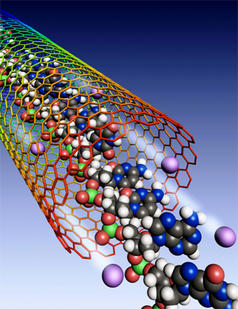 |
| DNA threads through a carbon nanotube. Enlarged to this scale, the nanotube would extend about the length of a football field. |
Abstract:
Nanotechnology involves manipulating the unimaginably small. A nanometer is about 5 carbon atoms in a row, or the distance your fingernail grows in one second. Matter behaves fundamentally differently at that scale, opening up new possibilities for products and processes. Nanotech is a vast emerging field of research, full of possibilities, and the media and the public are starting to take notice.
By Kirsten Keane
What do we know about nano?
Phoenix, AZ | Posted on May 8th, 2010"One promise of nanotech is the idea of building molecule-sized machines to haul atoms. You could ‘grow' anything you wanted. You could grow a house. Or a t-bone steak," said ASU law professor Joel Garreau at a science café, "Facts or Hype: What is the Media Telling Us about Nano & Other New Technologies?" at the Arizona Science Center on March 19.
Today, nanotechnology brings us self-cleaning windows and stain-resistant pants. These products are useful, but not exactly revolutionary. It's the promise of nanotechnology that's intriguing.
"The world could be transformed so abruptly as to be unrecognizable," Garreau said.
ASU is becoming a leader in nanotechnology research, both in science and engineering as well as matters of policy. In 2009, ASU biophysicist Stuart Lindsay published the first comprehensive textbook for the field, Introduction to Nanoscience. Although new, it is starting to be used widely.
A nano case study
Lindsay uses nanotechnology in his lab to help improve DNA sequencing techniques. One of the current challenges in DNA sequencing is to take the process from something that costs tens of thousands of dollars and takes weeks or months to develop to something that could be done on a computer chip in minutes or hours for just a few dollars.
"We want to make human health better, that's why we're doing it," says Lindsay.
The primary goal of Lindsay's research is to find a new way to read the DNA base proteins: A, T, C, and G. His team is exploring a method called electron tunneling, which Lindsay calls an "exotic piece of quantum mechanics." Electron tunneling involves passing DNA between two electrodes that can detect the chemical makeup of each individual base.
Another important piece of technology is the nanopore, which directs the DNA between the electrodes. Lindsay says the nanopore threads DNA "like a piece of cotton through a needle." Nanopores were once made by assembling natural proteins, which form holes in cell walls, or by taking an electron microscope beam and drilling a tiny hole in a piece of silicone. Both of these processes are difficult to do, and there is a problem of reliably printing electrode pairs very close to DNA.
Lindsay's team showed that a single carbon nanotube, two nanometers in diameter and centimeters long, can grow easily on a silicon wafer using conventional science methods. "You don't need exotic techniques," he says.
The DNA will then slither through the inside of the carbon nanotube. This phenomenon was highly unexpected. "The referees at Science didn't believe it the first time we submitted the paper, so we had to do a lot more to convince them," Lindsay says, laughing. The paper appeared in Science in January 2010.
The team still has work to do before they've got a working device and a company producing it, but Lindsay says, "We've shown the feasibility of this approach to DNA sequencing. A few years ago most people would have said this was science fiction."
He adds, "It's a shame because the truth about science is that most funding supports incremental advances, because the community will accept that they can do them. This means that the big breakthroughs are very difficult to support. It's really worth risky funding for some important goals because people will achieve them. If you get teams of bright people collaborating on a focused goal, you really can work miracles."
On the horizon
Part of the problem may be that the public can't tease out which projects are "possible but distant" and which are "next year's hot product." The mass media isn't always clear about how feasible, and imminent, promising new technologies are. Developing technologies and then testing them for effectiveness, safety and cost can take a long time. But the public can become wary of supporting research when overly hyped "breakthroughs" don't show up in the marketplace quickly.
At the science café, Garreau spoke about "The Seven Horizons: Timelines and Roadmaps for Emerging Technologies for the Next Twenty Years," a web site developed to assess emerging technologies. He said the timeline is helpful for addressing questions like, "How seriously should we take this? How much time have we got? Is this possibility something that could happen tomorrow with certainty, or something that might be possible many decades in the future?"
Technologies within the First Horizon are "available, but not ubiquitous," such as anti-microbial socks that eliminate odor with the help of nanomaterials. The other horizons include "commercial," "engineering," "scientific," "informed speculation," "blue sky" and finally the Seventh Horizon, "questionable," which includes science that doesn't seem possible within even the next 20 years.
Lindsay's research might currently fall under the Fourth Horizon, "scientific," meaning there is evidence that the technology is possible, but not much research has been done on how to make the process safe and economical in the marketplace. Technologies in this category, according to the Seven Horizons Web site, are "typically 4-10 years to reaching the public if everything goes right."
The Seven Horizons was developed by the Consortium for Emerging Technologies, Military Operations and National Security (CETMONS) in association with ASU's Sandra Day O'Connor College of Law, the Lincoln Center for Applied Ethics, and the Prevail Project: Wise Governance for Challenging Futures.
"Nanotech today barely exists," Garreau said at the science café. "Almost anything you can say today about nanotechnology is speculation."
Speculation or on the horizon, who is aware of these advances? Who will benefit from them? As the novelist William Gibson said, "The future is already here; it's just not evenly distributed."
Nanotechnology and society
One important issue facing nanotech today is the development of regulation in the face of scientific uncertainty about the technology. Elizabeth Corley, a professor in ASU's School of Public Affairs, studies the policy implications of nanotechnology.
"When we think about a field like nanotechnology, the science moves forward so quickly that the discussion of the social, ethical, and policy impacts often falls behind," says Corley, who is a co-principal investigator at the Center for Nanotechnology in Society at ASU (CNS-ASU).
"One of the goals of the CNS-ASU is to make sure that as a scientific community we engage in a discussion about the social and policy implications of nanotechnology research at the same time that the science is moving forward."
Corley received three engineering degrees before pursuing her doctoral studies in public policy. Her current research explores public perceptions about the risks and benefits of nanotechnology, as well as how the leading U.S. nanoscientists think about the role of risks and benefits in the development of nanotechnology regulation.
"Our recent research shows that nanotech is one of the first emerging technologies where we've seen the scientists more concerned than the public about certain risks," she says. The biggest difference in level of concern was related to human health and the environment.
Nanotech right now has a fragmented and almost nonexistent policy framework. For example, the FDA regulates some nanotechnology based on a product-by-product model, while the EPA regulates nanotechnology largely through the Toxic Substances Control Act (TSCA). These are very different models and some nanotechnology products are not covered under any existing regulations.
"The public often thinks differently about nanotechnology that is used to produce a life-saving device in the medical field than when using it for new surveillance practices and techniques," Corley says. "This means it is increasingly important to study the public's perceptions about particular application areas for nanotechnology, like the environment, the medical field, and national defense."
Another issue to explore, Corley says, is how we make policy about an emerging technology when we don't yet know all the risks.
Corley and her team have also tracked the public's knowledge about nanotechnology over time, particularly comparing survey data from 2004 and 2007. Surprisingly, when looked at as a whole, public knowledge levels about nanotechnology haven't changed much between 2004 and 2007 despite numerous outreach efforts. However, in a study published in The Scientist in January 2010, Corley and her team decided to take a closer look at different segments of the public. They found that there is a widening nanotech knowledge gap among members of the public with the least and most formal education levels.
From this research, Corley asks the question, "What sort of outreach efforts would more effectively reach those segments of the public with lower formal education levels?" Her results provide one possible answer to this question because the study showed that the Internet could serve as a "leveler" of these knowledge gaps.
"Does it really matter if the public understands science and technology?" asked Joe Kullman, media relations officer for ASU's Ira A. Fulton Schools of Engineering at the science café. His answer was an unequivocal, "Yes!"
"A lot of what happens, happens—or doesn't happen—because of politics," Kullman added. "People's perceptions inform policy. Politicians listen to what people think, regardless of whether what they think is accurate or not. If we make policy decisions based on misinformed perceptions, we will make some big mistakes."
Lindsay's research is funded by the DNA Sequencing Technology Program of the National Human Genome Research Institute at the National Institutes of Health. Corley's research is funded through the Center for Nanotechnology in Society at ASU, which is funded by the National Science Foundation.
Joel Garreau is the Lincoln Professor of Law, Culture and Values in the Sandra Day O'Connor College of Law. Elizabeth Corley is the Lincoln Professor of Public Policy, Ethics and Emerging Technologies in the School of Public Programs. Stuart Lindsay is a Regents' Professor in the Department of Physics and the Department of Chemistry and Biochemistry.
####
For more information, please click here
Copyright © Arizona State University
If you have a comment, please Contact us.Issuers of news releases, not 7th Wave, Inc. or Nanotechnology Now, are solely responsible for the accuracy of the content.
Bookmark:


| Related News Press |
News and information
 Simulating magnetization in a Heisenberg quantum spin chain April 5th, 2024
NRL charters Navy’s quantum inertial navigation path to reduce drift April 5th, 2024
Discovery points path to flash-like memory for storing qubits: Rice find could hasten development of nonvolatile quantum memory April 5th, 2024
Ethics
Artificial Intelligence Centered Cancer Nanomedicine: Diagnostics, Therapeutics and Bioethics June 3rd, 2022
Iran to hold intl. school on application of nanomaterials in medicine September 20th, 2016
Synthetic biology needs robust safety mechanisms before real world application: Ethics and technology hold the key to the success of synthetic biology September 17th, 2015
March 2016; 6th Int'l Conference on Nanostructures in Iran July 29th, 2015
Products
Spectradyne Partners with Particle Technology Labs for Measurement Services December 6th, 2018
Mode-Changing MEMS Accelerometer from STMicroelectronics Combines High Measurement Resolution and Ultra-Low Power for Industrial Applications November 7th, 2018
Fat-Repellent Nanolayers Can Make Oven Cleaning Easier October 17th, 2018
Aculon, Inc. Enters into Strategic Partnership Agreement with Henkel Corporation to Supply Key Mobile Device Manufacturers with NanoProof® PCB Waterproof Technology October 17th, 2018
Govt.-Legislation/Regulation/Funding/Policy
NRL charters Navy’s quantum inertial navigation path to reduce drift April 5th, 2024
Discovery points path to flash-like memory for storing qubits: Rice find could hasten development of nonvolatile quantum memory April 5th, 2024
Chemical reactions can scramble quantum information as well as black holes April 5th, 2024
Possible Futures
Discovery points path to flash-like memory for storing qubits: Rice find could hasten development of nonvolatile quantum memory April 5th, 2024
With VECSELs towards the quantum internet Fraunhofer: IAF achieves record output power with VECSEL for quantum frequency converters April 5th, 2024
Academic/Education
Rice University launches Rice Synthetic Biology Institute to improve lives January 12th, 2024
Multi-institution, $4.6 million NSF grant to fund nanotechnology training September 9th, 2022
Molecular Machines
First electric nanomotor made from DNA material: Synthetic rotary motors at the nanoscale perform mechanical work July 22nd, 2022
Nanotech scientists create world's smallest origami bird March 17th, 2021
Giant nanomachine aids the immune system: Theoretical chemistry August 28th, 2020
Molecular Nanotechnology
Scientists push the boundaries of manipulating light at the submicroscopic level March 3rd, 2023
First electric nanomotor made from DNA material: Synthetic rotary motors at the nanoscale perform mechanical work July 22nd, 2022
Nanotech scientists create world's smallest origami bird March 17th, 2021
Nanotubes/Buckyballs/Fullerenes/Nanorods/Nanostrings
Tests find no free-standing nanotubes released from tire tread wear September 8th, 2023
Detection of bacteria and viruses with fluorescent nanotubes July 21st, 2023
Nanomedicine
New micromaterial releases nanoparticles that selectively destroy cancer cells April 5th, 2024
Good as gold - improving infectious disease testing with gold nanoparticles April 5th, 2024
Researchers develop artificial building blocks of life March 8th, 2024
Environment
Billions of nanoplastics released when microwaving baby food containers: Exposure to plastic particles kills up to 75% of cultured kidney cells July 21st, 2023
Safety-Nanoparticles/Risk management
Tests find no free-standing nanotubes released from tire tread wear September 8th, 2023
Billions of nanoplastics released when microwaving baby food containers: Exposure to plastic particles kills up to 75% of cultured kidney cells July 21st, 2023
Nanobiotechnology
New micromaterial releases nanoparticles that selectively destroy cancer cells April 5th, 2024
Good as gold - improving infectious disease testing with gold nanoparticles April 5th, 2024
Researchers develop artificial building blocks of life March 8th, 2024
 |
||
 |
||
| The latest news from around the world, FREE | ||
 |
||
|
|
||
| Premium Products | ||
 |
||
|
Only the news you want to read!
Learn More |
||
 |
||
|
Full-service, expert consulting
Learn More |
||
|
|
||