Home > Press > Inexpensive metal generates hydrogen from water
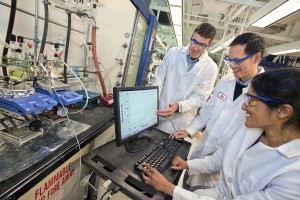 |
| From left, Jeffrey Long, Christopher Chang and Hemamala Karunadasa have discovered an inexpensive metal that can generate hydrogen from neutral water, even if it is dirty, and can operate in sea water. (Photo by Roy Kaltschmidt, Berkeley Lab Public Affairs) |
Abstract:
Berkeley Scientists Discover Inexpensive Metal Catalyst for Generating Hydrogen from Water
Inexpensive metal generates hydrogen from water
Berkeley, CA | Posted on May 1st, 2010Hydrogen would command a key role in future renewable energy technologies, experts agree, if a relatively cheap, efficient and carbon-neutral means of producing it can be developed. An important step towards this elusive goal has been taken by a team of researchers with the U.S. Department of Energy's (DOE) Lawrence Berkeley National Laboratory (Berkeley Lab) and the University of California, Berkeley. The team has discovered an inexpensive metal catalyst that can effectively generate hydrogen gas from water.
"Our new proton reduction catalyst is based on a molybdenum-oxo metal complex that is about 70 times cheaper than platinum, today's most widely used metal catalyst for splitting the water molecule," said Hemamala Karunadasa, one of the co-discoverers of this complex. "In addition, our catalyst does not require organic additives, and can operate in neutral water, even if it is dirty, and can operate in sea water, the most abundant source of hydrogen on earth and a natural electrolyte. These qualities make our catalyst ideal for renewable energy and sustainable chemistry."
Karunadasa holds joint appointments with Berkeley Lab's Chemical Sciences Division and UC Berkeley's Chemistry Department. She is the lead author of a paper describing this work that appears in the April 29, 2010 issue of the journal Nature, titled "A molecular molybdenum-oxo catalyst for generating hydrogen from water." Co-authors of this paper were Christopher Chang and Jeffrey Long, who also hold joint appointments with Berkeley Lab and UC Berkeley. Chang, in addition, is also an investigator with the Howard Hughes Medical Institute (HHMI).
Hydrogen gas, whether combusted or used in fuel cells to generate electricity, emits only water vapor as an exhaust product, which is why this nation would already be rolling towards a hydrogen economy if only there were hydrogen wells to tap. However, hydrogen gas does not occur naturally and has to be produced. Most of the hydrogen gas in the United States today comes from natural gas, a fossil fuel. While inexpensive, this technique adds huge volumes of carbon emissions to the atmosphere. Hydrogen can also be produced through the electrolysis of water - using electricity to split molecules of water into molecules of hydrogen and oxygen. This is an environmentally clean and sustainable method of production - especially if the electricity is generated via a renewable technology such as solar or wind - but requires a water-splitting catalyst.
Nature has developed extremely efficient water-splitting enzymes - called hydrogenases - for use by plants during photosynthesis, however, these enzymes are highly unstable and easily deactivated when removed from their native environment. Human activities demand a stable metal catalyst that can operate under non-biological settings.
Metal catalysts are commercially available, but they are low valence precious metals whose high costs make their widespread use prohibitive. For example, platinum, the best of them, costs some $2,000 an ounce.
"The basic scientific challenge has been to create earth-abundant molecular systems that produce hydrogen from water with high catalytic activity and stability," Chang says. "We believe our discovery of a molecular molybdenum-oxo catalyst for generating hydrogen from water without the use of additional acids or organic co-solvents establishes a new chemical paradigm for creating reduction catalysts that are highly active and robust in aqueous media."
The molybdenum-oxo complex that Karunadasa, Chang and Long discovered is a high valence metal with the chemical name of (PY5Me2)Mo-oxo. In their studies, the research team found that this complex catalyzes the generation of hydrogen from neutral buffered water or even sea water with a turnover frequency of 2.4 moles of hydrogen per mole of catalyst per second.
Long says, "This metal-oxo complex represents a distinct molecular motif for reduction catalysis that has high activity and stability in water. We are now focused on modifying the PY5Me ligand portion of the complex and investigating other metal complexes based on similar ligand platforms to further facilitate electrical charge-driven as well as light-driven catalytic processes. Our particular emphasis is on chemistry relevant to sustainable energy cycles."
This research was supported in part by the DOE Office of Science through Berkeley Lab's Helios Solar Energy Research Center, and in part by a grant from the National science Foundation.
Additional Information
More about the research of Christopher Chang at www.cchem.berkeley.edu/cjcgrp/
More about the research of Jeffrey Long at alchemy.cchem.berkeley.edu/
####
About Berkeley Lab
Berkeley Lab is a U.S. Department of Energy national laboratory located in Berkeley, California. It conducts unclassified scientific research and is managed by the University of California.
For more information, please click here
Contacts:
Mr. Lynn Yarris
Senior science writer
Lawrence Berkeley National Laboratory
Joint BioEnergy Institute
phone: 510-486-5375
Copyright © Berkeley Lab
If you have a comment, please Contact us.Issuers of news releases, not 7th Wave, Inc. or Nanotechnology Now, are solely responsible for the accuracy of the content.
Bookmark:


| Related News Press |
News and information
 Simulating magnetization in a Heisenberg quantum spin chain April 5th, 2024
NRL charters Navy’s quantum inertial navigation path to reduce drift April 5th, 2024
Discovery points path to flash-like memory for storing qubits: Rice find could hasten development of nonvolatile quantum memory April 5th, 2024
Chemistry
What heat can tell us about battery chemistry: using the Peltier effect to study lithium-ion cells March 8th, 2024
Nanoscale CL thermometry with lanthanide-doped heavy-metal oxide in TEM March 8th, 2024
Govt.-Legislation/Regulation/Funding/Policy
NRL charters Navy’s quantum inertial navigation path to reduce drift April 5th, 2024
Discovery points path to flash-like memory for storing qubits: Rice find could hasten development of nonvolatile quantum memory April 5th, 2024
Chemical reactions can scramble quantum information as well as black holes April 5th, 2024
Possible Futures
Discovery points path to flash-like memory for storing qubits: Rice find could hasten development of nonvolatile quantum memory April 5th, 2024
With VECSELs towards the quantum internet Fraunhofer: IAF achieves record output power with VECSEL for quantum frequency converters April 5th, 2024
Materials/Metamaterials/Magnetoresistance
Nanoscale CL thermometry with lanthanide-doped heavy-metal oxide in TEM March 8th, 2024
Focused ion beam technology: A single tool for a wide range of applications January 12th, 2024
Announcements
NRL charters Navy’s quantum inertial navigation path to reduce drift April 5th, 2024
Discovery points path to flash-like memory for storing qubits: Rice find could hasten development of nonvolatile quantum memory April 5th, 2024
Environment
Billions of nanoplastics released when microwaving baby food containers: Exposure to plastic particles kills up to 75% of cultured kidney cells July 21st, 2023
Energy
Development of zinc oxide nanopagoda array photoelectrode: photoelectrochemical water-splitting hydrogen production January 12th, 2024
Shedding light on unique conduction mechanisms in a new type of perovskite oxide November 17th, 2023
Inverted perovskite solar cell breaks 25% efficiency record: Researchers improve cell efficiency using a combination of molecules to address different November 17th, 2023
The efficient perovskite cells with a structured anti-reflective layer – another step towards commercialization on a wider scale October 6th, 2023
Automotive/Transportation
Researchers’ approach may protect quantum computers from attacks March 8th, 2024
Tests find no free-standing nanotubes released from tire tread wear September 8th, 2023
 |
||
 |
||
| The latest news from around the world, FREE | ||
 |
||
|
|
||
| Premium Products | ||
 |
||
|
Only the news you want to read!
Learn More |
||
 |
||
|
Full-service, expert consulting
Learn More |
||
|
|
||