Home > Press > Fuel Cells Get Up to Speed with a New Kind of Platinum
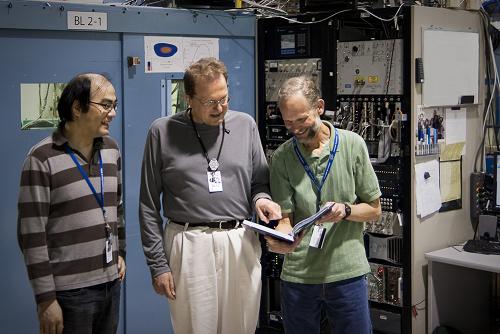 |
| Researchers including Hirohito Ogasawara (left), Anders Nilsson (center), and Mike Toney (right) used SSRL's bright X-ray beam to study a new form of platinum that could be used to make cheaper, more efficient fuel cells. (Photo courtesy Kelen Tuttle) |
Abstract:
A new form of platinum that could be used to make cheaper, more efficient fuel cells has been created by researchers at the Department of Energy's SLAC National Accelerator Laboratory and the University of Houston. The process, described in the April 25th issue of Nature Chemistry, could help enable broader use of the devices, which produce emissions-free energy using hydrogen.
Fuel Cells Get Up to Speed with a New Kind of Platinum
Menlo Park | Posted on April 28th, 2010"This is a significant advance," said scientist Anders Nilsson, who conducts research at the Stanford Institute for Materials and Energy Sciences, a joint institute between SLAC and Stanford University. "Fuel cells were invented more than 100 years ago. They haven't made a leap over to being a big technology yet, in part because of this difficulty with platinum."
Fuel cells hold significant promise for clean energy because the cell's only byproduct is water. But current fuel cell designs can require as much as 100 grams of platinum, pushing their price tags into the thousands of dollars. By tweaking platinum's reactivity, the researchers were able to curtail the amount of platinum required by 80 percent, and hope to soon reduce it by another 10 percent, greatly trimming away at the overall cost.
"I think with a factor of ten, we'll have a home run," Nilsson added.
Fuel cells work much like batteries—an anode provides electrons and a cathode collects them on the other end of an electrical circuit. But unlike batteries, fuel cells use hydrogen and oxygen to drive their energy-producing reactions; when oxygen enters the metal cathode, it is broken down into individual atoms before it forms water with hydrogen.
The choice of metal for the cathode is extremely important, as some metals cannot break apart the oxygen atoms while others try to bind too strongly to the oxygen atoms, taking them away from the key reaction. Scientists seek the perfect "balance point," where the number of oxygen bonds broken is maximized and the oxygen atoms bind more weakly to the catalyst. They achieved the balance with platinum, which is strong enough to break the oxygen bonds but does not bind to the free oxygen atoms too strongly. Unfortunately, it also costs enough to make platinum-electrode fuel cells untenably expensive.
In 2005, University of Houston researcher Peter Strasser started looking for ways to crack the platinum problem not by replacing platinum outright, as other researchers sought to do, but by making platinum more reactive.
To do this, Strasser and colleagues used a process called dealloying. First, they combined platinum with varying amounts of copper to create a copper-platinum alloy. Then they removed the copper from the surface region of the alloy. When they tested the binding properties of the dealloyed platinum-copper catalyst, they found it was much more reactive than it would be otherwise.
To find out why, Strasser, Nilsson and colleagues Mike Toney and Hirohito Ogasawara put dealloyed samples under the extremely bright X-ray beam at the Stanford Synchrotron Radiation Lightsource. By studying how X-rays scattered from the dealloyed samples, they were able to create detailed pictures of the metal's internal structure, revealing that the increased reactivity was caused by lattice strain—a phenomenon in which the arrangement of platinum atoms is modified. By compressing the surface platinum atoms closer together, the process causes platinum atoms to bind a little more weakly to oxygen atoms and inch closer to that magical balance point between molecule dissociation and catalytic binding.
"The distance between two neighboring atoms affects their electronic structure," Strasser said. "By changing the interatomic distance, we can manipulate how strongly they form bonds."
The next step for the researchers will be to use the SSRL beam to get a closer look at the reactions between oxygen and platinum, and to determine what can be done to make the process even more efficient. The ultimate goal is to create a potential replacement not only for gasoline engines but also for the batteries found in small electronic devices.
The majority of this research is supported by the U.S. Department of Energy Office of Science through its programs at the Stanford Synchrotron Radiation Lightsource and the Stanford Institute for Materials and Energy Sciences at SLAC National Accelerator Laboratory and Stanford University. Collaborating institutions also include Argonne National Laboratory, Oak Ridge National Laboratory, Technical University Berlin and the University of Houston.
####
About SLAC National Accelerator Laboratory
SLAC is a multi-program laboratory exploring frontier questions in photon science, astrophysics, particle physics and accelerator research. Located in Menlo Park, California, SLAC is operated by Stanford University for the U.S. Department of Energy Office of Science. The Stanford Synchrotron Radiation Lightsource at SLAC is a national user facility which provides synchrotron radiation for research in chemistry, biology, physics and materials science to over two thousand users each year.
For more information, please click here
Contacts:
Melinda Lee
SLAC Media Manager
1 (650) 926-8547
Robert Brown
SLAC Director of Communications
1 (650) 926-8707
Copyright © SLAC National Accelerator Laboratory
If you have a comment, please Contact us.Issuers of news releases, not 7th Wave, Inc. or Nanotechnology Now, are solely responsible for the accuracy of the content.
Bookmark:


| Related News Press |
News and information
 Simulating magnetization in a Heisenberg quantum spin chain April 5th, 2024
NRL charters Navy’s quantum inertial navigation path to reduce drift April 5th, 2024
Discovery points path to flash-like memory for storing qubits: Rice find could hasten development of nonvolatile quantum memory April 5th, 2024
Govt.-Legislation/Regulation/Funding/Policy
NRL charters Navy’s quantum inertial navigation path to reduce drift April 5th, 2024
Discovery points path to flash-like memory for storing qubits: Rice find could hasten development of nonvolatile quantum memory April 5th, 2024
Chemical reactions can scramble quantum information as well as black holes April 5th, 2024
Possible Futures
Discovery points path to flash-like memory for storing qubits: Rice find could hasten development of nonvolatile quantum memory April 5th, 2024
With VECSELs towards the quantum internet Fraunhofer: IAF achieves record output power with VECSEL for quantum frequency converters April 5th, 2024
Academic/Education
Rice University launches Rice Synthetic Biology Institute to improve lives January 12th, 2024
Multi-institution, $4.6 million NSF grant to fund nanotechnology training September 9th, 2022
Materials/Metamaterials/Magnetoresistance
Nanoscale CL thermometry with lanthanide-doped heavy-metal oxide in TEM March 8th, 2024
Focused ion beam technology: A single tool for a wide range of applications January 12th, 2024
Announcements
NRL charters Navy’s quantum inertial navigation path to reduce drift April 5th, 2024
Discovery points path to flash-like memory for storing qubits: Rice find could hasten development of nonvolatile quantum memory April 5th, 2024
Energy
Development of zinc oxide nanopagoda array photoelectrode: photoelectrochemical water-splitting hydrogen production January 12th, 2024
Shedding light on unique conduction mechanisms in a new type of perovskite oxide November 17th, 2023
Inverted perovskite solar cell breaks 25% efficiency record: Researchers improve cell efficiency using a combination of molecules to address different November 17th, 2023
The efficient perovskite cells with a structured anti-reflective layer – another step towards commercialization on a wider scale October 6th, 2023
Fuel Cells
Current and Future Developments in Nanomaterials and Carbon Nanotubes: Applications of Nanomaterials in Energy Storage and Electronics October 28th, 2022
 |
||
 |
||
| The latest news from around the world, FREE | ||
 |
||
|
|
||
| Premium Products | ||
 |
||
|
Only the news you want to read!
Learn More |
||
 |
||
|
Full-service, expert consulting
Learn More |
||
|
|
||