Home > Press > Bizarre matter could find use in quantum computers
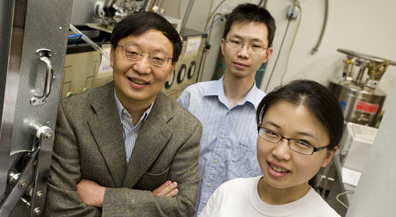 |
| From left, Rice University physicist Rui-Rui Du, graduate students Chi Zhang and Yanhua Dai, and former postdoctoral researcher Tauno Knuuttila (not pictured) have found that odd groupings of ultracold electrons could be useful in making fault-tolerant quantum computers. PHOTO CREDIT: Jeff Fitlow/Rice University |
Abstract:
Rice physicists: Odd electron mix has fault-tolerant quantum registry
Bizarre matter could find use in quantum computers
Houston, TX | Posted on April 22nd, 2010There are enticing new findings this week in the worldwide search for materials that support fault-tolerant quantum computing. New results from Rice University and Princeton University indicate that a bizarre state of matter that acts like a particle with one-quarter electron charge also has a "quantum registry" that is immune to information loss from external perturbations.
The research appeared online April 21 in Physical Review Letters. The team of physicists found that ultracold mixes of electrons caught in magnetic traps could have the necessary properties for constructing fault-tolerant quantum computers -- future computers that could be far more powerful than today's computers. The mixes of electrons are dubbed "5/2 quantum Hall liquids" in reference to the unusual quantum properties that describe their makeup.
"The big goal, the whole driving force, besides deep academic curiosity, is to build a quantum computer out of this," said the study's lead author Rui-Rui Du, professor of physics at Rice. "The key for that is whether these 5/2 liquids have 'topological' properties that would render them immune to the sorts of quantum perturbations that could cause information degradation in a quantum computer."
Du said the team's results indicate the 5/2 liquids have the desired properties. In the parlance of condensed-matter physics, they are said to represent a "non-Abelian" state of matter.
Non-Abelian is a mathematical term for a system with "noncommutative" properties. In math, commutative operations, like addition, are those that have the same outcome regardless of the order in which they are carried out. So, one plus two equals three, just as two plus one equals three. In daily life, commutative and noncommutative tasks are commonplace. For example, when doing the laundry, it doesn't matter if the detergent is added before the water or the water before the detergent, but it does matter if the clothes are washed before they're placed in the dryer.
"It will take a while to fully understand the complete implications of our results, but it is clear that we have nailed down the evidence for 'spin polarization,' which is one of the two necessary conditions that must be proved to show that the 5/2 liquids are non-Abelian," Du said. "Other research teams have been tackling the second condition, the one-quarter charge, in previous experiments."
The importance of the noncommutative quantum properties is best understood within the context of fault-tolerant quantum computers, a fundamentally new type of computer that hasn't been built yet.
Computers today are binary. Their electrical circuits, which can be open or closed, represent the ones and zeros in binary bits of information. In quantum computers, scientists hope to use "quantum bits," or qubits. Unlike binary ones and zeros, the qubits can be thought of as little arrows that represent the position of a bit of quantum matter. The arrow might represent a one if it points straight up or a zero if it points straight down, but it could also represent any number in between. In physics parlance, these arrows are called quantum "states." And for certain complex calculations, being able to represent information in many different states would present a great advantage over binary computing.
The upshot of the 5/2 liquids being non-Abelian is that they have a sort of "quantum registry," where information doesn't change due to external quantum perturbations.
"In a way, they have internal memory of their previous state," Du said.
The conditions needed to create the 5/2 liquids are extreme. At Rice, Tauno Knuuttila, a former postdoctoral research scientist in Du's group, spent several years building the "demagnetization refrigerator" needed to cool 5-millimeter squares of ultrapure semiconductors to within one-10,000th of a degree of absolute zero. It took a week for Knuuttila to simply cool the nearly one-ton instrument to the necessary temperature for the Rice experiments.
The gallium arsenide semiconductors used in the tests are the most pure on the planet. They were created by Loren Pfieiffer, Du's longtime collaborator at Princeton and Bell Labs. Rice graduate student Chi Zhang conducted additional tests at the National High Magnetic Field Laboratory in Tallahassee, Fla., to verify that the 5/2 liquid was spin- polarized.
Study co-authors include Zhang, Knuuttila, Pfeiffer, Princeton's Ken West and Rice's Yanhua Dai. The research is supported by the Department of Energy, the National Science Foundation and the Keck Foundation.
####
About Rice University
Located in Houston, Rice University is consistently ranked one of America's best teaching and research universities. Known for its "unconventional wisdom," Rice is distinguished by its: size -- 3,279 undergraduates and 2,277 graduate students; selectivity -- 12 applicants for each place in the freshman class; resources -- an undergraduate student-to-faculty ratio of 5-to-1; sixth largest endowment per student among American private research universities; residential college system, which builds communities that are both close-knit and diverse; and collaborative culture, which crosses disciplines, integrates teaching and research, and intermingles undergraduate and graduate work.
For more information, please click here
Contacts:
Jade Boyd
Associate Director and Science Editor
Office of Public Affairs/News & Media Relations
Rice University
(office) 713-348-6778
(cell) 713-302-2447
Copyright © Rice University
If you have a comment, please Contact us.Issuers of news releases, not 7th Wave, Inc. or Nanotechnology Now, are solely responsible for the accuracy of the content.
Bookmark:


| Related News Press |
News and information
 Simulating magnetization in a Heisenberg quantum spin chain April 5th, 2024
NRL charters Navy’s quantum inertial navigation path to reduce drift April 5th, 2024
Discovery points path to flash-like memory for storing qubits: Rice find could hasten development of nonvolatile quantum memory April 5th, 2024
Govt.-Legislation/Regulation/Funding/Policy
NRL charters Navy’s quantum inertial navigation path to reduce drift April 5th, 2024
Discovery points path to flash-like memory for storing qubits: Rice find could hasten development of nonvolatile quantum memory April 5th, 2024
Chemical reactions can scramble quantum information as well as black holes April 5th, 2024
Possible Futures
Discovery points path to flash-like memory for storing qubits: Rice find could hasten development of nonvolatile quantum memory April 5th, 2024
With VECSELs towards the quantum internet Fraunhofer: IAF achieves record output power with VECSEL for quantum frequency converters April 5th, 2024
Quantum Computing
Simulating magnetization in a Heisenberg quantum spin chain April 5th, 2024
Discovery points path to flash-like memory for storing qubits: Rice find could hasten development of nonvolatile quantum memory April 5th, 2024
With VECSELs towards the quantum internet Fraunhofer: IAF achieves record output power with VECSEL for quantum frequency converters April 5th, 2024
Chemical reactions can scramble quantum information as well as black holes April 5th, 2024
Discoveries
Chemical reactions can scramble quantum information as well as black holes April 5th, 2024
New micromaterial releases nanoparticles that selectively destroy cancer cells April 5th, 2024
Utilizing palladium for addressing contact issues of buried oxide thin film transistors April 5th, 2024
Announcements
NRL charters Navy’s quantum inertial navigation path to reduce drift April 5th, 2024
Discovery points path to flash-like memory for storing qubits: Rice find could hasten development of nonvolatile quantum memory April 5th, 2024
Quantum nanoscience
Simulating magnetization in a Heisenberg quantum spin chain April 5th, 2024
Optically trapped quantum droplets of light can bind together to form macroscopic complexes March 8th, 2024
Bridging light and electrons January 12th, 2024
'Sudden death' of quantum fluctuations defies current theories of superconductivity: Study challenges the conventional wisdom of superconducting quantum transitions January 12th, 2024
 |
||
 |
||
| The latest news from around the world, FREE | ||
 |
||
|
|
||
| Premium Products | ||
 |
||
|
Only the news you want to read!
Learn More |
||
 |
||
|
Full-service, expert consulting
Learn More |
||
|
|
||