Home > Press > Wake Forest earns patent for efficient, inexpensive fiber-based solar cells
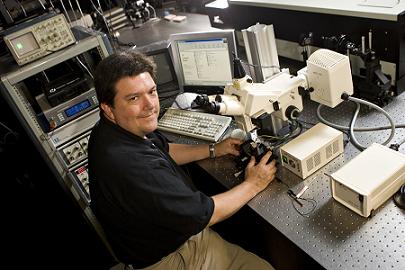 |
| David Carroll, associate professor of physics at Wake Forest University in Winston-Salem, N.C. is director of the school's Center for Nanotechnology and Molecular Materials, where recent research breakthroughs led to the formation of two start-up companies, FiberCell and PlexiLight, to commercialize new nanotechnologies. |
Abstract:
Wake Forest University has received the first patent for a new solar cell technology that can double the energy production of today's flat cells at a fraction of the cost.
Wake Forest earns patent for efficient, inexpensive fiber-based solar cells
Winston-Salem, NC | Posted on April 17th, 2010"It comes at a pretty high price to be green," said David Carroll, Ph.D., the director of Wake Forest's Center for Nanotechnology and Molecular Materials, where the fiber cell was developed. "This device can make a huge difference."
The university received the patent for fiber-based photovoltaic, or solar, cells from the European Patent Office; applications to the U.S. Patent Office are pending. The patent on the technology has been licensed to FiberCell Inc., based in the Piedmont Triad Research Park of Winston-Salem, to develop a way to manufacture the cells. The company is producing its first large test cells.
These new solar cells are made from millions of miniscule plastic fibers that can collect sunlight at oblique angles even when the sun is rising and setting. Flat-cell technology captures light primarily when the sun is directly above.
Where a flat cell loses energy when the sun's rays bounce off its shiny surface, the fiber-based design creates more surface area to confine the sun's rays, trapping the light in the tiny fiber "cans" where it bounces around until it is absorbed almost completely. That means much greater energy production with fiber-based cells: Wake Forest's fiber cells could produce about twice as many kilowatt hours per day as standard flat cells.
"We've been able to show that with a standard absorber we can collect more of the photons than anyone else can," Carroll said. "Because of the way the device works, I get more power."
To make the cells, the plastic fibers are assembled onto plastic sheets, with a technology similar to that used to create the tops of soft-drink cups. The absorber either a polymer or a dye is sprayed on. The plastic makes the cells lightweight and flexible a manufacturer could roll them up and ship them anywhere cheaply.
Carroll envisions several key uses for fiber cells:
•Green building: "We've known how to build the ‘smart house,' it's just been too expensive," he said. "The fiber cell can change that." Alter the dimensions and dye color, and builders can integrate the cells nearly anywhere in the home's design. Because fiber cells can collect light at various angles, they no longer have to stay on the roof to work. Partner the cells with devices that could store the power more efficiently, turn off lights and appliances when not in use, and capture and redirect the heat the building radiates at night, and you have a more affordable, energy-efficient structure.
•Bringing power to developing countries: Once the primary manufacturer ships the lightweight, plastic fiber cells, satellite plants in poor countries can spray them with the dye and prepare them for installation. Carroll estimates it would cost about $5 million to set up a finishing plant about $15 million less than it could cost to set up a similar plant for flat cells.
•Revolutionizing the power grid: "What if you didn't own your roof," Carroll asked. "What if the power company did?" The fiber cells installed on some homes in each neighborhood would feed the grid, and the power company would monitor energy collection and distribution through a computer network. The homeowner would not maintain the cells; that responsibility would fall to the power company.
####
About Wake Forest University
Wake Forest University’s Center for Nanotechnology and Molecular Materials uses revolutionary science to address the pressing needs of human society, from health care to green technologies. It is a shared resource serving academic, industrial and governmental researchers across the region.
For more information, please click here
Contacts:
Press Contacts:
Cheryl Walker
(336) 758-5237
Ellen Sterner Sedeno
(214) 546-8893
Copyright © Wake Forest University
If you have a comment, please Contact us.Issuers of news releases, not 7th Wave, Inc. or Nanotechnology Now, are solely responsible for the accuracy of the content.
Bookmark:


| Related News Press |
News and information
 Simulating magnetization in a Heisenberg quantum spin chain April 5th, 2024
NRL charters Navy’s quantum inertial navigation path to reduce drift April 5th, 2024
Discovery points path to flash-like memory for storing qubits: Rice find could hasten development of nonvolatile quantum memory April 5th, 2024
Possible Futures
Discovery points path to flash-like memory for storing qubits: Rice find could hasten development of nonvolatile quantum memory April 5th, 2024
With VECSELs towards the quantum internet Fraunhofer: IAF achieves record output power with VECSEL for quantum frequency converters April 5th, 2024
Academic/Education
Rice University launches Rice Synthetic Biology Institute to improve lives January 12th, 2024
Multi-institution, $4.6 million NSF grant to fund nanotechnology training September 9th, 2022
Announcements
NRL charters Navy’s quantum inertial navigation path to reduce drift April 5th, 2024
Discovery points path to flash-like memory for storing qubits: Rice find could hasten development of nonvolatile quantum memory April 5th, 2024
Patents/IP/Tech Transfer/Licensing
Getting drugs across the blood-brain barrier using nanoparticles March 3rd, 2023
Metasurfaces control polarized light at will: New research unlocks the hidden potential of metasurfaces August 13th, 2021
Arrowhead Pharmaceuticals Announces Closing of Agreement with Takeda November 27th, 2020
Energy
Development of zinc oxide nanopagoda array photoelectrode: photoelectrochemical water-splitting hydrogen production January 12th, 2024
Shedding light on unique conduction mechanisms in a new type of perovskite oxide November 17th, 2023
Inverted perovskite solar cell breaks 25% efficiency record: Researchers improve cell efficiency using a combination of molecules to address different November 17th, 2023
The efficient perovskite cells with a structured anti-reflective layer – another step towards commercialization on a wider scale October 6th, 2023
Solar/Photovoltaic
Development of zinc oxide nanopagoda array photoelectrode: photoelectrochemical water-splitting hydrogen production January 12th, 2024
Shedding light on unique conduction mechanisms in a new type of perovskite oxide November 17th, 2023
Inverted perovskite solar cell breaks 25% efficiency record: Researchers improve cell efficiency using a combination of molecules to address different November 17th, 2023
Charged “molecular beasts” the basis for new compounds: Researchers at Leipzig University use “aggressive” fragments of molecular ions for chemical synthesis November 3rd, 2023
 |
||
 |
||
| The latest news from around the world, FREE | ||
 |
||
|
|
||
| Premium Products | ||
 |
||
|
Only the news you want to read!
Learn More |
||
 |
||
|
Full-service, expert consulting
Learn More |
||
|
|
||