Home > Press > FramingNano Governance Platform well received by Swiss stakeholders
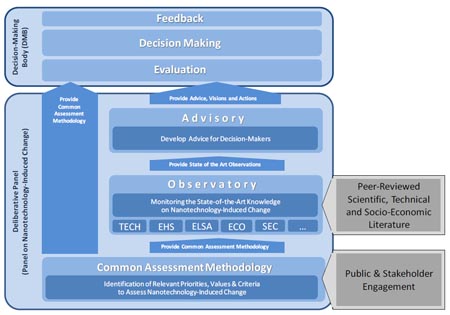 |
| Structure of the FramingNano Governance-Platform (© 2009 FramingNano Consortium) |
Abstract:
At invitation of the Innovation Society, St.Gallen, on March 18th, the national FramingNano Conference took place in the Stade de Suisse in Bern. Numerous stakeholders from industries, authorities and associations discussed the proposal for a European Governance Platform for a responsible development of nanosciences and nanotechnologies.
FramingNano Governance Platform well received by Swiss stakeholders
Switzerland | Posted on March 24th, 2010The FramingNano Governance Platform is the main outcome of the corresponding 2-years project funded under the 7th Framework Programme of the EU. Through stakeholder consultation, FramingNano aimed to substantiate principles and procedures which are regarded essential to establish and maintain a responsible and sustainable development of nanotechnologies.
To align the Platform to the interests of the different stakeholder groups, a series of multi-step consultations and workshops has been organised in European Countries including Switzerland. The workshops served to advance the concept of the Governance Platform and to gather expert inputs on possible ways of implementation into the decision making processes of nanotechnology governance at the European level and beyond.
The FramingNano Governance Platform offers an inclusive, continuous and adaptable framework to identify and assess challenges in the governance of nanotechnologies and to support the corresponding decision makers in their decision making procedures. The concept of Nanotechnology Induced Changes (NIC) is used to guide the proposed model of nanotechnology governance rather than a one-sided focus on risks only.
The Platform is geared around three key elements which provide means of how to create a common understanding of the challenges induced by nanotechnologies: a procedure dedicated to establish ‘common assessment methodologies', an ‘observatory', and an ‘advisory'.
* The affected stakeholders and the interested public should be meaningfully included in the determination of ‘common assessment methodologies' and boundaries underlying the governance of nanotechnologies. The Platform provides a procedure of public engagement to channel these values into the decision making process;
* An ‘observatory' function will provide a continuous overview and assessment of key developments and the advancing knowledge in relation to NIC. It would provide reference to the state-of-the-art scientific, technical and socio-economic information available and be composed of independent experts of the relevant fields;
* Based on the input of the common assessment methodology and the outcomes of the observatory, an ‘advisory' board will translate this intelligence into visions, actions and recommendations on nanotechnology governance for decision makers.
The FramingNano Governance Platform was well received by the participating Swiss nanotechnology stakeholders and overall accepted as a sensible way forward to address current and future issues of nanotechnology governance. The continuous and adaptive model of governance was particularly acknowledged. It was however also pointed to the fact that the implementation of the Platform will probably be complicated, in need of political will, and possibly a lengthy process yet to come.
The participants further discussed aspects of an implementation of the Governance Platform in Switzerland. It was however acknowledged that such an approach would only fully unfold if installed on an international level.
The FP7 project "FramingNano: An International multi stakeholder dialogue platform to regulate the development of Nanosciences and Nanotechnologies (NS&T)" started in May 2007. The two years support action (SA) is funded under the Programme Capacities, in the area Science in Society, within the 7th Framework Program (FP7) of the EU. It includes six partners from six European countries. FramingNano is led by AIRI/Nanotec IT (Italy) and includes The Innovation Society (Switzerland), The Institute of Nanotechnology - IoN (UK), National Institute for Public Health & the Environment - RIVM (The Netherlands), Fondation EurActiv (Belgium), Technology Centre (Czech Republic).
For further information please contact the national workshop coordinator Markus Widmer
####
About The Innovation Society
We are an independent consulting company, based at the Technology Centre of the Federal Institute of Materials Science & Technology (EMPA) in St.Gallen (Switzerland).
For more information, please click here
Contacts:
Christoph Meili
The Innovation Society, Ltd
Lerchenfeldstr. 5
CH-9014 St.Gallen (Switzerland)
Fon: +41 (0)71 274 74 17
Mob: +41 (0)76 326 77 97
Copyright © The Innovation Society
If you have a comment, please Contact us.Issuers of news releases, not 7th Wave, Inc. or Nanotechnology Now, are solely responsible for the accuracy of the content.
Bookmark:


| Related News Press |
News and information
 Simulating magnetization in a Heisenberg quantum spin chain April 5th, 2024
NRL charters Navy’s quantum inertial navigation path to reduce drift April 5th, 2024
Discovery points path to flash-like memory for storing qubits: Rice find could hasten development of nonvolatile quantum memory April 5th, 2024
Preparing for Nano
Disruptive by Design: Nano Now February 1st, 2019
How nanoscience will improve our health and lives in the coming years: Targeted medicine deliveries and increased energy efficiency are just two of many ways October 26th, 2016
Searching for a nanotech self-organizing principle May 1st, 2016
Govt.-Legislation/Regulation/Funding/Policy
NRL charters Navy’s quantum inertial navigation path to reduce drift April 5th, 2024
Discovery points path to flash-like memory for storing qubits: Rice find could hasten development of nonvolatile quantum memory April 5th, 2024
Chemical reactions can scramble quantum information as well as black holes April 5th, 2024
Announcements
NRL charters Navy’s quantum inertial navigation path to reduce drift April 5th, 2024
Discovery points path to flash-like memory for storing qubits: Rice find could hasten development of nonvolatile quantum memory April 5th, 2024
Safety-Nanoparticles/Risk management
Tests find no free-standing nanotubes released from tire tread wear September 8th, 2023
Billions of nanoplastics released when microwaving baby food containers: Exposure to plastic particles kills up to 75% of cultured kidney cells July 21st, 2023
Events/Classes
Researchers demonstrate co-propagation of quantum and classical signals: Study shows that quantum encryption can be implemented in existing fiber networks January 20th, 2023
 |
||
 |
||
| The latest news from around the world, FREE | ||
 |
||
|
|
||
| Premium Products | ||
 |
||
|
Only the news you want to read!
Learn More |
||
 |
||
|
Full-service, expert consulting
Learn More |
||
|
|
||