Home > Press > UCLA's CNSI, Kyoto University institute to collaborate on research, academic exchanges
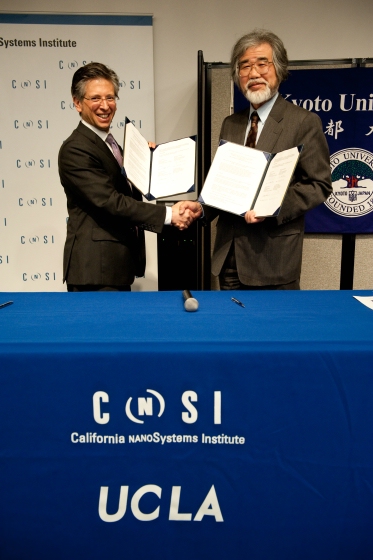 |
| CNSI director Paul Weiss (left) and iCeMS director Norio Nakatsuji at the UCLA signing ceremony |
Abstract:
The California NanoSystems Institute (CNSI) at UCLA and the Institute for Integrated Cell-Material Sciences (iCeMS) at Japan's Kyoto University have signed a memorandum of understanding to collaborate on international research efforts and academic exchanges.
By Jennifer Marcus
UCLA's CNSI, Kyoto University institute to collaborate on research, academic exchanges
Los Angeles, CA | Posted on March 24th, 2010"This memorandum strengthens our ties to iCeMS and to Kyoto University, and the CNSI research agenda will be greatly advanced by this connection," said CNSI director Paul Weiss, a distinguished professor of chemistry and biochemistry who hold's UCLA's Fred Kavli Chair in Nanosystems Sciences. "The iCeMS is already carrying out transformative work in the cell-material field, which promises to have major impact on regenerative medicine and the development of new drugs."
The iCeMS is one of five World Premier International Research Centers selected under a national initiative by the Japanese Ministry of Education, Culture, Sports, Science and Technology to promote pioneering research fields in which Japan has a competitive edge.
The institute aims to advance cell-material sciences, for which Kyoto University is known, and to develop new scientific fields through the integration of biosciences, chemistry, material sciences and physics, followed by innovative technologies and applications.
The new agreement, signed on March 15 by Professor Norio Nakatsuji, director of the iCeMS, and Weiss, outlines the institutes' intentions to work together on international collaborative research efforts, including joint research projects; short-term exchanges of scientists, faculty members and students; and jointly organized conferences and workshops.
Through these activities, the iCeMS and the CNSI will enhance their science communication skills and social literacy globally, with the aim of nurturing the scientists of tomorrow.
According to Nakatsuji, the agreement with the CNSI will lead to multidisciplinary collaborations with benefits for both institutions.
"The memorandum will enhance the quality of research at iCeMS and encourage greater participation in the global scientific community among our scientists," he said. "Both are essential for Japan's continued role as a leader in science and technology."
The two institutes share interests in gaining a deeper understanding of molecular interactions in order to further advance stem-cell research and new drug therapies and delivery systems, as well as green chemical technologies and sustainable energy resources.
Several collaborations involving researchers at both institutes are already underway, including a collaboration between UCLA professor Omar Yaghi and Kyoto University professor Susumu Kitagawa on the synthesis of multifarious pores, and one between UCLA professor Jim Gimzewski and Kyoto professor Takafumi Ueno on the chemical design of protein surfaces toward integrated meso-molecular devices.
This agreement reflects the CNSI's commitment to the globalization of science. The institute has positioned itself at the forefront of international centers of nanoscience and nanotechnology by creating strong links with universities and other research facilities in Asia and Europe. Presently, the CNSI has formal connections with institutions in China, Japan, Singapore, Korea, the United Kingdom and the Netherlands and serves as a crossroads for top scientists and engineers from around the world.
####
About California NanoSystems Institute
The California NanoSystems Institute at UCLA is an integrated research center operating jointly at UCLA and UC Santa Barbara whose mission is to foster interdisciplinary collaborations for discoveries in nanosystems and nanotechnology; train the next generation of scientists, educators and technology leaders; and facilitate partnerships with industry, fueling economic development and the social well-being of California, the United States and the world. The CNSI was established in 2000 with $100 million from the state of California and an additional $250 million in federal research grants and industry funding. At the institute, scientists in the areas of biology, chemistry, biochemistry, physics, mathematics, computational science and engineering are measuring, modifying and manipulating the building blocks of our world — atoms and molecules. These scientists benefit from an integrated laboratory culture enabling them to conduct dynamic research at the nanoscale, leading to significant breakthroughs in the areas of health, energy, the environment and information technology.
About The Institute for Integrated Cell-Material Sciences at Kyoto University
The Institute for Integrated Cell-Material Sciences at Kyoto University aims to advance the integration of cell and material sciences — both of which are traditionally strong fields for the university — by creating a uniquely innovative global research environment. The iCeMS seeks to integrate biosciences, chemistry, material science and physics to capture the potential power of meso-control of functional architectures and stem cells. Cells in living organisms have acquired these tools to control the mesoscale realm (5–100 nanometers) through the course of evolution, thereby realizing clean chemical reactions in ambient environments to perform functions such as energy conversion, cell growth and differentiation.
For more information, please click here
Contacts:
Media Contacts
Jennifer Marcus,
310-267-4839
Copyright © California NanoSystems Institute
If you have a comment, please Contact us.Issuers of news releases, not 7th Wave, Inc. or Nanotechnology Now, are solely responsible for the accuracy of the content.
Bookmark:


| Related News Press |
News and information
 Simulating magnetization in a Heisenberg quantum spin chain April 5th, 2024
NRL charters Navy’s quantum inertial navigation path to reduce drift April 5th, 2024
Discovery points path to flash-like memory for storing qubits: Rice find could hasten development of nonvolatile quantum memory April 5th, 2024
Academic/Education
Rice University launches Rice Synthetic Biology Institute to improve lives January 12th, 2024
Multi-institution, $4.6 million NSF grant to fund nanotechnology training September 9th, 2022
Nanomedicine
New micromaterial releases nanoparticles that selectively destroy cancer cells April 5th, 2024
Good as gold - improving infectious disease testing with gold nanoparticles April 5th, 2024
Researchers develop artificial building blocks of life March 8th, 2024
Announcements
NRL charters Navy’s quantum inertial navigation path to reduce drift April 5th, 2024
Discovery points path to flash-like memory for storing qubits: Rice find could hasten development of nonvolatile quantum memory April 5th, 2024
Nanobiotechnology
New micromaterial releases nanoparticles that selectively destroy cancer cells April 5th, 2024
Good as gold - improving infectious disease testing with gold nanoparticles April 5th, 2024
Researchers develop artificial building blocks of life March 8th, 2024
Alliances/Trade associations/Partnerships/Distributorships
Chicago Quantum Exchange welcomes six new partners highlighting quantum technology solutions, from Chicago and beyond September 23rd, 2022
University of Illinois Chicago joins Brookhaven Lab's Quantum Center June 10th, 2022
Research partnerships
Discovery points path to flash-like memory for storing qubits: Rice find could hasten development of nonvolatile quantum memory April 5th, 2024
Researchers’ approach may protect quantum computers from attacks March 8th, 2024
'Sudden death' of quantum fluctuations defies current theories of superconductivity: Study challenges the conventional wisdom of superconducting quantum transitions January 12th, 2024
 |
||
 |
||
| The latest news from around the world, FREE | ||
 |
||
|
|
||
| Premium Products | ||
 |
||
|
Only the news you want to read!
Learn More |
||
 |
||
|
Full-service, expert consulting
Learn More |
||
|
|
||