Home > Press > Chemist monitors nanotechnology's environmental impact
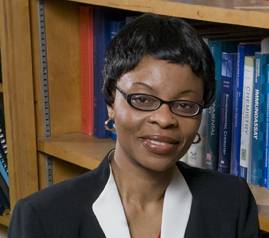 |
| Omowunmi Sadik |
Abstract:
Interest in ‘green' innovation means not just thinking big but also very, very, very small.
Chemist monitors nanotechnology's environmental impact
Binghamton, NY | Posted on March 23rd, 2010At least that's the way Omowunmi Sadik, director of Binghamton University's Center for Advanced Sensors and Environmental Systems, sees it. She's working to develop sensors that would detect and identify engineered nanoparticles. Her research will advance our understanding of the risks associated with the environmental release and transformation of these particles.
"Society has a duty to not only consider the positive sides of science and technology but also the not-so-desirable sides of technology itself," said Sadik, a professor of chemistry. "We need to think not just about how to make these nanoparticles but also about their impact on human health and the environment."
A survey by the Project on Emerging Nanotechnologies found that nanoparticles — particles less than 100 nanometers in size — are now used in more than 1,000 consumer products ranging from cars to food. Silver nanoparticles are widely used as coating materials in cookware and tableware and as ingredients in laundry liquids and clothes because of their antibacterial properties. You can even buy socks infused with silver nanoparticles designed to reduce bacteria and odor.
"But what happens if we buy those socks and we wash them?" Sadik asked. "The nanoparticles end up in our water system."
Little is known about how these and other engineered nanoparticles interact with our water systems, the soil and the air. Some are known toxins; others have properties similar to asbestos. And it's difficult, if not downright impossible, to monitor them. Current techniques rely on huge microscopes to identify nanoparticles, but the devices are not portable and do not provide information about the toxicity of materials.
Sadik and a Binghamton colleague, Howard Wang, have received funding from the Environmental Protection Agency to design, create and test sensors for monitoring engineered nanoparticles and naturally occurring cell particles.
Chemist monitors nanotechnology's environmental impact:
"We need to understand the chemical transformation of these materials in the ecosystem so we can take action to prevent unnecessary exposure," Sadik said.
Her lab has already created a membrane that will not only trap a single nanoparticle but also provide a means of signal generation. It uses cyclodextrin, whose molecular structure resembles a tiny cup. "It can be used not only as a sensor, but also for cleanup," Sadik said.
That discovery and others make Sadik believe that nanotechnology may also prove useful in the remediation of environmental pollutants. Green nanotechnology could even reduce the use of solvents and result in manufacturing protocols that produce less waste, she said.
For instance, Sadik has used nanoparticles to transform Chromium 6, a known carcinogen, into Chromium 3, which is benign. "I do see the positive side of it," she said.
"We want to be able to develop nanomaterials while avoiding the unintended consequences of such developments," Sadik added. "We don't want to stop development, but we do want to encourage responsibility."
####
About Binghamton University
In a little over 60 years, Binghamton University has built a reputation as a world-class institution that combines a broadly interdisciplinary, international education with one of the most vibrant research programs in the nation.
For more information, please click here
Copyright © Binghamton University
If you have a comment, please Contact us.Issuers of news releases, not 7th Wave, Inc. or Nanotechnology Now, are solely responsible for the accuracy of the content.
Bookmark:


| Related News Press |
News and information
 Simulating magnetization in a Heisenberg quantum spin chain April 5th, 2024
NRL charters Navy’s quantum inertial navigation path to reduce drift April 5th, 2024
Discovery points path to flash-like memory for storing qubits: Rice find could hasten development of nonvolatile quantum memory April 5th, 2024
Preparing for Nano
Disruptive by Design: Nano Now February 1st, 2019
How nanoscience will improve our health and lives in the coming years: Targeted medicine deliveries and increased energy efficiency are just two of many ways October 26th, 2016
Searching for a nanotech self-organizing principle May 1st, 2016
Govt.-Legislation/Regulation/Funding/Policy
NRL charters Navy’s quantum inertial navigation path to reduce drift April 5th, 2024
Discovery points path to flash-like memory for storing qubits: Rice find could hasten development of nonvolatile quantum memory April 5th, 2024
Chemical reactions can scramble quantum information as well as black holes April 5th, 2024
Academic/Education
Rice University launches Rice Synthetic Biology Institute to improve lives January 12th, 2024
Multi-institution, $4.6 million NSF grant to fund nanotechnology training September 9th, 2022
Sensors
Announcements
NRL charters Navy’s quantum inertial navigation path to reduce drift April 5th, 2024
Discovery points path to flash-like memory for storing qubits: Rice find could hasten development of nonvolatile quantum memory April 5th, 2024
Environment
Billions of nanoplastics released when microwaving baby food containers: Exposure to plastic particles kills up to 75% of cultured kidney cells July 21st, 2023
Safety-Nanoparticles/Risk management
Tests find no free-standing nanotubes released from tire tread wear September 8th, 2023
Billions of nanoplastics released when microwaving baby food containers: Exposure to plastic particles kills up to 75% of cultured kidney cells July 21st, 2023
Research partnerships
Discovery points path to flash-like memory for storing qubits: Rice find could hasten development of nonvolatile quantum memory April 5th, 2024
Researchers’ approach may protect quantum computers from attacks March 8th, 2024
'Sudden death' of quantum fluctuations defies current theories of superconductivity: Study challenges the conventional wisdom of superconducting quantum transitions January 12th, 2024
 |
||
 |
||
| The latest news from around the world, FREE | ||
 |
||
|
|
||
| Premium Products | ||
 |
||
|
Only the news you want to read!
Learn More |
||
 |
||
|
Full-service, expert consulting
Learn More |
||
|
|
||