Home > Press > JPK Instruments supplies multiple instrument solutions to Swansea University’s Centre for NanoHealth
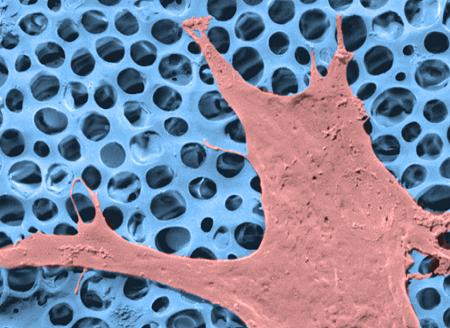 |
| Image of a cell growing on an artificial scaffold, developed at Swansea University, which could be used for wound healing |
Abstract:
JPK Instruments, a world-leading manufacturer of nanoanalytic instrumentation for research in life sciences and soft matter, is pleased to announce the installation of multiple instrument solutions at the new Swansea University (Wales, UK) Centre for NanoHealth.
JPK Instruments supplies multiple instrument solutions to Swansea University’s Centre for NanoHealth
Berlin | Posted on March 23rd, 2010One of the biggest challenges facing the future of healthcare is enhancing early intervention in diagnosing and treating diseases in non-hospital environments; in the home, community clinic or local doctors' surgery. Current medical practice is based around relatively late intervention, which with many diseases does not result in complete cure, but rather extends a patient's life whilst, hopefully, maintaining quality of life. The key to early intervention is the earliest possible detection of disease, and the swift identification of appropriate medical or surgical treatments. The Centre for NanoHealth is a unique interdisciplinary research centre based on the application of Nanotechnology leading innovations in Healthcare established to address these challenges.
The acquisition of the latest instrumentation techniques is of important benefit to the Centre's future research programs and the announcement that JPK Instruments is supply multiple solutions is welcomed by the group. Using JPK's patented NanoWizard® AFM platform, systems will initially be used in three exciting applications areas. Dr. Chris Wright will lead a team to study cell mechanics as part of his program on bionanotechnology which focuses on nanoscale mechanisms of disease and its control. Dr. Peter Dunstan will be developing chemical finger printing techniques using TERS - tip enhanced Raman spectroscopy which will couple the AFM to a Raman spectrometer. Professor Steve Wilks is to use new electrical mode innovations to develop the next generation of diagnostic sensors having unprecedented sensitivity by applying nanowire technology.
The choice of JPK to supply these systems came after extensive evaluation of different vendors to match the needs of the Centre. JPK responded with the commitment to deliver the best instrumentation and unrivalled customer-focused applications support to match their company goal of bridging the worlds of nanotechnology tools and life science applications with cutting-edge technology and unique applications expertise.
Professor Steve Wilks, Deputy Head of the Swansea University's School of Engineering and Director of The Centre for NanoHealth said: "The JPK instruments will provide the CNH with a world-leading platform to understand the behaviour of cells and proteins at the nanoscale and identify key detection mechanisms for clinical screening. This is essential for the development of next generation medical sensors for diagnosing diseases at a much earlier stage."
For further details of the NanoWizard and applications from JPK, please visit the JPK web site (www.jpk.com).
####
About JPK Instruments
JPK Instruments AG is a world-leading manufacturer of nanoanalytic instruments - particularly atomic force microscope (AFM) systems and optical tweezers - for a broad range of applications reaching from soft matter physics to nano-optics, from surface chemistry to cell and molecular biology. JPK was recognized as Germany’s fastest growing nanotechnology company in 2007 and 2008 (Deloitte). From its earliest days applying atomic force microscope (AFM) technology, JPK has recognized the opportunities provided by nanotechnology for transforming life sciences and soft matter research. This focus has driven JPK’s success in uniting the worlds of nanotechnology tools and life science applications by offering cutting-edge technology and unique applications expertise. Headquartered in Berlin and with direct operations in Dresden, Cambridge (UK), Singapore and Tokyo, JPK maintains a global network of distributors and support centers and provides on the spot applications and service support to an ever-growing community of researchers.
About Swansea University’s Centre for NanoHealth
The Centre for NanoHealth (CNH) will be located within a Clinical and Biomedical research environment on Swansea’s Singleton hospital site, giving access to patients and creating a pioneering, integrated facility in which novel devices and sensors can be designed, manufactured, functionalised, tested and evaluated.
The £21.6M project is funded by the European Regional Development Fund through the Welsh European Funding Office, Swansea University, NHS Trust, WAG Health Department and Industry. Technology, and particularly Nanotechnology, has an increasingly important and strategic role to play in furthering our ability to detect and treat disease, and this has been central to the work of the University’s Multidisciplinary Nanotechnology Centre (MNC), established within the School of Engineering in 2001.
For more details, please visit www.swan.ac.uk/engineering/NanoHealth/
For further information, please contact JPK direct or their marketing partners, NetDyaLog, who will also provide high resolution images for your use.
For more information, please click here
Contacts:
Jezz Leckenby
NetDyaLog Limited
T: +44 (0) 1799 521881
M: +44 (0) 7843 012997
or
Petra Dammermann
JPK Instruments
T: +49 (0) 30 5331 12541
Copyright © JPK Instruments
If you have a comment, please Contact us.Issuers of news releases, not 7th Wave, Inc. or Nanotechnology Now, are solely responsible for the accuracy of the content.
Bookmark:


| Related News Press |
News and information
 Simulating magnetization in a Heisenberg quantum spin chain April 5th, 2024
NRL charters Navy’s quantum inertial navigation path to reduce drift April 5th, 2024
Discovery points path to flash-like memory for storing qubits: Rice find could hasten development of nonvolatile quantum memory April 5th, 2024
Academic/Education
Rice University launches Rice Synthetic Biology Institute to improve lives January 12th, 2024
Multi-institution, $4.6 million NSF grant to fund nanotechnology training September 9th, 2022
Nanomedicine
New micromaterial releases nanoparticles that selectively destroy cancer cells April 5th, 2024
Good as gold - improving infectious disease testing with gold nanoparticles April 5th, 2024
Researchers develop artificial building blocks of life March 8th, 2024
Announcements
NRL charters Navy’s quantum inertial navigation path to reduce drift April 5th, 2024
Discovery points path to flash-like memory for storing qubits: Rice find could hasten development of nonvolatile quantum memory April 5th, 2024
Tools
Ferroelectrically modulate the Fermi level of graphene oxide to enhance SERS response November 3rd, 2023
The USTC realizes In situ electron paramagnetic resonance spectroscopy using single nanodiamond sensors November 3rd, 2023
Nanobiotechnology
New micromaterial releases nanoparticles that selectively destroy cancer cells April 5th, 2024
Good as gold - improving infectious disease testing with gold nanoparticles April 5th, 2024
Researchers develop artificial building blocks of life March 8th, 2024
New-Contracts/Sales/Customers
Bruker Light-Sheet Microscopes at Major Comprehensive Cancer Center: New Advanced Imaging Center Powered by Two MuVi and LCS SPIM Microscopes March 25th, 2021
Arrowhead Pharmaceuticals Announces Closing of Agreement with Takeda November 27th, 2020
Veeco Announces Aledia Order of 300mm MOCVD Equipment for microLED Displays: Propel™ Platform First 300mm System with EFEM Designed for Advanced Display Applications October 20th, 2020
GREENWAVES TECHNOLOGIES Announces Next Generation GAP9 Hearables Platform Using GLOBALFOUNDRIES 22FDX Solution October 16th, 2020
 |
||
 |
||
| The latest news from around the world, FREE | ||
 |
||
|
|
||
| Premium Products | ||
 |
||
|
Only the news you want to read!
Learn More |
||
 |
||
|
Full-service, expert consulting
Learn More |
||
|
|
||