Home > Press > Paper Describes Functional Nanomaterials For Medical, Health Devices
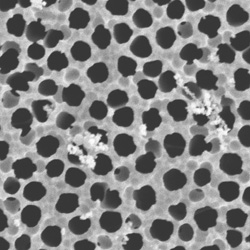 |
| Atomic layer deposition is especially useful for coating complex nanoscale structures. This image is a scanning electron micrograph obtained from a zinc oxide-coated nanoporous alumina membrane. |
Abstract:
A team led by researchers from North Carolina State University has published a paper that describes the use of a technique called atomic layer deposition to incorporate "biological functionality" into complex nanomaterials, which could lead to a new generation of medical and environmental health applications. For example, the researchers show how the technology can be used to develop effective, low-cost water purification devices that could be used in developing countries.
By Matt Shipman
Paper Describes Functional Nanomaterials For Medical, Health Devices
Raleigh, NC | Posted on March 22nd, 2010"Atomic layer deposition is a technique that can be used to create thin films for coating metals or ceramics, and is especially useful for coating complex nanoscale structures," says Dr. Roger Narayan, the paper's lead author. "This paper shows how atomic layer deposition can be used to create biologically functional materials, such as materials that have antibacterial properties. Another example would be a material that does not bond to proteins in the body, which could be used for implantable medical sensors." Narayan is a professor in the joint biomedical engineering department of NC State's College of Engineering and the University of North Carolina at Chapel Hill.
One of the applications discussed in the paper is a material that could be used as a filter for point-of-use water purification. "This would be very helpful in the developing world, or in disaster situations - like Haiti - where people do not have access to safe water," Narayan says. "Over one billion people do not have access to safe water. This can lead to a variety of public health problems, including cholera and hepatitis."
Specifically, the researchers show that atomic layer deposition can be used to create a film for coating nanoporous membranes, which may be used for filtering out pathogenic bacteria. "The film could also provide antimicrobial functionality," Narayan says, "to neutralize bacteria."
In the study, the researchers found that membranes treated with one of these films were able to neutralize two common pathogens: E. coli and Staphylococcus aureus. The researchers are currently working with colleagues to assess how well the membranes perform against a variety of environmental bacteria. It's anticipated that these membranes could find use in a variety of medical and environmental health applications, such as hemodialysis filters and implantable sensors.
The research, "Atomic layer deposition-based functionalization of materials for medical and environmental health applications," is published in the March issue of the journal Philosophical Transactions of the Royal Society A. The research was funded by the National Science Foundation and the National Institutes of Health. The research was co-authored by Narayan, Dr. Nancy Monteiro-Riviere, professor of investigative dermatology and toxicology at the Center for Chemical Toxicology Research and Pharmacokinetics at NC State, Dr. Chunming Jin, a post-doctoral research associate at NC State, and Dr. Junping Zhang, a former post-doctoral research associate at NC State. Additional co-authors were from Kodak Research Laboratories, Argonne National Laboratory, North Dakota State University, National Yang-Ming University in Taiwan, and Taipei Medical University in Taiwan.
Note to editors: The study abstract follows.
"Atomic layer deposition-based functionalization of materials for medical and environmental health applications"
Authors: Roger J. Narayan, Nancy A. Monteiro-Riviere, Chunming Jin and Junping Zhang, North Carolina State University, et al.
Published: March 2010, Philosophical Transactions of the Royal Society A
Abstract: Nanoporous alumina membranes exhibit high pore densities, well-controlled pore sizes, uniform pore sizes and straight pores. Owing to these unusual properties, nanoporous alumina membranes are currently being considered for use in implantable sensor membranes and water purification membranes. Atomic layer deposition is a thin-film growth process that may be used to modify the pore size in a nanoporous alumina membrane while retaining a narrow pore distribution. In addition, films deposited by means of atomic layer deposition may impart improved biological functionality to nanoporous alumina membranes. In this study, zinc oxide coatings and platinum coatings were deposited on nanoporous alumina membranes by means of atomic layer deposition. PEGylated nanoporous alumina membranes were prepared by self-assembly of 1-mercaptoundec-11-yl hexa(ethylene glycol) on platinum-coated nanoporous alumina membranes. The pores of the PEGylated nanoporous alumina membranes remained free of fouling after exposure to human platelet-rich plasma; protein adsorption, fibrin networks and platelet aggregation were not observed on the coated membrane surface. Zinc oxide-coated nanoporous alumina membranes demonstrated activity against Escherichia coli and Staphylococcus aureus bacteria. The results of this work indicate that nanoporous alumina membranes may be modified using atomic layer deposition for use in a variety of medical and environmental health applications.
####
About North Carolina State University
With more than 31,000 students and nearly 8,000 faculty and staff, North Carolina State University is a comprehensive university known for its leadership in education and research, and globally recognized for its science, technology, engineering and mathematics leadership.
NC State students, faculty and staff are focused. As one of the leading land-grant institutions in the nation, NC State is committed to playing an active and vital role in improving the quality of life for the citizens of North Carolina, the nation and the world.
How? Researchers across the university and Centennial Campus are deeply engaged in making new, application-driven discoveries. As a major research university, NC State has the people —from undergraduate and graduate students to faculty — and the responsibility to advance knowledge, transfer technology, and discover and develop innovations that solve some of the world’s most pressing problems.
And we are. NC State’s research expenditures are approaching more than $325 million annually, with almost 70 percent of faculty engaged in sponsored research and 2,500 graduate students supported by research grants. NC State is ranked third among all public universities (without medical schools) in industry-sponsored research expenditures.
For more information, please click here
Contacts:
Matt Shipman
News Services
919.515.6386
Dr. Roger Narayan
919.696.8488
Copyright © North Carolina State University
If you have a comment, please Contact us.Issuers of news releases, not 7th Wave, Inc. or Nanotechnology Now, are solely responsible for the accuracy of the content.
Bookmark:


| Related News Press |
News and information
 Simulating magnetization in a Heisenberg quantum spin chain April 5th, 2024
NRL charters Navy’s quantum inertial navigation path to reduce drift April 5th, 2024
Discovery points path to flash-like memory for storing qubits: Rice find could hasten development of nonvolatile quantum memory April 5th, 2024
Good as gold - improving infectious disease testing with gold nanoparticles April 5th, 2024
Thin films
Utilizing palladium for addressing contact issues of buried oxide thin film transistors April 5th, 2024
Understanding the mechanism of non-uniform formation of diamond film on tools: Paving the way to a dry process with less environmental impact March 24th, 2023
New study introduces the best graphite films: The work by Distinguished Professor Feng Ding at UNIST has been published in the October 2022 issue of Nature Nanotechnology November 4th, 2022
Govt.-Legislation/Regulation/Funding/Policy
NRL charters Navy’s quantum inertial navigation path to reduce drift April 5th, 2024
Discovery points path to flash-like memory for storing qubits: Rice find could hasten development of nonvolatile quantum memory April 5th, 2024
Chemical reactions can scramble quantum information as well as black holes April 5th, 2024
Possible Futures
Discovery points path to flash-like memory for storing qubits: Rice find could hasten development of nonvolatile quantum memory April 5th, 2024
With VECSELs towards the quantum internet Fraunhofer: IAF achieves record output power with VECSEL for quantum frequency converters April 5th, 2024
Nanomedicine
New micromaterial releases nanoparticles that selectively destroy cancer cells April 5th, 2024
Good as gold - improving infectious disease testing with gold nanoparticles April 5th, 2024
Researchers develop artificial building blocks of life March 8th, 2024
Materials/Metamaterials/Magnetoresistance
Nanoscale CL thermometry with lanthanide-doped heavy-metal oxide in TEM March 8th, 2024
Focused ion beam technology: A single tool for a wide range of applications January 12th, 2024
Announcements
NRL charters Navy’s quantum inertial navigation path to reduce drift April 5th, 2024
Discovery points path to flash-like memory for storing qubits: Rice find could hasten development of nonvolatile quantum memory April 5th, 2024
Interviews/Book Reviews/Essays/Reports/Podcasts/Journals/White papers/Posters
Simulating magnetization in a Heisenberg quantum spin chain April 5th, 2024
Discovery points path to flash-like memory for storing qubits: Rice find could hasten development of nonvolatile quantum memory April 5th, 2024
Environment
Billions of nanoplastics released when microwaving baby food containers: Exposure to plastic particles kills up to 75% of cultured kidney cells July 21st, 2023
Water
Taking salt out of the water equation October 7th, 2022
Nanobiotechnology
New micromaterial releases nanoparticles that selectively destroy cancer cells April 5th, 2024
Good as gold - improving infectious disease testing with gold nanoparticles April 5th, 2024
Researchers develop artificial building blocks of life March 8th, 2024
 |
||
 |
||
| The latest news from around the world, FREE | ||
 |
||
|
|
||
| Premium Products | ||
 |
||
|
Only the news you want to read!
Learn More |
||
 |
||
|
Full-service, expert consulting
Learn More |
||
|
|
||