Home > Press > Imperfections are perfect
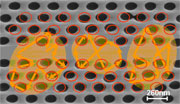 |
| Figure 1. The red circles show the position of holes in the optical chip in what has so far been seen as an ideal structure. Random disorder has been introduced in this structure (compare the position of red circles to the actual holes (black) in the structure), which results in the localisation of light (orange areas). |
Abstract:
Researchers from DTU Fotonik surprise the scientific world with their new discovery which, in the long term, may be used in, e.g., solar cells and quantum computers. Their findings will be published on 12 March 2010 in the prestigious international journal Science.
By Lotte Krull
Imperfections are perfect
Denmark | Posted on March 16th, 2010All over the world, intensive research is being conducted on how to use the smallest particles of light, photons, for communication applications. Where electronic technology makes use of microchips, optical communication uses the so-called optical chip.
On optical chips, a structure of holes is etched, and it is by means of these holes that the researchers try to control the photons' movements on the chip So far, the aim has been to achieve a regular and ordered hole structure, and it has been the general conviction that disorder or imperfections in the hole structure reduce or simply destroy the functionality of the optical chip.
Disorder as a valuable resource
A group of researchers from DTU Fotonik has now turned everything totally upside down and demonstrated that disordered structures on optical chips may actually be an advantage. The researchers deliberately placed the holes on the optical chip irregularly, and this improved the chip.
It has thus proved possible to capture and thus control photons very effectively on the ‘disordered' chip. The discovery allows the production of a brand new type of optical chips where disorder is utilised as a valuable resource instead of being considered a limitation.
This finding is a major basic scientific breakthrough, which is published in the international journal Science on 12 March 2010.
The discovery may potentially be used in, e.g., solar cells and optical sensors or within quantum information technology. The dawning quantum information technology promises fundamentally new ways of coding and processing information, using the laws of quantum mechanics. This can, among other things, be used for 100% secure information exchange or, ultimately, for a quantum computer which can perform calculations far faster than the supercomputers of today.
The research group behind the discovery
The research has been conducted at the Department of Photonics Engineering at the Technical University of Denmark by a research group consisting of postdocs Luca Sapienza, Søren Stobbe and David Garcia, PhD students Henri Thyrrestrup and Stephan Smolka as well as Associate Professor and group leader Peter Lodahl.
####
For more information, please click here
Contacts:
Associate Professor Peter Lodahl
DTU Fotonik, Quantum Photonics Group tel. (mobile): +45 51 64 74 83
See also: www.fotonik.dtu.dk/quantumphotonics
Copyright © Technical University of Denmark
If you have a comment, please Contact us.Issuers of news releases, not 7th Wave, Inc. or Nanotechnology Now, are solely responsible for the accuracy of the content.
Bookmark:


| Related News Press |
News and information
 Simulating magnetization in a Heisenberg quantum spin chain April 5th, 2024
NRL charters Navy’s quantum inertial navigation path to reduce drift April 5th, 2024
Discovery points path to flash-like memory for storing qubits: Rice find could hasten development of nonvolatile quantum memory April 5th, 2024
Possible Futures
Discovery points path to flash-like memory for storing qubits: Rice find could hasten development of nonvolatile quantum memory April 5th, 2024
With VECSELs towards the quantum internet Fraunhofer: IAF achieves record output power with VECSEL for quantum frequency converters April 5th, 2024
Chip Technology
Discovery points path to flash-like memory for storing qubits: Rice find could hasten development of nonvolatile quantum memory April 5th, 2024
Utilizing palladium for addressing contact issues of buried oxide thin film transistors April 5th, 2024
HKUST researchers develop new integration technique for efficient coupling of III-V and silicon February 16th, 2024
Quantum Computing
Simulating magnetization in a Heisenberg quantum spin chain April 5th, 2024
Discovery points path to flash-like memory for storing qubits: Rice find could hasten development of nonvolatile quantum memory April 5th, 2024
With VECSELs towards the quantum internet Fraunhofer: IAF achieves record output power with VECSEL for quantum frequency converters April 5th, 2024
Chemical reactions can scramble quantum information as well as black holes April 5th, 2024
Nanoelectronics
Interdisciplinary: Rice team tackles the future of semiconductors Multiferroics could be the key to ultralow-energy computing October 6th, 2023
Key element for a scalable quantum computer: Physicists from Forschungszentrum Jülich and RWTH Aachen University demonstrate electron transport on a quantum chip September 23rd, 2022
Reduced power consumption in semiconductor devices September 23rd, 2022
Atomic level deposition to extend Moore’s law and beyond July 15th, 2022
Discoveries
Chemical reactions can scramble quantum information as well as black holes April 5th, 2024
New micromaterial releases nanoparticles that selectively destroy cancer cells April 5th, 2024
Utilizing palladium for addressing contact issues of buried oxide thin film transistors April 5th, 2024
Announcements
NRL charters Navy’s quantum inertial navigation path to reduce drift April 5th, 2024
Discovery points path to flash-like memory for storing qubits: Rice find could hasten development of nonvolatile quantum memory April 5th, 2024
Energy
Development of zinc oxide nanopagoda array photoelectrode: photoelectrochemical water-splitting hydrogen production January 12th, 2024
Shedding light on unique conduction mechanisms in a new type of perovskite oxide November 17th, 2023
Inverted perovskite solar cell breaks 25% efficiency record: Researchers improve cell efficiency using a combination of molecules to address different November 17th, 2023
The efficient perovskite cells with a structured anti-reflective layer – another step towards commercialization on a wider scale October 6th, 2023
Research partnerships
Discovery points path to flash-like memory for storing qubits: Rice find could hasten development of nonvolatile quantum memory April 5th, 2024
Researchers’ approach may protect quantum computers from attacks March 8th, 2024
'Sudden death' of quantum fluctuations defies current theories of superconductivity: Study challenges the conventional wisdom of superconducting quantum transitions January 12th, 2024
Solar/Photovoltaic
Development of zinc oxide nanopagoda array photoelectrode: photoelectrochemical water-splitting hydrogen production January 12th, 2024
Shedding light on unique conduction mechanisms in a new type of perovskite oxide November 17th, 2023
Inverted perovskite solar cell breaks 25% efficiency record: Researchers improve cell efficiency using a combination of molecules to address different November 17th, 2023
Charged “molecular beasts” the basis for new compounds: Researchers at Leipzig University use “aggressive” fragments of molecular ions for chemical synthesis November 3rd, 2023
Quantum nanoscience
Simulating magnetization in a Heisenberg quantum spin chain April 5th, 2024
Optically trapped quantum droplets of light can bind together to form macroscopic complexes March 8th, 2024
Bridging light and electrons January 12th, 2024
'Sudden death' of quantum fluctuations defies current theories of superconductivity: Study challenges the conventional wisdom of superconducting quantum transitions January 12th, 2024
 |
||
 |
||
| The latest news from around the world, FREE | ||
 |
||
|
|
||
| Premium Products | ||
 |
||
|
Only the news you want to read!
Learn More |
||
 |
||
|
Full-service, expert consulting
Learn More |
||
|
|
||