Home > Press > Graphene pioneers named ‘hottest researchers’
 |
Abstract:
Two scientists who discovered graphene at The University of Manchester have been listed among the world's ‘hottest researchers', according to the Times Higher Education (THE).
Graphene pioneers named ‘hottest researchers’
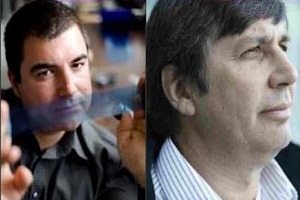
UK | Posted on March 16th, 2010Professor Andre Geim and Dr Konstantin Novoselov from the School of Physics and Astronomy take joint second and third place respectively in the annual list compiled by data analyst Thomson Reuters.
Professor Geim and Dr Novoselov were the only UK researchers to feature in the table, and this is the second year in a row they've been listed. The ranking is based on the number of ‘hot papers' researchers have produced that are under two years old and have been cited at a consistently high rate.
Professor Geim said: "We were very surprised to find ourselves on this list again. This mainly shows how hot the subject of graphene is. In the last few years thousands of researchers have started working on graphene worldwide, and now we need to compete with all of them. The fact that we introduced graphene no longer counts in this rating.
"It is very hard to run in front of such a large crowd. Is it good luck - yes, but mostly we are on the list thanks to very hard work."
The two Manchester academics discovered graphene - the world's thinnest material - in 2004, and it has rapidly become one of the hottest topics in materials science and solid-state physics. Graphene not only promises to revolutionise semiconductor, sensor, and display technology, but could also lead to breakthroughs in fundamental quantum physics research.
The THE analysis covers 2008-09 and is based on citations measured by Thomson Reuters' Web of Science database. Professor Geim produced 13 ‘hot' papers in the period, and Professor Novoselov produced 12
This is the latest in a long list of awards for the graphene pioneers; Prof Geim - Langworthy and Royal Society 2010 Anniversary Research Professor of Physics at the University of Manchester - received the prestigious John J. Carty Award for the Advancement of Science this year. In 2009 he received the Körber European Science Award.
Professor Geim moved to The University of Manchester in 2001 and is currently Chair of Condensed Matter Physics, Langworthy Research Professor and Director of Manchester Centre for Mesoscience and Nanotechnology.
In 2008 Dr Novoselov, a Royal Society Research Fellow in The School of Physics and Astronomy, was named one of the world's top young innovators by a panel of expert judges and the editorial staff of Technology Review.
####
About University of Manchester
Manchester is one of the most dynamic and lively places in Europe. A big city with a compact and friendly centre. A trendsetting music and style capital that still has a place for traditional street markets and local pubs. A place with an illustrious past that's always at the cutting edge of what's new.
Manchester's ability to welcome and embrace change throughout its history has given it a rare energy. Manchester was at the epicentre of the industrial revolution, and the spirit that brought the world into the modern age is evident in its trademark Victorian buildings and monuments, such as the gothic Town Hall in Albert Square. But over the last few years the city centre has undergone an extensive transformation. New public spaces have been created and imaginative buildings and developments have appeared, reshaping Manchester's skyline.
Manchester also sets itself apart in terms of sporting prowess with two of the biggest football clubs on the planet. The changes to the city's infrastructure as a result of the success of the 2002 Commonwealth Games has left first-class sports facilities for all the public to enjoy, especially students.
For more information, please click here
Copyright © University of Manchester
If you have a comment, please Contact us.Issuers of news releases, not 7th Wave, Inc. or Nanotechnology Now, are solely responsible for the accuracy of the content.
Bookmark:


| Related News Press |
News and information
 Simulating magnetization in a Heisenberg quantum spin chain April 5th, 2024
NRL charters Navy’s quantum inertial navigation path to reduce drift April 5th, 2024
Discovery points path to flash-like memory for storing qubits: Rice find could hasten development of nonvolatile quantum memory April 5th, 2024
Materials/Metamaterials/Magnetoresistance
Nanoscale CL thermometry with lanthanide-doped heavy-metal oxide in TEM March 8th, 2024
Focused ion beam technology: A single tool for a wide range of applications January 12th, 2024
Announcements
NRL charters Navy’s quantum inertial navigation path to reduce drift April 5th, 2024
Discovery points path to flash-like memory for storing qubits: Rice find could hasten development of nonvolatile quantum memory April 5th, 2024
Quantum nanoscience
Simulating magnetization in a Heisenberg quantum spin chain April 5th, 2024
Optically trapped quantum droplets of light can bind together to form macroscopic complexes March 8th, 2024
Bridging light and electrons January 12th, 2024
'Sudden death' of quantum fluctuations defies current theories of superconductivity: Study challenges the conventional wisdom of superconducting quantum transitions January 12th, 2024
 |
||
 |
||
| The latest news from around the world, FREE | ||
 |
||
|
|
||
| Premium Products | ||
 |
||
|
Only the news you want to read!
Learn More |
||
 |
||
|
Full-service, expert consulting
Learn More |
||
|
|
||