 |
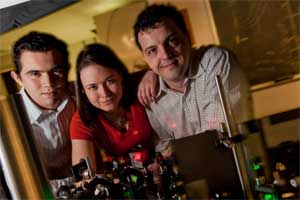
| From left, Rice graduate students Sergio Dominguez-Medina, Liane Slaughter and Alexei Tcherniak, co-authors (with Stephan Link and Ji Won Ha) of a new paper investigating the plasmonic properties of nanoparticles as they relate to a century-old theory. Courtesy Jeff Fitlow. |
Abstract:
Rice team tests century-old calculations
By Mike Williams, Rice News Staff
Look at Mie!
Houston, TX | Posted on March 13th, 2010Calculations are fine, but seeing is believing. That's the thought behind a new paper by Rice University students who decided to put to the test calculations made more than a century ago.
In 1908, the German physicist Gustav Mie came up with an elegant set of equations to describe the interaction of electromagnetic waves with a spherical metal particle. The theory has been a touchstone ever since for researchers seeking to quantify how nanoscale plasmonic particles scatter radiation.
"The Mie theory is used extensively whenever you deal with nanoparticles and their optical properties," said Alexei Tcherniak, a Rice graduate student and primary author of the new paper in the online edition of Nano Letters this month. "That's the foundation of every calculation."
Tcherniak and Stephan Link, a Rice assistant professor of chemistry and electrical and computer engineering, co-authored the paper with former graduate student Ji Won Ha and current Rice graduate students Liane Slaughter and Sergio Dominguez-Medina.
Better characterization of single nanoparticles is important to researchers pursuing microscopic optical sensors, subwavelength "super lenses," catalysis and photothermal cancer therapies that use nanoparticles.
"Since technology is moving toward single-particle detection, we wanted to see whether Mie's predictions would hold," Tcherniak said. "Average properties fall exactly on the predictions of Mie theory. But we show that individual particles deviate quite a bit."
Particles that differ in size can return similar signals because they vary in shape and orientation on the substrate, with which they also interact. Mie's theory, developed for spherical particles in solution long before the advent of single-particle spectroscopy, did not consider these factors.
The project began as a sideline in the students' attempt to track single nanoparticles in solution. It became their primary focus when they realized the scope of the task, which involved analyzing five sets of gold particles ranging from 51 to 237 nanometers wide - the "biologically relevant" sizes, Tcherniak explained.
Each set of particles was photographed with a scanning electron microscope and then analyzed for its absorption and scattering properties via single-particle photothermal imaging and laser dark-field scattering.
It was tedious, they admitted.
"When you need to find a particle 50 nanometers across on a sample that is 5-by-5 millimeters, you're looking for a needle in a haystack," Tcherniak said. Slaughter and Dominguez-Medina nodded in agreement and recalled a summer of long days categorizing hundreds of particles -- enough "to get all those points on the graph."
They used a couple of strategies to locate particles. One was to put micron-scale grid coordinates on the glass slide containing nanoparticle samples. "That let us know roughly where they were," Tcherniak said.
Another involved applying a bit of astronomy to their microscopy. They found themselves looking for "constellations" in the patterns of specks. "We started saying, 'Oh, that looks like a nose. Do we have a nose anywhere else?'" Slaughter said. "We were so tired; the names might not have been very good."
But their results are.
"Mie theory was around long before anyone knew about nanoparticles, so it's a neat thing to be able to test it," said Link of his students' work. "This is important because they really put together the building blocks that will enable scientists to look at more complex structures. This was not an easy job."
The National Science Foundation, the Robert A. Welch Foundation and 3M supported the research.
####
About Rice University
Rice has from its inception been dedicated to three missions: educating and preparing outstanding students for diverse careers and lives; contributing to the advancement of knowledge across a wide range of fields; and being of service to our city, our state, our nation, and our world. The Call to Conversation posed the question whether our current mission statement fully encompassed our ambitions, particularly our commitment as a research university to creating new knowledge and our obligation to train future leaders across a range of endeavors. It states: “The mission of Rice University, shaped largely by its founder and the first president, is to provide an unsurpassed undergraduate education in science, engineering, the arts, humanities, and social sciences; to produce internationally distinguished scholarship and research and excellent graduate education in carefully focused areas; to ensure that such an education remains affordable; to maintain the distinctive character of a community of learning that is relatively small in scale; and to serve the continuing educational needs of the larger community.”
For more information, please click here
Copyright © Rice University
If you have a comment, please Contact us.Issuers of news releases, not 7th Wave, Inc. or Nanotechnology Now, are solely responsible for the accuracy of the content.
Bookmark:


| Related News Press |
News and information
 Simulating magnetization in a Heisenberg quantum spin chain April 5th, 2024
NRL charters Navy’s quantum inertial navigation path to reduce drift April 5th, 2024
Discovery points path to flash-like memory for storing qubits: Rice find could hasten development of nonvolatile quantum memory April 5th, 2024
Govt.-Legislation/Regulation/Funding/Policy
NRL charters Navy’s quantum inertial navigation path to reduce drift April 5th, 2024
Discovery points path to flash-like memory for storing qubits: Rice find could hasten development of nonvolatile quantum memory April 5th, 2024
Chemical reactions can scramble quantum information as well as black holes April 5th, 2024
Academic/Education
Rice University launches Rice Synthetic Biology Institute to improve lives January 12th, 2024
Multi-institution, $4.6 million NSF grant to fund nanotechnology training September 9th, 2022
Nanomedicine
New micromaterial releases nanoparticles that selectively destroy cancer cells April 5th, 2024
Good as gold - improving infectious disease testing with gold nanoparticles April 5th, 2024
Researchers develop artificial building blocks of life March 8th, 2024
Announcements
NRL charters Navy’s quantum inertial navigation path to reduce drift April 5th, 2024
Discovery points path to flash-like memory for storing qubits: Rice find could hasten development of nonvolatile quantum memory April 5th, 2024
Tools
Ferroelectrically modulate the Fermi level of graphene oxide to enhance SERS response November 3rd, 2023
The USTC realizes In situ electron paramagnetic resonance spectroscopy using single nanodiamond sensors November 3rd, 2023
Nanobiotechnology
New micromaterial releases nanoparticles that selectively destroy cancer cells April 5th, 2024
Good as gold - improving infectious disease testing with gold nanoparticles April 5th, 2024
Researchers develop artificial building blocks of life March 8th, 2024
 |
||
 |
||
| The latest news from around the world, FREE | ||
 |
||
|
|
||
| Premium Products | ||
 |
||
|
Only the news you want to read!
Learn More |
||
 |
||
|
Full-service, expert consulting
Learn More |
||
|
|
||