Home > Press > Nanoscience poses solutions, problems for environmental ills
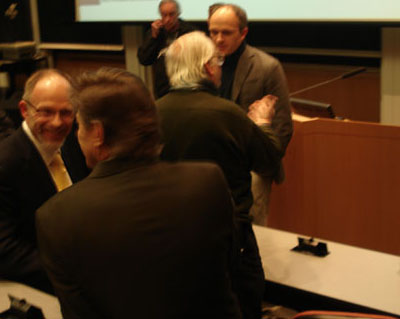 |
| Jeff Morris (Left) and Franz Geiger (Center) talk to audience members Tuesday night after a town hall meeting on nanotechnology. Courtesy Thomas Forrest/MEDILL. |
Abstract:
Story by Thomas Forrest
Imagine a cloud blocking out the sun's light, engulfing the world in darkness as people lived their fossil fueled dominated lives. This was the proposal of some scientists on Tuesday night in Northwestern University. Franz Geiger, associate professor of physical chemistry at Northwestern University, explained the potential benefits and ethical dilemma of such a situation at the third annual Nanotechnology Town Hall Meeting at Abbot Auditorium.
Nanoscience poses solutions, problems for environmental ills
Evanston, IL | Posted on January 14th, 2010He explained that one way to combat climate change without altering the way people live their lives was by shooting aerosols into space that could act as a reflector and deflect sunlight from earth. He presented a serene picture of the ash from a volcanic eruption preventing the light from the sun.
"The problem is that it will look at noon in July like this," he said.
Geiger acknowledged the psychological effects and moral hazards of such an occurrence. He said that he did not know what reflecting the sunlight from earth would do to the emotional well-being of people. "We know what happens in Iceland, which has a very high suicide rate," he said.
He said the alternative would be to actually have a reflector in orbit. He continued that nanoparticles would act as a giant reflector and cost roughly $10 billion dollars a year worldwide. "The temperature on the planet doesn't increase as quickly as it does without the reflectors, we can continue burning fossil fuels and driving one person per car, and life is good," he continued.
He said that controlling fossil fuel emissions was one way to combat climate control, but this was a costly and difficult proposition because the economy was based on fossil fuels.
Laurie Zoloth, director of the Center for Bioethics, Science and Society, discussed Northwestern University's commitment to nanotechnology and research, and she informed the audience of Northwestern University's Science in Society blog. She said the blog attempts to educate the community about the research efforts from Northwestern University and around the world and the ethical implications of that research.
"We've only been at this for about four or five years," said Jeff Morris, national program director for nanotechnology for the Environmental Protection Agency. He continued that there was still a lot that needed to be discovered about nanotechnology and how it affected health.
He said that a few studies suggesting toxicity did not necessarily equal risk, and researchers don't know if it represented real exposure. Morris said it took about 15 years before a researcher could really get to understand any types of depth within their studies.
"I'm not sure we can wait that long," Morris added.
He said that some of the challenges of research include being flexible and recognizing the limits of science. He added that the EPA has increased research on targeted effects, screening tools and an emphasis on green nanotechnology to discover what information was most needed to best inform decisions on nanotechnology.
"Nanoscale materials show promise for improving the environment," Morris said.
He said that little was known about nanomaterial toxicity and exposure. He said that a few studies suggesting toxicity did not necessarily equal risk, and researchers don't know if it represented real exposure.
Laura Hodson, the industrial hygienist for the Nanotechnology Research Center at the National Institute for Occupational Safety and Health, addressed the safety of nanotechnology. She said that researchers could always manage risk and control materials that may be hazardous.
"Fire can kill us, but we all have fire in our house. We cook with it every day, so we manage the risk," Hodson said. She said that researchers could always manage risk and control materials that may be hazardous.
"Nanomaterials are purposely engineered for their unique size dependent properties and behavior," she said.
She spoke about the beneficial applications of nanotechnology to the environment such as decreasing dependency on fuel, the ability to make fuel cells, batteries and pollution control.
"We have a second chance at new science, and indeed a second chance at a kind of industrial re-revolution named nanotechnology," Zoloth said.
####
About Northwestern University
Northwestern University combines innovative teaching and pioneering research in a highly collaborative environment that transcends traditional academic boundaries. It provides students and faculty exceptional opportunities for intellectual, personal and professional growth in a setting enhanced by the richness of Chicago.
For more information, please click here
Copyright © Northwestern University
If you have a comment, please Contact us.Issuers of news releases, not 7th Wave, Inc. or Nanotechnology Now, are solely responsible for the accuracy of the content.
Bookmark:


| Related News Press |
News and information
 Simulating magnetization in a Heisenberg quantum spin chain April 5th, 2024
NRL charters Navy’s quantum inertial navigation path to reduce drift April 5th, 2024
Discovery points path to flash-like memory for storing qubits: Rice find could hasten development of nonvolatile quantum memory April 5th, 2024
Ethics
Artificial Intelligence Centered Cancer Nanomedicine: Diagnostics, Therapeutics and Bioethics June 3rd, 2022
Iran to hold intl. school on application of nanomaterials in medicine September 20th, 2016
Synthetic biology needs robust safety mechanisms before real world application: Ethics and technology hold the key to the success of synthetic biology September 17th, 2015
March 2016; 6th Int'l Conference on Nanostructures in Iran July 29th, 2015
Preparing for Nano
Disruptive by Design: Nano Now February 1st, 2019
How nanoscience will improve our health and lives in the coming years: Targeted medicine deliveries and increased energy efficiency are just two of many ways October 26th, 2016
Searching for a nanotech self-organizing principle May 1st, 2016
Possible Futures
Discovery points path to flash-like memory for storing qubits: Rice find could hasten development of nonvolatile quantum memory April 5th, 2024
With VECSELs towards the quantum internet Fraunhofer: IAF achieves record output power with VECSEL for quantum frequency converters April 5th, 2024
Announcements
NRL charters Navy’s quantum inertial navigation path to reduce drift April 5th, 2024
Discovery points path to flash-like memory for storing qubits: Rice find could hasten development of nonvolatile quantum memory April 5th, 2024
Environment
Billions of nanoplastics released when microwaving baby food containers: Exposure to plastic particles kills up to 75% of cultured kidney cells July 21st, 2023
Safety-Nanoparticles/Risk management
Tests find no free-standing nanotubes released from tire tread wear September 8th, 2023
Billions of nanoplastics released when microwaving baby food containers: Exposure to plastic particles kills up to 75% of cultured kidney cells July 21st, 2023
Events/Classes
Researchers demonstrate co-propagation of quantum and classical signals: Study shows that quantum encryption can be implemented in existing fiber networks January 20th, 2023
 |
||
 |
||
| The latest news from around the world, FREE | ||
 |
||
|
|
||
| Premium Products | ||
 |
||
|
Only the news you want to read!
Learn More |
||
 |
||
|
Full-service, expert consulting
Learn More |
||
|
|
||