Home > Press > Argonne scientists squeeze more out of metal-organic framework
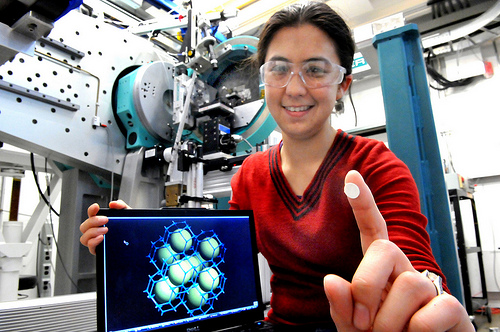 |
| Argonne scientist Karena Chapman holds up a wafer of metal organic framework ZIF-8 with its structure displayed on the computer screen. Chapman along with scientists Peter Chupas and Gregory Halder were able to change the structure of a metal organic framework at pressures low enough for large scale industrial applications. |
Abstract:
Scientists at the U.S. Department of Energy's (DOE) Argonne National Laboratory have discovered a new route to transform the structure of porous materials at industrially-accessible high pressures.
Argonne scientists squeeze more out of metal-organic framework
Argonne, IL | Posted on January 14th, 2010Normally, these materials will spring back to their original structure after they have been compressed, almost like a spring, but above a certain pressure this material adopts a new structure," Argonne scientist Karena Chapman said. "It is a related structure, but it is as if when we compressed the spring, it bounced back to a different shape."
ZIF-8 is a commercially available metal-organic framework (MOF) with molecular-scale pores that can have valuable catalytic applications. Chapman, along with scientists Gregory Halder and Peter Chupas, used the Advanced Photon Source's high-focused X-ray beams to observe the structure of the compound after it withstood varying degrees of pressure. The structural transition was found to occur at relatively modest pressures — pressures that can be achieved on the larger scales needed to test how the change in structure affects the compound's functional behavior.
Gas uptake measurements, carried out within the Materials Science Division, revealed that the material's porosity was modified for the new structure. This could be used to optimize its performance for specific applications in areas such as hydrogen storage for fuel cells. This discovery shows that by exerting pressure on MOFs through the pelletization process, researchers can modify the compound's structure and storage property.
While this type of structural change has been seen in traditional porous materials (e.g., zeolites) at much higher pressures, the structural changes in the MOF material occur at lower pressures and consequently, this modification can be more readily scaled up to industrial levels.
The next step is for the scientists to examine the mechanism of the structural change and how this modification process can be most effectively exploited for molecular storage and separation applications.
A paper about this discovery was recently published in the Journal of the American Chemical Society, here pubs.acs.org/doi/abs/10.1021/ja908415z?journalCode=jacsat.
####
About Argonne National Laboratory
Argonne National Laboratory seeks solutions to pressing national problems in science and technology. The nation's first national laboratory, Argonne conducts leading-edge basic and applied scientific research in virtually every scientific discipline. Argonne researchers work closely with researchers from hundreds of companies, universities, and federal, state and municipal agencies to help them solve their specific problems, advance America 's scientific leadership and prepare the nation for a better future. With employees from more than 60 nations, Argonne is managed by UChicago Argonne, LLC for the U.S. Department of Energy's Office of Science.
For more information, please click here
Contacts:
Brock Cooper
630/252-5565
Copyright © Argonne National Laboratory
If you have a comment, please Contact us.Issuers of news releases, not 7th Wave, Inc. or Nanotechnology Now, are solely responsible for the accuracy of the content.
Bookmark:


| Related News Press |
News and information
 Simulating magnetization in a Heisenberg quantum spin chain April 5th, 2024
NRL charters Navy’s quantum inertial navigation path to reduce drift April 5th, 2024
Discovery points path to flash-like memory for storing qubits: Rice find could hasten development of nonvolatile quantum memory April 5th, 2024
Chemistry
What heat can tell us about battery chemistry: using the Peltier effect to study lithium-ion cells March 8th, 2024
Nanoscale CL thermometry with lanthanide-doped heavy-metal oxide in TEM March 8th, 2024
Possible Futures
Discovery points path to flash-like memory for storing qubits: Rice find could hasten development of nonvolatile quantum memory April 5th, 2024
With VECSELs towards the quantum internet Fraunhofer: IAF achieves record output power with VECSEL for quantum frequency converters April 5th, 2024
Discoveries
Chemical reactions can scramble quantum information as well as black holes April 5th, 2024
New micromaterial releases nanoparticles that selectively destroy cancer cells April 5th, 2024
Utilizing palladium for addressing contact issues of buried oxide thin film transistors April 5th, 2024
Materials/Metamaterials/Magnetoresistance
Nanoscale CL thermometry with lanthanide-doped heavy-metal oxide in TEM March 8th, 2024
Focused ion beam technology: A single tool for a wide range of applications January 12th, 2024
Announcements
NRL charters Navy’s quantum inertial navigation path to reduce drift April 5th, 2024
Discovery points path to flash-like memory for storing qubits: Rice find could hasten development of nonvolatile quantum memory April 5th, 2024
Energy
Development of zinc oxide nanopagoda array photoelectrode: photoelectrochemical water-splitting hydrogen production January 12th, 2024
Shedding light on unique conduction mechanisms in a new type of perovskite oxide November 17th, 2023
Inverted perovskite solar cell breaks 25% efficiency record: Researchers improve cell efficiency using a combination of molecules to address different November 17th, 2023
The efficient perovskite cells with a structured anti-reflective layer – another step towards commercialization on a wider scale October 6th, 2023
Industrial
Boron nitride nanotube fibers get real: Rice lab creates first heat-tolerant, stable fibers from wet-spinning process June 24th, 2022
Nanotubes: a promising solution for advanced rubber cables with 60% less conductive filler June 1st, 2022
Protective equipment with graphene nanotubes meets the strictest ESD safety standards March 25th, 2022
OCSiAl receives the green light for Luxembourg graphene nanotube facility project to power the next generation of electric vehicles in Europe March 4th, 2022
Fuel Cells
Current and Future Developments in Nanomaterials and Carbon Nanotubes: Applications of Nanomaterials in Energy Storage and Electronics October 28th, 2022
 |
||
 |
||
| The latest news from around the world, FREE | ||
 |
||
|
|
||
| Premium Products | ||
 |
||
|
Only the news you want to read!
Learn More |
||
 |
||
|
Full-service, expert consulting
Learn More |
||
|
|
||