Home > Press > Computer-rendered flexibility map of Bacteriorhodposin
 |
| Nanomechanical Sensing Group, Rowland Institute at Harvard |
Abstract:
Investigators study the properties of proteins, akin to tiny molecular machines with complex moving parts, by analyzing their crystal structures.
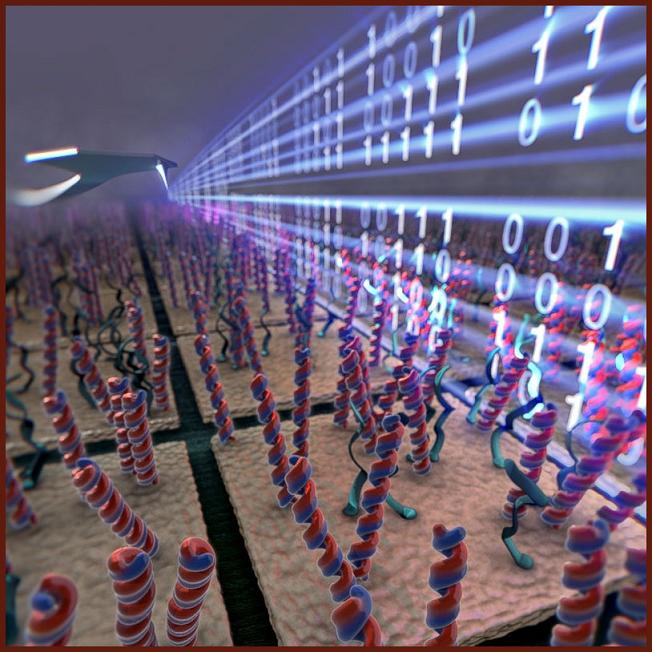
Computer-rendered flexibility map of Bacteriorhodposin
Cambridge, MA | Posted on January 12th, 2010Given the extremely small physical dimensions involved, capturing the "frozen images of their atoms" is extremely difficult. Moreover, these molecular machines work fast---moving to and fro in mere microseconds. To take a snapshot, a team at the Rowland Institute at Harvard led by Ozgur Sahin, Primary Investigator and Junior Fellow, and Sudhir Husale, postdoctoral fellow, developed a new technology called microsecond force spectroscopy. The method offers dramatically improved spatial and temporal resolutions in mechanical measurements and provides researchers with a robust platform to investigate a wide range of proteins involved in diseases and other biological processes. Pictured is a computer-rendered flexibility map of Bacteriorhodposin, a membrane protein that converts light into electrical energy. The findings were published online in Nature on December 13. Sahin and Husale's collaborators included Henrik H. J. Persson, a Research Associate at the Stanford Genome Technology Center, and Mingdong Dong, a postdoctoral fellow at Rowland.
####
About Harvard University
Harvard University (incorporated as The President and Fellows of Harvard College) is a private university located in Cambridge, Massachusetts and a member of the Ivy League. Founded in 1636 by the colonial Massachusetts legislature, Harvard is the oldest institution of higher learning in the United States and currently comprises ten separate academic units. It is also the first and oldest corporation in the United States.
From Wikipedia, the free encyclopedia
For more information, please click here
Copyright © Harvard University
If you have a comment, please Contact us.Issuers of news releases, not 7th Wave, Inc. or Nanotechnology Now, are solely responsible for the accuracy of the content.
Bookmark:


| Related News Press |
News and information
 Simulating magnetization in a Heisenberg quantum spin chain April 5th, 2024
NRL charters Navy’s quantum inertial navigation path to reduce drift April 5th, 2024
Discovery points path to flash-like memory for storing qubits: Rice find could hasten development of nonvolatile quantum memory April 5th, 2024
Nanomedicine
New micromaterial releases nanoparticles that selectively destroy cancer cells April 5th, 2024
Good as gold - improving infectious disease testing with gold nanoparticles April 5th, 2024
Researchers develop artificial building blocks of life March 8th, 2024
Tools
Ferroelectrically modulate the Fermi level of graphene oxide to enhance SERS response November 3rd, 2023
The USTC realizes In situ electron paramagnetic resonance spectroscopy using single nanodiamond sensors November 3rd, 2023
 |
||
 |
||
| The latest news from around the world, FREE | ||
 |
||
|
|
||
| Premium Products | ||
 |
||
|
Only the news you want to read!
Learn More |
||
 |
||
|
Full-service, expert consulting
Learn More |
||
|
|
||