Home > Press > Nanoscale origami from DNA - Researchers develop a new toolbox for nano-engineering
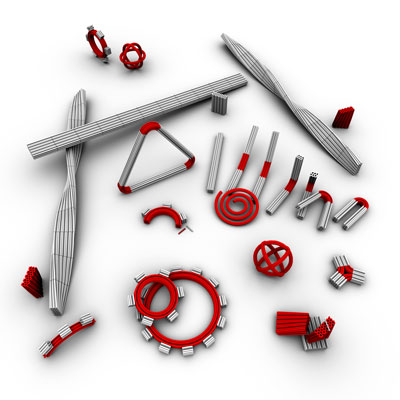 |
| DNA molecules as ideal building blocks for nano structures. Image: H. Dietz, TUM Dept. of Physics |
Abstract:
Scientists at the Technische Universitaet Muenchen (TUM) and Harvard University have thrown the lid off a new toolbox for building nanoscale structures out of DNA, with complex twisting and curving shapes. In the August 7 issue of the journal Science, they report a series of experiments in which they folded DNA, origami-like, into three-dimensional objects including a beach ball-shaped wireframe capsule just 50 nanometers in diameter.
Nanoscale origami from DNA - Researchers develop a new toolbox for nano-engineering
Germany & Massachusetts | Posted on August 6th, 2009"Our goal was to find out whether we could program DNA to assemble into shapes that exhibit custom curvature or twist, with features just a few nanometers wide," says biophysicist Hendrik Dietz, a professor at the Technische Universitaet Muenchen. Dietz's collaborators in these experiments were Professor William Shih and Dr. Shawn Douglas of Harvard University. "It worked," he says, "and we can now build a diversity of three-dimensional nanoscale machine parts, such as round gears or curved tubes or capsules. Assembling those parts into bigger, more complex and functional devices should be possible."
As a medium for nanoscale engineering, DNA has the dual advantages of being a smart material - not only tough and flexible but also programmable - and being very well characterized by decades of study. Basic tools that Dietz, Douglas, and Shih employ are programmable self-assembly - directing DNA strands to form custom-shaped bundles of cross-linked double helices - and targeted insertions or deletions of base pairs that can give such bundles a desired twist or curve. Right-handed or left-handed twisting can be specified. They report achieving precise, quantitative control of these shapes, with a radius of curvature as tight as 6 nanometers.
The toolbox they have developed includes a graphical software program that helps to translate specific design concepts into the DNA programming required to realize them. Three-dimensional shapes are produced by "tuning" the number, arrangement, and lengths of helices.
In their current paper, the researchers present a wide variety of nanoscale structures and describe in detail how they designed, formed, and verified them. "Many advanced macroscopic machines require curiously shaped parts in order to function," Dietz says, "and we have the tools to make them. But we currently cannot build something intricate such as an ant's leg or, much smaller, a ten-nanometer-small chemical plant such as a protein enzyme. We expect many benefits if only we could build super-miniaturized devices on the nanoscale using materials that work robustly in the cells of our bodies - biomolecules such as DNA."
Original paper:
Folding DNA into Twisted and Curved Nanoscale Shapes
Hendrik Dietz, Shawn M. Douglas, and William M. Shih,
Science 7 August 2009: Vol. 325. no. 5941, pp. 725 - 730 - DOI: 10.1126/science.1174251
####
About Technische Universitaet Muenchen
Technische Universität München (TUM; sometimes translated as Technical University Munich)[2] is a research university with campuses in Munich, Garching, and Weihenstephan.
TUM is among the highest acclaimed universities in Germany, producing several Nobel Laureates including Gerhard Ertl who in 2007 received the Nobel Prize in Chemistry.
From Wikipedia, the free encyclopedia
For more information, please click here
Contacts:
Prof. Hendrik Dietz
Department of Physics
Technische Universitaet Muenchen
James-Franck-Str. 1, 85748 Garching, Germany
Tel. +49 89 289 12539
Fax: +49 89 289 12523
Copyright © Technische Universitaet Muenchen
If you have a comment, please Contact us.Issuers of news releases, not 7th Wave, Inc. or Nanotechnology Now, are solely responsible for the accuracy of the content.
Bookmark:


| Related News Press |
News and information
 Simulating magnetization in a Heisenberg quantum spin chain April 5th, 2024
NRL charters Navy’s quantum inertial navigation path to reduce drift April 5th, 2024
Discovery points path to flash-like memory for storing qubits: Rice find could hasten development of nonvolatile quantum memory April 5th, 2024
Possible Futures
Discovery points path to flash-like memory for storing qubits: Rice find could hasten development of nonvolatile quantum memory April 5th, 2024
With VECSELs towards the quantum internet Fraunhofer: IAF achieves record output power with VECSEL for quantum frequency converters April 5th, 2024
Molecular Machines
First electric nanomotor made from DNA material: Synthetic rotary motors at the nanoscale perform mechanical work July 22nd, 2022
Nanotech scientists create world's smallest origami bird March 17th, 2021
Giant nanomachine aids the immune system: Theoretical chemistry August 28th, 2020
Announcements
NRL charters Navy’s quantum inertial navigation path to reduce drift April 5th, 2024
Discovery points path to flash-like memory for storing qubits: Rice find could hasten development of nonvolatile quantum memory April 5th, 2024
Nanobiotechnology
New micromaterial releases nanoparticles that selectively destroy cancer cells April 5th, 2024
Good as gold - improving infectious disease testing with gold nanoparticles April 5th, 2024
Researchers develop artificial building blocks of life March 8th, 2024
 |
||
 |
||
| The latest news from around the world, FREE | ||
 |
||
|
|
||
| Premium Products | ||
 |
||
|
Only the news you want to read!
Learn More |
||
 |
||
|
Full-service, expert consulting
Learn More |
||
|
|
||