Home > Press > New silver nanoparticle skin gel for healing burns
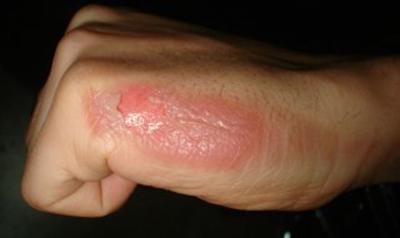 |
| A new skin gel made of silver nanoparticles may help improve the treatment of burns, researchers say. Credit: The American Chemical Society |
Abstract:
Scientists in India are reporting successful laboratory tests of a new and potentially safer alternative to silver-based gels applied to the skin of burn patients to treat infections.
New silver nanoparticle skin gel for healing burns
Pune, India | Posted on July 23rd, 2009With names like silver sulfadiazine and silver nitrate, these germ-fighters save lives and speed healing. The researchers describe gel composed of silver nanoparticles — each 1/50,000th the width of a human hair — that appears more effective than these traditional gels. Their study is scheduled for the Aug. 3 issue of ACS' Molecular Pharmaceutics, a bi-monthly journal.
Kishore Paknikar and colleagues note that antimicrobial silver compounds have been used for decades on burn patients, whose damaged skin is highly vulnerable to bacterial infections. However, topical silver agents now in use can loose effectiveness in the body, cause skin discoloration, and damage cells. Drug-resistant bacteria can make these treatments less effective.
The scientists demonstrated that their gel killed a broad range of harmful bacteria, including Pseudomonas aeruginosa, one of the most common causes of burn infections, as well as several drug-resistant microbes. The gel, which contains 30 times less silver than silver sulfadiazine, did not have any apparent toxic effects when applied to the healthy skin of test animals. "These results clearly indicate that silver nanoparticles could provide a safer alternative to conventional antimicrobial agents in the form of a topical antimicrobial formulation," the article states.
DOWNLOAD FULL TEXT ARTICLE: pubs.acs.org/stoken/presspac/presspac/full/10.1021/mp900056g
####
About American Chemical Society
ACS is a congressionally chartered independent membership organization which represents professionals at all degree levels and in all fields of chemistry and sciences that involve chemistry.
For more information, please click here
Contacts:
Kishore Paknikar, Ph.D.
Centre for Nanobioscience
Agharkar Research Institute
Pune, India
Phone: 91-20-25653680, ext. 372
Fax: 91-20-2565142
Email:
Copyright © Eurekalert
If you have a comment, please Contact us.Issuers of news releases, not 7th Wave, Inc. or Nanotechnology Now, are solely responsible for the accuracy of the content.
Bookmark:


| Related News Press |
News and information
 Simulating magnetization in a Heisenberg quantum spin chain April 5th, 2024
NRL charters Navy’s quantum inertial navigation path to reduce drift April 5th, 2024
Discovery points path to flash-like memory for storing qubits: Rice find could hasten development of nonvolatile quantum memory April 5th, 2024
Possible Futures
Discovery points path to flash-like memory for storing qubits: Rice find could hasten development of nonvolatile quantum memory April 5th, 2024
With VECSELs towards the quantum internet Fraunhofer: IAF achieves record output power with VECSEL for quantum frequency converters April 5th, 2024
Nanomedicine
New micromaterial releases nanoparticles that selectively destroy cancer cells April 5th, 2024
Good as gold - improving infectious disease testing with gold nanoparticles April 5th, 2024
Researchers develop artificial building blocks of life March 8th, 2024
Announcements
NRL charters Navy’s quantum inertial navigation path to reduce drift April 5th, 2024
Discovery points path to flash-like memory for storing qubits: Rice find could hasten development of nonvolatile quantum memory April 5th, 2024
Nanobiotechnology
New micromaterial releases nanoparticles that selectively destroy cancer cells April 5th, 2024
Good as gold - improving infectious disease testing with gold nanoparticles April 5th, 2024
Researchers develop artificial building blocks of life March 8th, 2024
 |
||
 |
||
| The latest news from around the world, FREE | ||
 |
||
|
|
||
| Premium Products | ||
 |
||
|
Only the news you want to read!
Learn More |
||
 |
||
|
Full-service, expert consulting
Learn More |
||
|
|
||