Home > Press > Prof. Choi Unveils Method to Improve Emission Efficiency of OLED
 |
Abstract:
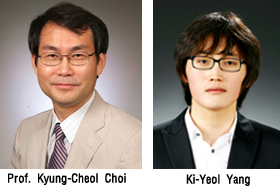
A KAIST research team led by Prof. Kyung-Cheol Choi of the School of Electrical Engineering & Computer Science discovered the surface plasmon-enhanced spontaneous emission based on an organic light-emitting device (OLED), a finding expected to improve OLED's emission efficiency, KAIST authorities said on Thursday (July 9).
Prof. Choi Unveils Method to Improve Emission Efficiency of OLED
Korea | Posted on July 15th, 2009For surface plasmon localization, silver nanoparticles were thermally deposited in a high vacuum on cathode. Since plasmons provide a strong oscillator decay channel, time-resolved photoluninescene (PL) results displayed a 1.75-fold increased emission rate, and continuous wave PL results showed a twofold enhanced intensity.
"The method using surface plasmon represents a new technology to enhance the emission efficiency of OLED. It is expected to greatly contribute to the development of new technologies in OLED and flexible display, as well as securing original technology," Prof. Choi said.
The finding was published in the April issue of Applied Physics Letters and the June 25 issue of Optics Express. It will be also featured as the research highlight of the August issue of Nature Photonics and Virtual Journal of Ultrafast Science.
####
About KAIST
Korea Advanced Institute of Science and Technology (KAIST) was established in 1971 as the nation’s first graduate school specializing in science and engineering education and research. The school’s founding was a catalyst for Korea’s rapid rise from a producer of light industry goods to a world leader in high-technology industries.
For more information, please click here
Contacts:
335 Gwahak-ro (373-1 Guseong-dong), Yuseong-gu, Daejeon 305-701,
Republic of Korea Tel . +82-42-350-2114 Fax . +82-42-350-2210 (2220)
Copyright © KAIST
If you have a comment, please Contact us.Issuers of news releases, not 7th Wave, Inc. or Nanotechnology Now, are solely responsible for the accuracy of the content.
Bookmark:


| Related News Press |
News and information
 Simulating magnetization in a Heisenberg quantum spin chain April 5th, 2024
NRL charters Navy’s quantum inertial navigation path to reduce drift April 5th, 2024
Discovery points path to flash-like memory for storing qubits: Rice find could hasten development of nonvolatile quantum memory April 5th, 2024
Good as gold - improving infectious disease testing with gold nanoparticles April 5th, 2024
Display technology/LEDs/SS Lighting/OLEDs
Utilizing palladium for addressing contact issues of buried oxide thin film transistors April 5th, 2024
Light guide plate based on perovskite nanocomposites November 3rd, 2023
Simple ballpoint pen can write custom LEDs August 11th, 2023
Possible Futures
Discovery points path to flash-like memory for storing qubits: Rice find could hasten development of nonvolatile quantum memory April 5th, 2024
With VECSELs towards the quantum internet Fraunhofer: IAF achieves record output power with VECSEL for quantum frequency converters April 5th, 2024
Discoveries
Chemical reactions can scramble quantum information as well as black holes April 5th, 2024
New micromaterial releases nanoparticles that selectively destroy cancer cells April 5th, 2024
Utilizing palladium for addressing contact issues of buried oxide thin film transistors April 5th, 2024
Announcements
NRL charters Navy’s quantum inertial navigation path to reduce drift April 5th, 2024
Discovery points path to flash-like memory for storing qubits: Rice find could hasten development of nonvolatile quantum memory April 5th, 2024
 |
||
 |
||
| The latest news from around the world, FREE | ||
 |
||
|
|
||
| Premium Products | ||
 |
||
|
Only the news you want to read!
Learn More |
||
 |
||
|
Full-service, expert consulting
Learn More |
||
|
|
||