Home > Press > Quick-fix Molecular Machines
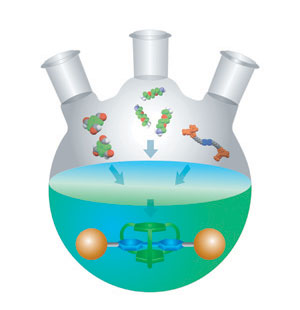 |
| Berkeley Lab researchers at the Molecular Foundry have developed a route to rapidly assemble 'cage-like' container molecules that could be used as molecular machines. |
Abstract:
Berkeley Lab researchers have developed simple recipes to whip up ‘cage-like' container structures for the creation of complex molecular machines.
Quick-fix Molecular Machines
Berkeley, CA | Posted on May 25th, 2009A sprinkle of this, a dash of that, sit back and let chemistry do its magic. Smells like a cooking analogy, but Berkeley Lab researchers have used just such a simple recipe to whip up ‘cage-like' container structures to create complex molecular machines that can be programmed to rotate, switch and perform mechanical work.
Previous research has shown efficient synthetic techniques can be used to construct complicated molecular machines that function by moving the individual parts within an overall molecular architecture. An example of this is a rotaxane-a complex molecule made of interlocking components that resemble wheels and axles. The tiniest building blocks in a scientist's toy chest, these nanoscale parts ‘clip' together to form functional molecular machines.
Unlike their macroscale counterparts, however, these interlocked molecules require no tinkering-"you can throw all the pieces together and let it assemble on its own," said Yi Liu, a staff scientist in the Organic and Macromolecular Synthesis Facility in the Molecular Foundry, a U.S. Department of Energy User Facility located at Berkeley Lab that provides support to nanoscience researchers around the world. ‘The challenge is how to engineer a synthetic route to make the assembly happen on demand."
Liu and colleagues have done just this, creating a caged structure made of benzene-like rings that assemble themselves around an axle of bipyridinium (a similar but positively-charged molecule containing nitrogen) to create an interlocked architecture. The cage itself could hold ions or small biological molecules, making it potentially useful for sensing applications.
"Our findings are especially attractive as the entire structure is formed through a ‘one-pot' synthesis from six individual ingredients. Once the driving force, in this case the weak interactions between molecules, is identified, we can tailor the clipping to give us just the interlocked structure in an efficient manner, without undesirable polymer byproducts," Liu said. "What could be simpler?"
The researchers anticipate the caged structure could be used as molecular containers for sensing, or as molecular switches by selectively sliding the cage along the axle, with ‘on' and ‘off' settings at either end. "The easy steps and simple precursors suggest these structures can be readily obtained in large-scale to support their applications," Liu adds.
"Linear p-acceptor templated dynamic clipping to macrobicycles and [2]rotaxanes," by Liana M. Klivansky, Gayane Koshkakaryan, Dennis Cao and Yi Liu, appears in Angewandte Chemie International Edition and is available in Angewandte Chemie online.
The Office of Science, Office of Basic Energy Sciences, of the United States Department of Energy, supported this work, under contract No. DE-AC02-05 CH11231.
The Molecular Foundry is one of the five DOE Nanoscale Science Research Centers (NSRCs), premier national user facilities for interdisciplinary research at the nanoscale. Together the NSRCs comprise a suite of complementary facilities that provide researchers with state-of-the-art capabilities to fabricate, process, characterize and model nanoscale materials, and constitute the largest infrastructure investment of the National Nanotechnology Initiative. The NSRCs are located at DOE's Argonne, Brookhaven, Lawrence Berkeley, Oak Ridge and Sandia and Los Alamos National Laboratories. For more information about the DOE NSRCs, please visit nano.energy.gov.
####
About Berkeley Lab
Berkeley Lab is a U.S. Department of Energy national laboratory located in Berkeley, California. It conducts unclassified scientific research and is managed by the University of California. Visit our website at www.lbl.gov.
For more information, please click here
Contacts:
Aditi Risbud
(510)486-4861
Copyright © Berkeley Lab
If you have a comment, please Contact us.Issuers of news releases, not 7th Wave, Inc. or Nanotechnology Now, are solely responsible for the accuracy of the content.
Bookmark:


| Related News Press |
News and information
 Simulating magnetization in a Heisenberg quantum spin chain April 5th, 2024
NRL charters Navy’s quantum inertial navigation path to reduce drift April 5th, 2024
Discovery points path to flash-like memory for storing qubits: Rice find could hasten development of nonvolatile quantum memory April 5th, 2024
Possible Futures
Discovery points path to flash-like memory for storing qubits: Rice find could hasten development of nonvolatile quantum memory April 5th, 2024
With VECSELs towards the quantum internet Fraunhofer: IAF achieves record output power with VECSEL for quantum frequency converters April 5th, 2024
Molecular Machines
First electric nanomotor made from DNA material: Synthetic rotary motors at the nanoscale perform mechanical work July 22nd, 2022
Nanotech scientists create world's smallest origami bird March 17th, 2021
Giant nanomachine aids the immune system: Theoretical chemistry August 28th, 2020
Self Assembly
Liquid crystal templated chiral nanomaterials October 14th, 2022
Nanoclusters self-organize into centimeter-scale hierarchical assemblies April 22nd, 2022
Atom by atom: building precise smaller nanoparticles with templates March 4th, 2022
Nanostructures get complex with electron equivalents: Nanoparticles of two different sizes break away from symmetrical designs January 14th, 2022
Sensors
Announcements
NRL charters Navy’s quantum inertial navigation path to reduce drift April 5th, 2024
Discovery points path to flash-like memory for storing qubits: Rice find could hasten development of nonvolatile quantum memory April 5th, 2024
 |
||
 |
||
| The latest news from around the world, FREE | ||
 |
||
|
|
||
| Premium Products | ||
 |
||
|
Only the news you want to read!
Learn More |
||
 |
||
|
Full-service, expert consulting
Learn More |
||
|
|
||