Home > Press > Dimensional Crossover in Nano-size Particles
 |
Abstract:
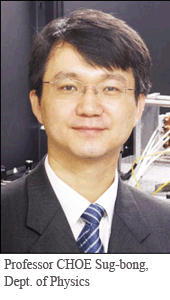
Professor CHOE Sug-bong found that nano-size particles could be reduced to the point where they exist in a blurred boundary between a two-dimensional and one-dimensional phase.
Dimensional Crossover in Nano-size Particles
Seoul, Korea | Posted on May 11th, 2009CHOE's research marks the first time that the dimensional crossover from a two-dimensional planar object and a one-dimensional line has been observed, as well as the critical point where the phase boundary ceases to exist.
Professor CHOE said the latest findings add detail to the complex picture of nature's universal laws in phase transitions, which regulate everything from the transition between vapor and liquid to changes in stock markets and earthquakes.
The discovery could also contribute to advancing emerging technology fields such as nano-sprintronics and developing new methods for producing nano-materials, he said.
``The research was conducted to improve our knowledge of nature's universality in controlling natural phenomenon, but the fundamental logic revealed in our study also offers possibilities for industrial applications,'' CHOE said.
``Nano-size objects used in electronic devices are getting smaller and smaller, and it's easy to predict that the nano-particles will be reduced in size to a point where they make the transition from the three-dimensional regime to a two-dimensional regime, and eventually a one-dimensional regime. However, scientists have been coming short of revealing exactly at what size the transitions occurs and the process of the transition, and our study provides an advancement in this area,'' he said.
The crossover to the one-dimensional regime occurred at a few hundred nanometers, which corresponds to the integration scale for modern nano-devices, CHOE said.
When the widths of the nano-wires were between 4.2 micrometers to 756 nanometers, the motions of domain walls retained the speed of a two-dimensional phase.
However, crossover behavior was first detected when the nano-wires were reduced to 500 nanometers in width, and at the 150-nanometer level particles began showing one-dimensional characteristics.
``We were surprised to discover that the two dimensional characteristics and one-dimensional characteristics co-existed when the nano-particles were between 500 nanometers and 150 nanometers in width,'' CHOE said.
``For this certain material, the crossover to the one dimensional phase occurred when it was reduced below 150 nanometers, while it retained two dimensional characteristics above 500 nanometers.''
This study was published in journal Nature on April 8.
####
About Seoul National University
Seoul National University honors the ideals of liberal education and aims to teach students a lifelong love of learning that will form the basis for continuous personal growth.
At the same time it is committed to preparing students to work and live in an increasingly competitive global environment. As South Korea's first national university, Seoul National University has a tradition of standing up for democracy and peace on the Korean peninsula.
Graduates have long served as public servants in key positions of the Korean government. In teaching, research, and public service, Seoul National University continues to set the standard of excellence.
The mission of Seoul National University in the twenty-first century is to create a vibrant intellectual community where students and scholars join together in building the future. As Korea's leading research university, Seoul National University is committed to diversifying its student body and faculty, fostering global exchange, and promoting path-breaking research in all fields of knowledge.
For more information, please click here
Contacts:
Main Campus, Gwanak _ 599 Gwanak-ro, Gwanak-gu, Seoul 151-742, Korea
Tel: 82-2-880-4447
Fax: 82-2-880-4449
Medical Campus, Yongon _103 Daehangno, Jongno-gu, Seoul 110-799, Korea
Copyright © Seoul National University
If you have a comment, please Contact us.Issuers of news releases, not 7th Wave, Inc. or Nanotechnology Now, are solely responsible for the accuracy of the content.
Bookmark:


| Related News Press |
News and information
 Simulating magnetization in a Heisenberg quantum spin chain April 5th, 2024
NRL charters Navy’s quantum inertial navigation path to reduce drift April 5th, 2024
Discovery points path to flash-like memory for storing qubits: Rice find could hasten development of nonvolatile quantum memory April 5th, 2024
Possible Futures
Discovery points path to flash-like memory for storing qubits: Rice find could hasten development of nonvolatile quantum memory April 5th, 2024
With VECSELs towards the quantum internet Fraunhofer: IAF achieves record output power with VECSEL for quantum frequency converters April 5th, 2024
Spintronics
Quantum materials: Electron spin measured for the first time June 9th, 2023
Linearly assembled Ag-Cu nanoclusters: Spin transfer and distance-dependent spin coupling November 4th, 2022
Materials/Metamaterials/Magnetoresistance
Nanoscale CL thermometry with lanthanide-doped heavy-metal oxide in TEM March 8th, 2024
Focused ion beam technology: A single tool for a wide range of applications January 12th, 2024
Announcements
NRL charters Navy’s quantum inertial navigation path to reduce drift April 5th, 2024
Discovery points path to flash-like memory for storing qubits: Rice find could hasten development of nonvolatile quantum memory April 5th, 2024
Industrial
Boron nitride nanotube fibers get real: Rice lab creates first heat-tolerant, stable fibers from wet-spinning process June 24th, 2022
Nanotubes: a promising solution for advanced rubber cables with 60% less conductive filler June 1st, 2022
Protective equipment with graphene nanotubes meets the strictest ESD safety standards March 25th, 2022
OCSiAl receives the green light for Luxembourg graphene nanotube facility project to power the next generation of electric vehicles in Europe March 4th, 2022
 |
||
 |
||
| The latest news from around the world, FREE | ||
 |
||
|
|
||
| Premium Products | ||
 |
||
|
Only the news you want to read!
Learn More |
||
 |
||
|
Full-service, expert consulting
Learn More |
||
|
|
||