Home > Press > Novellus' 32nm UV-Absorbing Dielectric Films Key to Improved Device Reliability
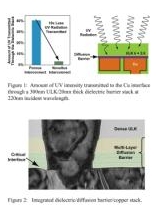 |
| Figure 1: Amount of UV intensity transmitted to the Cu interface through a 300nm ULK/20nm thick dielectric barrier stack at 220nm incident wavelength. Figure 2: Integrated dielectric/diffusion barrier/copper stack. (PRNewsFoto/Novellus Systems, Inc.) |
Abstract:
Dense ULK and Diffusion Barrier Stack Absorbs Order-of-Magnitude More UV Radiation Than Porous Interconnect Alternatives
Novellus' 32nm UV-Absorbing Dielectric Films Key to Improved Device Reliability
San Jose, CA | Posted on May 6th, 2009In order for RC delay to continue to scale in accordance with the International Technology Roadmap for Semiconductors (ITRS), device manufacturers are integrating ultra-low k (ULK) dielectric materials into their 32 nm process flows. At the same time, UltraViolet Thermal Processing (UVTP) is being introduced into the semiconductor manufacturing process to improve the mechanical properties of these ULK materials, making them more robust for subsequent Chemical Mechanical Planarization (CMP) and packaging operations. However, the UVTP process can alter the nature of the stress of the ULK film stack at the copper-dielectric interface. While it is widely accepted that maintaining a compressive stress at this interface can positively impact copper electromigration and film stack reliability, exposing some dielectric films to UV radiation can shift the stress in the film from compressive to tensile, which will negatively affect device performance.
Novellus (Nasdaq: NVLS) has developed a suite of 32nm dielectric films which significantly reduce the transmission of UV radiation to the critical copper-dielectric interface, maintaining a compressive stress in this region and hence device reliability. Figure 1 shows that the Novellus interconnect stack, consisting of a dense ULK and a low-k diffusion barrier, transmits an order-of-magnitude lower UV intensity (220nm wavelength) in comparison to a porous ULK solution. The improved UV absorption of Novellus' ULK film stack is a direct result of the chemical composition of the film. Figure 2 shows the integration of a multi-layer diffusion barrier beneath the dense ULK film. This unique barrier was designed to remain compressive after UV exposure and protect the copper-dielectric interface. Novellus' Multi-Station Sequential Processing (MSSP) architecture ensures that the multi-layer barrier can be deposited in a single pass with high productivity.
"Some 32nm ULK inter-metal dielectric and diffusion barrier films can be negatively impacted by UVTP, changing the stress on the underlying copper-dielectric interface," said Andy Antonelli, technology manager at Novellus' PECVD business. "Relative to competitive offerings, the greater UV absorption capabilities of the new Novellus films preserves the compressive stress at this critical interface and thus minimizes reliability concerns."
For more information regarding the use of dielectric diffusion barriers resistant to UV, go to www.novellustechnews.com.
About Novellus' PECVD Technology:
For high-volume manufacturing applications at 45nm and beyond, Novellus' advanced low-k, ILD, IMD, and dielectric diffusion barrier films offer the lowest k-effective, superior RC control, and an easily integrated low-cost dielectric solution.
####
About Novellus Systems, Inc.
Novellus Systems, Inc. (Nasdaq: NVLS) is a leading provider of advanced process equipment for the global semiconductor industry. The company's products deliver value to customers by providing innovative technology backed by trusted productivity. An S&P 500 company, Novellus is headquartered in San Jose, Calif. with subsidiary offices across the globe.
For more information, please click here
Copyright © PR Newswire Association LLC.
If you have a comment, please Contact us.Issuers of news releases, not 7th Wave, Inc. or Nanotechnology Now, are solely responsible for the accuracy of the content.
Bookmark:


| Related News Press |
News and information
 Simulating magnetization in a Heisenberg quantum spin chain April 5th, 2024
NRL charters Navy’s quantum inertial navigation path to reduce drift April 5th, 2024
Discovery points path to flash-like memory for storing qubits: Rice find could hasten development of nonvolatile quantum memory April 5th, 2024
Chip Technology
Discovery points path to flash-like memory for storing qubits: Rice find could hasten development of nonvolatile quantum memory April 5th, 2024
Utilizing palladium for addressing contact issues of buried oxide thin film transistors April 5th, 2024
HKUST researchers develop new integration technique for efficient coupling of III-V and silicon February 16th, 2024
Announcements
NRL charters Navy’s quantum inertial navigation path to reduce drift April 5th, 2024
Discovery points path to flash-like memory for storing qubits: Rice find could hasten development of nonvolatile quantum memory April 5th, 2024
Tools
Ferroelectrically modulate the Fermi level of graphene oxide to enhance SERS response November 3rd, 2023
The USTC realizes In situ electron paramagnetic resonance spectroscopy using single nanodiamond sensors November 3rd, 2023
 |
||
 |
||
| The latest news from around the world, FREE | ||
 |
||
|
|
||
| Premium Products | ||
 |
||
|
Only the news you want to read!
Learn More |
||
 |
||
|
Full-service, expert consulting
Learn More |
||
|
|
||