Home > Press > Safer Nano Cancer Detector: Nanoparticle test in mice could pave the way for human uses
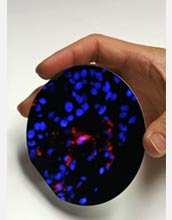 |
| Bright red-orange photoluminescence observed from porous silicon nanoparticles with human HeLa cells, magnified 1000x and viewed in the reflection from a silicon wafer. Prepared from high-purity silicon wafers, these nanoparticles provide a non-toxic and biodegradable alternative to conventional quantum dots for in-vitro and in-vivo fluorescence imaging. The cell nuclei are stained blue. Credit: Luo Gu, Ji-Ho Park, UCSD |
Abstract:
The first biodegradable fluorescent nanoparticle to safely image tumors and organs in live mice could be used for cancer detection and treatment in humans.
Chemistry professor Michael Sailor and a team including National Science Foundation supported researchers at the University of California, San Diego, report developing the first nanoscale "quantum dot" particle that glows brightly enough to allow physicians to examine internal organs and lasts long enough to release cancer drugs before breaking down into harmless by-products.
Safer Nano Cancer Detector: Nanoparticle test in mice could pave the way for human uses
Arlington, VA | Posted on May 1st, 2009The research is another step towards mainstreaming the use of nanotechnology in medicine. Many researchers say using nanomaterials for medical reasons is the health field's next major frontier. The payoff, they say, could be lower drug toxicity, lower treatment costs, more efficient drug use, and better patient diagnosis.
"There are a lot of nanomaterials that have an ability to do fluorescence imaging," says Sailor, referring to a useful property that potentially could help doctors further see organs, diagnose patients and perform surgeries. "But they're generally toxic and not appropriate for putting into people."
The problem results from toxic organic or inorganic chemicals used to make the materials glow. For example, fluorescent semiconductor nanoparticles known as quantum dots can release potentially harmful heavy metals when they break down. A paramount issue in determining the efficacy of nanomaterials is the body's ability to harmlessly get rid of residual leftovers after the nanomaterial helps diagnose or treat a disease.
So Sailor's team designed a new, non-toxic quantum dot nanoparticle made from silicon wafers, the same high-purity wafers that go into the manufacture of computer chips. Reseachers took the thin wafers and ran electric current through them drilling billions of pores. They then used ultrasound waves to break the wafer into bits as small as 100 nanometers.
The resulting spongy silicon particles contained nano-scale features capable of displaying quantum confinement effects, or the so-called "quantum dots." The ones in the UCSD experiment glowed a reddish color when exposed to red, blue, or ultraviolet light.
When the nanoparticles were tested in mice, researchers saw tumors glow for several hours, then dim as the particles degraded. The number of nanoparticles dropped noticeably in a week, and they were undetectable after four weeks. They performed a battery of toxicity assays and saw no evidence of toxicity. However, the researchers stopped short of concluding these new nanoparticles were completely harmless.
"Very high doses of any substance can be harmful," says Sailor. "The important conclusion from this work is that the materials are nontoxic at the concentrations we need to use to see tumors."
The fact that their quantum dots are made from silicon is key. "A major contributing factor is the fact that these materials degrade into silicic acid, a form of silicon that is commonly present in the human body and that is needed for proper bone and tissue growth," Sailor says.
Examples where such materials should be useful include the early diagnosis and treatment of cancer. Nanoparticles that glow can reveal tumors too small to detect by other means. During surgery, they can allow the doctor to better find and remove all traces of a cancerous growth. In addition, they can enable targeted delivery of drugs and make it possible to use smaller, safer doses.
Some cancer drugs such as doxorubicin, which is used in chemotherapy, can stick to the pore walls in the new biodegradable nanomaterial and slowly escape as the silicon dissolves. When doxorubicin is delivered to the whole body in doses high enough to be effective, it often has toxic side effects, and its incorporation in the new silicon nanoparticles may provide a more effective, less dangerous way to deliver this important drug.
More needs to be done before this new material can undergo clinical trials in humans. Researchers need to further test its toxicity, how well it delivers drugs to diseased tissues, and how well it can be imaged in clinical settings.
Graduate students Ji-Ho Park and Luo Gu in Sailor's lab; Sangeeta Bhatia, bioengineering professor at the Massachusetts Institute of Technology and graduate student Geoffrey von Malzahn in Bhatia's lab; and Erkki Ruoslahti, Tumor Microenvironment professor at the University of California, Santa Barbara assisted the research.
Along with NSF, the National Cancer Institute helped fund the research.
####
For more information, please click here
Contacts:
Bobbie Mixon
National Science Foundation
(703) 292-8070
David A. Brant
National Science Foundation
(703) 292-4941
Linda S Sapochak
National Science Foundation
(703) 292-4932
Copyright © National Science Foundation
If you have a comment, please Contact us.Issuers of news releases, not 7th Wave, Inc. or Nanotechnology Now, are solely responsible for the accuracy of the content.
Bookmark:


| Related News Press |
News and information
 Simulating magnetization in a Heisenberg quantum spin chain April 5th, 2024
NRL charters Navy’s quantum inertial navigation path to reduce drift April 5th, 2024
Discovery points path to flash-like memory for storing qubits: Rice find could hasten development of nonvolatile quantum memory April 5th, 2024
Govt.-Legislation/Regulation/Funding/Policy
NRL charters Navy’s quantum inertial navigation path to reduce drift April 5th, 2024
Discovery points path to flash-like memory for storing qubits: Rice find could hasten development of nonvolatile quantum memory April 5th, 2024
Chemical reactions can scramble quantum information as well as black holes April 5th, 2024
Nanomedicine
New micromaterial releases nanoparticles that selectively destroy cancer cells April 5th, 2024
Good as gold - improving infectious disease testing with gold nanoparticles April 5th, 2024
Researchers develop artificial building blocks of life March 8th, 2024
Discoveries
Chemical reactions can scramble quantum information as well as black holes April 5th, 2024
New micromaterial releases nanoparticles that selectively destroy cancer cells April 5th, 2024
Utilizing palladium for addressing contact issues of buried oxide thin film transistors April 5th, 2024
Announcements
NRL charters Navy’s quantum inertial navigation path to reduce drift April 5th, 2024
Discovery points path to flash-like memory for storing qubits: Rice find could hasten development of nonvolatile quantum memory April 5th, 2024
Safety-Nanoparticles/Risk management
Tests find no free-standing nanotubes released from tire tread wear September 8th, 2023
Billions of nanoplastics released when microwaving baby food containers: Exposure to plastic particles kills up to 75% of cultured kidney cells July 21st, 2023
 |
||
 |
||
| The latest news from around the world, FREE | ||
 |
||
|
|
||
| Premium Products | ||
 |
||
|
Only the news you want to read!
Learn More |
||
 |
||
|
Full-service, expert consulting
Learn More |
||
|
|
||