Home > Press > UQ gets fabrication infrastructure boost
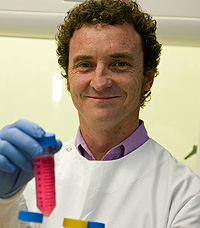 |
| Professor Cooper-White |
Abstract:
A $100 million Australian National Fabrication Facility launched this month in Canberra includes a Queensland node, based at The University of Queensland.
UQ gets fabrication infrastructure boost
Australia | Posted on October 21st, 2008The ANFF links seven university-based centres around the country, giving researchers and industry access to state-of-the-art fabrication facilities.
It was established last year under the National Collaborative Research Infrastructure Strategy, and will enable researchers to engineer and manipulate materials down to the scale of billionths of a metre.
The Minister for Innovation, Industry, Science and Research, Senator Kim Carr said the new facility represented a major step forward in Australia's capacity for research in nanotechnology and micro-fabrication.
UQ Deputy Vice-Chancellor (Research) Professor David Siddle welcomed the announcement.
"The development of facilities to support research is essential to Australia's future international competitiveness," he said.
"As a leading research-intensive university, UQ is playing a significant role in the development of national research infrastructure."
Professor Siddle said it was in the national interest for leading research institutions to collaborate on the development of world-class facilities.
The Queensland node has received $12 million support, including $10 million Federal and State Government funding, with the balance from UQ.
Professor Justin Cooper-White, of UQ's Australian Institute for Bioengineering and Nanotechnology, is Director of the Queensland node.
"The facility is more than a collection of leading-edge equipment and specialist clean rooms minimising unwanted particulate contamination; it is managed and staffed by key senior research officers with extensive expertise," he said.
"It provides a dedicated facility for the synthesis, processing, characterisation and fabrication of functional organics and organic semiconductors, new generation photoresists, functional polymers and nanoparticles and bio-inspired nanomaterials, smart surfaces and microdevices."
The Queensland node consists of two facilities, the Soft Materials Processing Facility and the BioNano Device Fabrication Facility.
They are based at UQ in purpose-built laboratories in the Australian Institute for Bioengineering and Nanotechnology and the School of Chemistry's Centre for Organic Photonics and Electronics
####
For more information, please click here
Contacts:
Jan King
telephone 07 3365 1120
Copyright © University of Queensland
If you have a comment, please Contact us.Issuers of news releases, not 7th Wave, Inc. or Nanotechnology Now, are solely responsible for the accuracy of the content.
Bookmark:


| Related News Press |
News and information
 Simulating magnetization in a Heisenberg quantum spin chain April 5th, 2024
NRL charters Navy’s quantum inertial navigation path to reduce drift April 5th, 2024
Discovery points path to flash-like memory for storing qubits: Rice find could hasten development of nonvolatile quantum memory April 5th, 2024
Govt.-Legislation/Regulation/Funding/Policy
NRL charters Navy’s quantum inertial navigation path to reduce drift April 5th, 2024
Discovery points path to flash-like memory for storing qubits: Rice find could hasten development of nonvolatile quantum memory April 5th, 2024
Chemical reactions can scramble quantum information as well as black holes April 5th, 2024
Academic/Education
Rice University launches Rice Synthetic Biology Institute to improve lives January 12th, 2024
Multi-institution, $4.6 million NSF grant to fund nanotechnology training September 9th, 2022
Chip Technology
Discovery points path to flash-like memory for storing qubits: Rice find could hasten development of nonvolatile quantum memory April 5th, 2024
Utilizing palladium for addressing contact issues of buried oxide thin film transistors April 5th, 2024
HKUST researchers develop new integration technique for efficient coupling of III-V and silicon February 16th, 2024
Announcements
NRL charters Navy’s quantum inertial navigation path to reduce drift April 5th, 2024
Discovery points path to flash-like memory for storing qubits: Rice find could hasten development of nonvolatile quantum memory April 5th, 2024
 |
||
 |
||
| The latest news from around the world, FREE | ||
 |
||
|
|
||
| Premium Products | ||
 |
||
|
Only the news you want to read!
Learn More |
||
 |
||
|
Full-service, expert consulting
Learn More |
||
|
|
||