Home > Press > Sandia recognizes five green-certified buildings: Buildings awarded LEED building certification
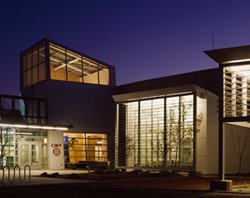 |
| Center for Integrated Nanotechnologies |
Abstract:
Sandia National Laboratories recently recognized five green-certified buildings in a brief ceremony organized by the Labs' Environmental Planning Department.
The buildings have been awarded Leadership in Energy and Environmental Design (LEED®), New Construction (NC) building certification given by the U.S. Green Building Council. LEED is a standard that recognizes the environmental and energy performance, use of materials and resources and indoor environmental quality of a building. Sandia has more than 600,000 square feet of LEED-NC certified space, equivalent to 10 percent of the total building footprint.
Sandia recognizes five green-certified buildings: Buildings awarded LEED building certification
ALBUQUERQUE, NM | Posted on September 24th, 2008Three of the five buildings are part of Microsystems and Engineering Sciences Applications (MESA) complex dedicated to the advancement of mircoelectromechanical systems (MEMS). The buildings were planned to be the cornerstone of a campus-style technical area. The MESA complex of four new buildings includes about 377,000 square feet on a 30-acre site. It is dedicated to the design, analysis, prototyping, development and qualification of MEMS components.
"The LEED rating system is a prestigious, independent recognition that a building has achieved the highest level of environmental performance," says Jack Mizner, who coordinated the LEED celebration event. "These buildings also provide a healthful, resource efficient, and productive environment for our workforce."
Center for Integrated Nanotechnologies Download 300dpi 600KB JPEG image (Media are welcome to download/publish this image with related news stories.)
All the LEED-NC certified buildings include:
* MESA MicroFab facility (LEED-NC certified), the first microchip fabrication facility in the world to obtain the LEED certification. The microfab includes sophisticated safety systems and controls because of the hazardous materials used in the production of semiconductors. The facility provides clean rooms and transition clean room space, support labs, chemical and specialty gas rooms and a service yard.
* MESA Microsystems Laboratory (LEED-NC silver), dedicated to light labs for chemical, electrical and laser work. The lab provides facilities for research and development of MEMS components, rapid prototyping and testing of the integrated systems. The building maximizes day lighting into occupied spaces by placing the sensitive labs on the interior of the building. All offices have windows that provide day lighting from the skylights above. On the south elevation, a sunscreen provides shading along all the offices.
* MESA Weapons Integration Facility (WIF) (LEED-NC silver), a three-story building that consists of both a classified and an unclassified portion. The classified portion houses weapons, computational, and engineering sciences (C&ES) and microsystems staff and will facilitate design, system integration and qualification of weapons systems. The unclassified portion houses C&ES staff and MESA partners. The building will enable collaboration between partners from industry, academia and Sandia scientists and engineers. The WIF facility is integrated into the MESA campus design and shares many of the green features of the other new buildings.
* Joint Computational Engineering Laboratory (JCEL) (LEED-NC silver), a 66,143 square foot office/computational facility designed to accommodate classified work. It is the first building at Sandia that incorporates sustainable design from the beginning of the project.
* Center for Integrated Nanotechnology (CINT) (LEED-NC certified), a 97,294 square foot facility that houses both labs and office space for research into advanced nanotechnology. Using LEED as a central design guide, this sustainable facility maximizes site potential, water use and preservation, energy conservation and appropriate energy building materials selection, and indoor environmental quality.
Sandia has two additional building projects currently registered under the LEED-NC program. Sandia is also planning to "green" its existing facilities using the LEED rating system. The goal is to certify one or more buildings each year under the LEED-Existing Building (EB) or LEED Commercial Interior (CI) rating systems.
####
About Sandia National Laboratories
Sandia is a multiprogram laboratory operated by Sandia Corporation, a Lockheed Martin company, for the U.S. Department of Energy’s National Nuclear Security Administration. With main facilities in Albuquerque, N.M., and Livermore, Calif., Sandia has major R&D responsibilities in national security, energy and environmental technologies, and economic competitiveness.
For more information, please click here
Contacts:
Chris Burroughs
(505) 844-0948
Copyright © Sandia National Laboratories
If you have a comment, please Contact us.Issuers of news releases, not 7th Wave, Inc. or Nanotechnology Now, are solely responsible for the accuracy of the content.
Bookmark:


| Related News Press |
News and information
 Simulating magnetization in a Heisenberg quantum spin chain April 5th, 2024
NRL charters Navy’s quantum inertial navigation path to reduce drift April 5th, 2024
Discovery points path to flash-like memory for storing qubits: Rice find could hasten development of nonvolatile quantum memory April 5th, 2024
Laboratories
A battery’s hopping ions remember where they’ve been: Seen in atomic detail, the seemingly smooth flow of ions through a battery’s electrolyte is surprisingly complicated February 16th, 2024
NRL discovers two-dimensional waveguides February 16th, 2024
Three-pronged approach discerns qualities of quantum spin liquids November 17th, 2023
Announcements
NRL charters Navy’s quantum inertial navigation path to reduce drift April 5th, 2024
Discovery points path to flash-like memory for storing qubits: Rice find could hasten development of nonvolatile quantum memory April 5th, 2024
Grants/Sponsored Research/Awards/Scholarships/Gifts/Contests/Honors/Records
Discovery points path to flash-like memory for storing qubits: Rice find could hasten development of nonvolatile quantum memory April 5th, 2024
Chemical reactions can scramble quantum information as well as black holes April 5th, 2024
 |
||
 |
||
| The latest news from around the world, FREE | ||
 |
||
|
|
||
| Premium Products | ||
 |
||
|
Only the news you want to read!
Learn More |
||
 |
||
|
Full-service, expert consulting
Learn More |
||
|
|
||