Home > Press > Lasers pushing the limits: The dissociation of nitrogen molecules by a free-electron laser signals a departure for more extreme light-matter interacti
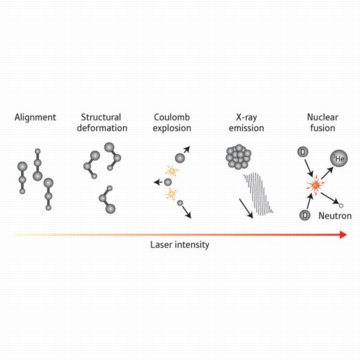 |
| Figure 1: Various phenomena observed in molecules with increasingly intense optical laser fields. From Yamanouchi, K. The next frontier. Science 295, 1660 (2002). Reprinted with permission from AAAS (www.sciencemag.org) |
Abstract:
When matter is hit by a laser-beam, the effects on the molecules can be dramatic, particularly for short pulses of high-intensity radiation. In a quest to push the limits of intensity to achieve extreme light-matter interactions in large molecules, a team of researchers from RIKEN's Advanced Science Institute in Wako, the SPring-8 Center in Harima, and the University of Tokyo, has demonstrated the ionisation and consequently the dissociation of nitrogen molecules using a free-electron laser.
Lasers pushing the limits: The dissociation of nitrogen molecules by a free-electron laser signals a departure for more extreme light-matter interacti
Japan | Posted on September 12th, 2008Laser radiation is an electromagnetic wave that oscillates along a laser beam. These oscillating electromagnetic fields can exert strong forces on the electrons in a molecule, particularly at the very short wavelengths in the extreme ultraviolet (XUV) part of the spectrum. At high laser intensities, the influence on molecules increases, leading to a so-called Coulomb explosion (Fig. 1).
A Coulomb explosion is a process where the force exerted by the laser field is so strong on electrons in a molecule that an electron gets ejected and leaves positively charged ions. These ions strongly repel each other and the molecule quickly dissociates. However, few experimental studies on this process have been reported and "little is understood concerning the interaction of intense high-frequency light in the XUV with atoms and molecules," comments Katsumi Midorikawa from the research team.
So far, Coulomb explosions have been observed in hydrogen, deuterium and even in the much heavier nitrogen molecules using so-called higher harmonic laser sources. Experiments using these laser sources reach the limits available with such technology owing to the amount of laser power that is required. Now, the team has demonstrated a Coulomb explosion of nitrogen molecules using the XUV free electron laser (XUV-FEL) at the SPring-8 site1.
The researchers focused laser light of extremely short wavelengths of only 50 nm on nitrogen gas. They found that each nitrogen atom absorbs two light particles from the beam, providing sufficient energy to eject an electron, so that N2 is transformed into the highly unstable N22+ molecule. Because of the strong repulsive forces, the two nitrogen ions separated. The detection of individual N+ atoms provides conclusive evidence that a Coulomb explosion occurred.
Achieving a Coulomb explosion in this way is significant because, as Midorikawa comments, "the XUV-FEL laser has the potential to produce much higher beam intensities that will allow a much better study of the interaction of matter with strong electromagnetic fields." Indeed, experiments on larger molecules will commence once the XUV-FEL facility reaches full capacity.
Reference
1. Sato, T., Okino, T., Yamanouchi, K., Yagishita, A., Kannari, F., Yamakawa, K., Midorikawa, K., Nakano, H., Yabashi, M., Nagasono, M. & Ishikawa, T. Dissociative two-photon ionization of N2 in extreme ultraviolet by intense self-amplified spontaneous emission free electron laser light. Applied Physics Letters 92, 154103 (2008).
####
For more information, please click here
Copyright © Riken
If you have a comment, please Contact us.Issuers of news releases, not 7th Wave, Inc. or Nanotechnology Now, are solely responsible for the accuracy of the content.
Bookmark:


| Related News Press |
Physics
 Simulating magnetization in a Heisenberg quantum spin chain April 5th, 2024
News and information
Simulating magnetization in a Heisenberg quantum spin chain April 5th, 2024
NRL charters Navy’s quantum inertial navigation path to reduce drift April 5th, 2024
Discovery points path to flash-like memory for storing qubits: Rice find could hasten development of nonvolatile quantum memory April 5th, 2024
Discoveries
Chemical reactions can scramble quantum information as well as black holes April 5th, 2024
New micromaterial releases nanoparticles that selectively destroy cancer cells April 5th, 2024
Utilizing palladium for addressing contact issues of buried oxide thin film transistors April 5th, 2024
Announcements
NRL charters Navy’s quantum inertial navigation path to reduce drift April 5th, 2024
Discovery points path to flash-like memory for storing qubits: Rice find could hasten development of nonvolatile quantum memory April 5th, 2024
Photonics/Optics/Lasers
With VECSELs towards the quantum internet Fraunhofer: IAF achieves record output power with VECSEL for quantum frequency converters April 5th, 2024
Nanoscale CL thermometry with lanthanide-doped heavy-metal oxide in TEM March 8th, 2024
Optically trapped quantum droplets of light can bind together to form macroscopic complexes March 8th, 2024
HKUST researchers develop new integration technique for efficient coupling of III-V and silicon February 16th, 2024
 |
||
 |
||
| The latest news from around the world, FREE | ||
 |
||
|
|
||
| Premium Products | ||
 |
||
|
Only the news you want to read!
Learn More |
||
 |
||
|
Full-service, expert consulting
Learn More |
||
|
|
||