Home > Press > Right on target: Short-lived nuclei can be efficiently trapped for study in the electron beam of a high-energy electron storage ring
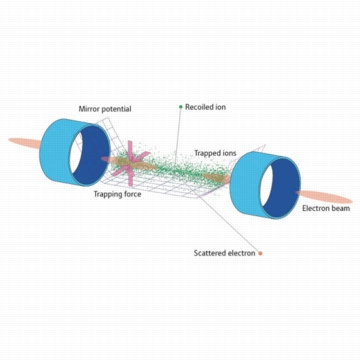 |
| Figure 1: The SCRIT nuclear target permits electron scattering measurements to be performed on short-lived (radioactive) nuclei. The trap makes use of the electron beam in a high-energy electron storage ring. Cesium ions are confined transversely by the electron beam (green dots) and longitudinally by an electrostatic potential (indicated by the grey grid). |
Abstract:
A team of Japanese researchers has developed a technique that will enable the study of the internal structure of unstable (radioactive) nuclei with electron scattering1.
Right on target: Short-lived nuclei can be efficiently trapped for study in the electron beam of a high-energy electron storage ring
Japan | Posted on September 12th, 2008In an electron scattering measurement an electron is accelerated up to several hundreds of MeV (106 eV) and scatters from a charged nucleus. "This technique is the only way to determine precisely—and model independently—the proton distribution in a nucleus," explains Masanori Wakasugi from the RIKEN Nishina Center for Accelerator-Based Science in Wako. "Electron scattering measurements have greatly contributed to the establishment of nuclear structure models that are written in current textbooks."
It has not been possible, however, to use this technique to study short-lived nuclei because of the difficulty in confining a sufficiently large number of such nuclei in a target. What this means in practice is that the collision luminosity—a measure of how likely an electron is to scatter from a nucleus—for unstable nuclei has to be quite high.
The team designed a high-luminosity target in the Kaken electron storage ring at Kyoto University that takes advantage of the ion-trapping potential of the circulating electron beam (Fig. 1). Cesium (Cs1+) ions were accelerated up to 4.05 keV and injected into the electron beam in a region that forms the target. The target, named SCRIT (self-confining radioactive isotope ion target), is about 200 mm long and made up of 40 longitudinally stacked, thin electrodes that can trap the ions in an electronic potential. Because the target ions are confined within a region that is the same size as the electron beam, it is possible to achieve a high luminosity even with a small number of ions.
Specially designed detectors determine the ionization state of the Cs ions and the energy and trajectory of the scattered electrons. The team determined that the Cs ions remain trapped for about 85 ms and that the electrons have a high probability of interaction with the trapped ions indicating a high luminosity. Although the experimentally measured luminosity is about 40 times lower than would be needed to perform electron scattering on unstable nuclei, a higher electron beam current could make up the difference.
The study of nuclei far from stability may ultimately help in developing a general theory of nuclei, according to Wakasugi. In addition, unstable nuclei play an important role in nucleo-synthesis. The SCRIT would enable radioactive nuclei with a half-life of as little as 100 ms to be studied.
Reference
1. Wakasugi, M., Emoto, T., Furukawa, Y., Ishii, K., Ito, S., Koseki, T., Kurita, K., Kuwajima, A., Masuda, T., Morikawa, A., et al. Novel internal target for electron scattering off unstable nuclei. Physical Review Letters 100, 164801 (2008). | article |
####
For more information, please click here
Copyright © Riken
If you have a comment, please Contact us.Issuers of news releases, not 7th Wave, Inc. or Nanotechnology Now, are solely responsible for the accuracy of the content.
Bookmark:


| Related News Press |
Physics
 Simulating magnetization in a Heisenberg quantum spin chain April 5th, 2024
News and information
Simulating magnetization in a Heisenberg quantum spin chain April 5th, 2024
NRL charters Navy’s quantum inertial navigation path to reduce drift April 5th, 2024
Discovery points path to flash-like memory for storing qubits: Rice find could hasten development of nonvolatile quantum memory April 5th, 2024
Discoveries
Chemical reactions can scramble quantum information as well as black holes April 5th, 2024
New micromaterial releases nanoparticles that selectively destroy cancer cells April 5th, 2024
Utilizing palladium for addressing contact issues of buried oxide thin film transistors April 5th, 2024
Announcements
NRL charters Navy’s quantum inertial navigation path to reduce drift April 5th, 2024
Discovery points path to flash-like memory for storing qubits: Rice find could hasten development of nonvolatile quantum memory April 5th, 2024
 |
||
 |
||
| The latest news from around the world, FREE | ||
 |
||
|
|
||
| Premium Products | ||
 |
||
|
Only the news you want to read!
Learn More |
||
 |
||
|
Full-service, expert consulting
Learn More |
||
|
|
||