Home > Press > Transparent coating repels water, could reduce corrosion
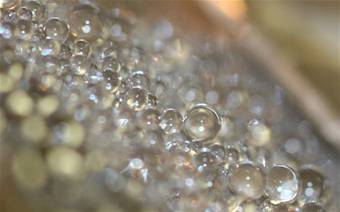 |
| This image shows how a transparent coating causes water to bead up into drops and roll or bounce off a surface. This new technology will help protect and sustain Air Force systems by preventing corrosion and reducing ice formation on optical elements and aircraft. (Courtesy photo) |
Abstract:
The development of a transparent coating that causes water to bead up into drops and roll or bounce off a surface will help protect and sustain Air Force systems by preventing corrosion and reducing ice formation on optical elements and aircraft.
Transparent coating repels water, could reduce corrosion
Arlington, VA | Posted on August 16th, 2008An Air Force Office of Scientific Research-funded team, led by Dr. C.J. Brinker, has developed the transparent coating
In addition to keeping water away, the researchers also are using this technology to design a patterned surface that combines extremely water-repellent and water-absorbent areas to draw water out of humid air. This application -- modeled after the Namib Desert beetle -- could provide a new method for collecting water without the use of energy and could benefit troops in areas where water is scarce.
In order to produce and apply a coating with superhydrophobic, or extremely water-repellent, properties, the Brinker Nanostructures Research Group at the University of New Mexico and Sandia National Laboratories had to control coating roughness and surface chemistry on a small scale.
The team, already known for their breakthroughs in aerogel thin film processing, drew from that research to develop a simple method for depositing the coating on every contour of a surface by spraying, spinning or dipping.
Doctor Brinker explained that by a simple modification of a chemical precursor, the team reversed the shrinkage that typically occurs as a coating dries. Instead, it springs back, creating a nanoporous surface with super water-repellant properties.
"The most recent advancement in this research is the ability to selectively pattern the coating and spatially control the wetting behavior for a desired application," Doctor Brinker said. "This allows us to define the pathways along which water droplets will roll."
Their recent work has opened the door to new applications that exploit the way the coated surface interacts with liquid droplets. When water droplets roll along the coated surface, they pick up debris as they go. Doctor Brinker explained that this property might make the collection, concentration and identification of aerosol borne particles like anthrax possible.
The research is also likely to transition to commercial applications such as protection of electronics and antiquities from water damage.
####
For more information, please click here
Copyright © Air Force Office of Scientific Research
If you have a comment, please Contact us.Issuers of news releases, not 7th Wave, Inc. or Nanotechnology Now, are solely responsible for the accuracy of the content.
Bookmark:


| Related News Press |
News and information
 Simulating magnetization in a Heisenberg quantum spin chain April 5th, 2024
NRL charters Navy’s quantum inertial navigation path to reduce drift April 5th, 2024
Discovery points path to flash-like memory for storing qubits: Rice find could hasten development of nonvolatile quantum memory April 5th, 2024
Govt.-Legislation/Regulation/Funding/Policy
NRL charters Navy’s quantum inertial navigation path to reduce drift April 5th, 2024
Discovery points path to flash-like memory for storing qubits: Rice find could hasten development of nonvolatile quantum memory April 5th, 2024
Chemical reactions can scramble quantum information as well as black holes April 5th, 2024
Materials/Metamaterials/Magnetoresistance
Nanoscale CL thermometry with lanthanide-doped heavy-metal oxide in TEM March 8th, 2024
Focused ion beam technology: A single tool for a wide range of applications January 12th, 2024
Military
NRL charters Navy’s quantum inertial navigation path to reduce drift April 5th, 2024
What heat can tell us about battery chemistry: using the Peltier effect to study lithium-ion cells March 8th, 2024
New chip opens door to AI computing at light speed February 16th, 2024
Aerospace/Space
Under pressure - space exploration in our time: Advancing space exploration through diverse collaborations and ethical policies February 16th, 2024
Bridging light and electrons January 12th, 2024
Manufacturing advances bring material back in vogue January 20th, 2023
 |
||
 |
||
| The latest news from around the world, FREE | ||
 |
||
|
|
||
| Premium Products | ||
 |
||
|
Only the news you want to read!
Learn More |
||
 |
||
|
Full-service, expert consulting
Learn More |
||
|
|
||