Home > Press > NanoArt for Kids program opens the window to this tiny scale of science for K-12 students
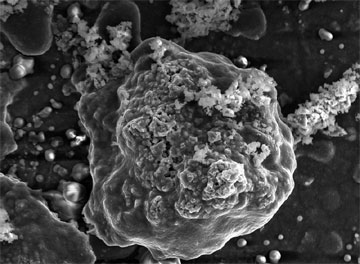 |
| Nanoflower |
Abstract:
Children learn by exploring their world and will now be able to see a tiny version of our world that looks quite different with powerful microscopes to challenge their imaginations
NanoArt for Kids program opens the window to this tiny scale of science for K-12 students
Nacogdoches, TX | Posted on August 13th, 2008The NanoArt K12 program has been launched by Cris Orfescu, artist and scientist from NanoArt21.org in collaboration with Judith Light Feather, artist and founder of The Nanotechnology Group Inc., which provides support to group members for the facilitation and development of innovative Nanoscale Science education globally.
The purpose of this worldwide program is to stimulate creativity and expand the visionary imaginations of our children through innovative education activities to promote a new paradigm unifying the art-science-technology intersections at the nanoscale. Size matters in all scales of science and textbook publishers have not included the nanoscale of science in their subject matter for K-12 students. Universities are now offering teachers workshops in various areas of the country to explain nano science to high school students in hopes that they will introduce new material into their classrooms.
NanoArt is a new discipline which combines art with science creating paintings and sculptures at molecular and atomic levels. Scientists use chemical or physical processes to explore the surfaces, composition and interaction of elements at the nanoscale, which can now be viewed and manipulated with powerful research tools like scanning electron (SEM) scanning tunneling (STM) and atomic force microscopes (AFM). These scientific images are then captured and further processed, using different digital techniques. Since these tools are too expensive for primary grade classrooms we will be providing weblinks to sites that the children, parents and teachers can explore.
Nano means ‘dwarf' and a nanometer is 1 billionth of a meter which is too small to see with the human eye. This unique introduction to the K-12 students showcasing the beauty of nature at this tiny scale of science is designed to stimulate their imagination and curiosity strengthening the desire to learn more science, technology and engineering (STEM) courses as they move through the primary grades and enter high school.
Art is the perfect media for this first introduction as the visual scans naturally challenge the child to recognize patterns in the shapes they are familiar with in their everyday reality. You will soon discover when viewing the scans provided that many familiar shapes will appear within the scans that can be further developed through drawings, paintings and sculptures, which can be submitted for the NanoArt K12 online exhibition. All compositions will be grouped online by age/grade level for the viewers.
It is our intention that the NanoArt for Kids will open the door for teachers to explore the outsource materials being created and include some of the visual elements and experiential online labs in their classrooms in the future.
####
For more information, please click here
Contacts:
Send your questions to
or
Copyright © The NanoTechnology Group NanoNews Division
If you have a comment, please Contact us.Issuers of news releases, not 7th Wave, Inc. or Nanotechnology Now, are solely responsible for the accuracy of the content.
Bookmark:


| Related News Press |
News and information
 Simulating magnetization in a Heisenberg quantum spin chain April 5th, 2024
NRL charters Navy’s quantum inertial navigation path to reduce drift April 5th, 2024
Discovery points path to flash-like memory for storing qubits: Rice find could hasten development of nonvolatile quantum memory April 5th, 2024
Academic/Education
Rice University launches Rice Synthetic Biology Institute to improve lives January 12th, 2024
Multi-institution, $4.6 million NSF grant to fund nanotechnology training September 9th, 2022
Announcements
NRL charters Navy’s quantum inertial navigation path to reduce drift April 5th, 2024
Discovery points path to flash-like memory for storing qubits: Rice find could hasten development of nonvolatile quantum memory April 5th, 2024
Human Interest/Art
Drawing data in nanometer scale September 30th, 2022
Scientists prepare for the world’s smallest race: Nanocar Race II March 18th, 2022
Graphene nanotubes revolutionize touch screen use for prosthetic hands August 3rd, 2021
JEOL Announces 2020 Microscopy Image Grand Prize Winners January 7th, 2021
 |
||
 |
||
| The latest news from around the world, FREE | ||
 |
||
|
|
||
| Premium Products | ||
 |
||
|
Only the news you want to read!
Learn More |
||
 |
||
|
Full-service, expert consulting
Learn More |
||
|
|
||