Home > Press > Smart Contact Lenses
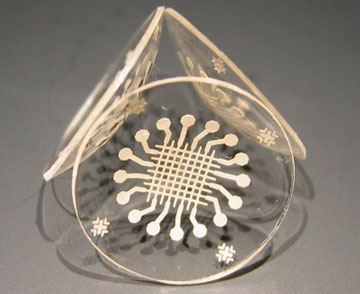 |
| These contact lenses with a pattern of conductive silver wires could be used to measure pressure inside the eye and study glaucoma, a major cause of blindness. (Tingrui Pan/UC Davis photo) |
Abstract:
"Smart" contact lenses that measure pressure within the eye and dispense medication accordingly could be made possible using a new material developed by biomedical engineers at UC Davis.
Smart Contact Lenses
Davis, CA | Posted on August 7th, 2008Tingrui Pan, assistant professor of biomedical engineering, and postdoctoral researcher Hailin Cong started with a material called polydimethylsiloxane (PDMS). They developed a method for placing powdered silver on the PDMS in a precise pattern, to create conductive wires. The silver also has antimicrobial properties.
The researchers were able to shape the PDMS-silver into a contact-lens shape, and show that it could function as a simple pressure sensor. Glaucoma, a build-up of pressure in the eye, is a leading cause of blindness worldwide. A contact lens that could continuously measure pressure within the eye and relay the data to a computer would allow doctors to learn more about glaucoma and improve patient treatment.
The researchers plan to apply for approval to begin trials of the lenses in humans, Pan said. They are collaborating with Professor James Brandt of the Department of Ophthalmology at the UC Davis School of Medicine.
A paper describing the fabrication technique was published in the July 2008 issue of the journal Advanced Functional Materials.
####
For more information, please click here
Contacts:
Tingrui Pan
Biomedical Engineering
(530) 754 9508
Andy Fell
UC Davis News Service
(530) 752-4533
Copyright © UC Davis
If you have a comment, please Contact us.Issuers of news releases, not 7th Wave, Inc. or Nanotechnology Now, are solely responsible for the accuracy of the content.
Bookmark:


| Related News Press |
News and information
 Simulating magnetization in a Heisenberg quantum spin chain April 5th, 2024
NRL charters Navy’s quantum inertial navigation path to reduce drift April 5th, 2024
Discovery points path to flash-like memory for storing qubits: Rice find could hasten development of nonvolatile quantum memory April 5th, 2024
Nanomedicine
New micromaterial releases nanoparticles that selectively destroy cancer cells April 5th, 2024
Good as gold - improving infectious disease testing with gold nanoparticles April 5th, 2024
Researchers develop artificial building blocks of life March 8th, 2024
Discoveries
Chemical reactions can scramble quantum information as well as black holes April 5th, 2024
New micromaterial releases nanoparticles that selectively destroy cancer cells April 5th, 2024
Utilizing palladium for addressing contact issues of buried oxide thin film transistors April 5th, 2024
Announcements
NRL charters Navy’s quantum inertial navigation path to reduce drift April 5th, 2024
Discovery points path to flash-like memory for storing qubits: Rice find could hasten development of nonvolatile quantum memory April 5th, 2024
 |
||
 |
||
| The latest news from around the world, FREE | ||
 |
||
|
|
||
| Premium Products | ||
 |
||
|
Only the news you want to read!
Learn More |
||
 |
||
|
Full-service, expert consulting
Learn More |
||
|
|
||